


























1 / 11
0
Views
0
Downloads




0.0
0
Save
0 Likes
Share
Graph Go Round: Function Notation & Graphing Activity!
0 Views
0 Downloads
Paste this activity's link or code into your existing LMS (Google Classroom, Canvas, Teams, Schoology, Moodle, etc.).
Students can open and work on the activity right away, with no student login required.
You'll still be able to track student progress and results from your teacher account.
Information
Description
What It Is:
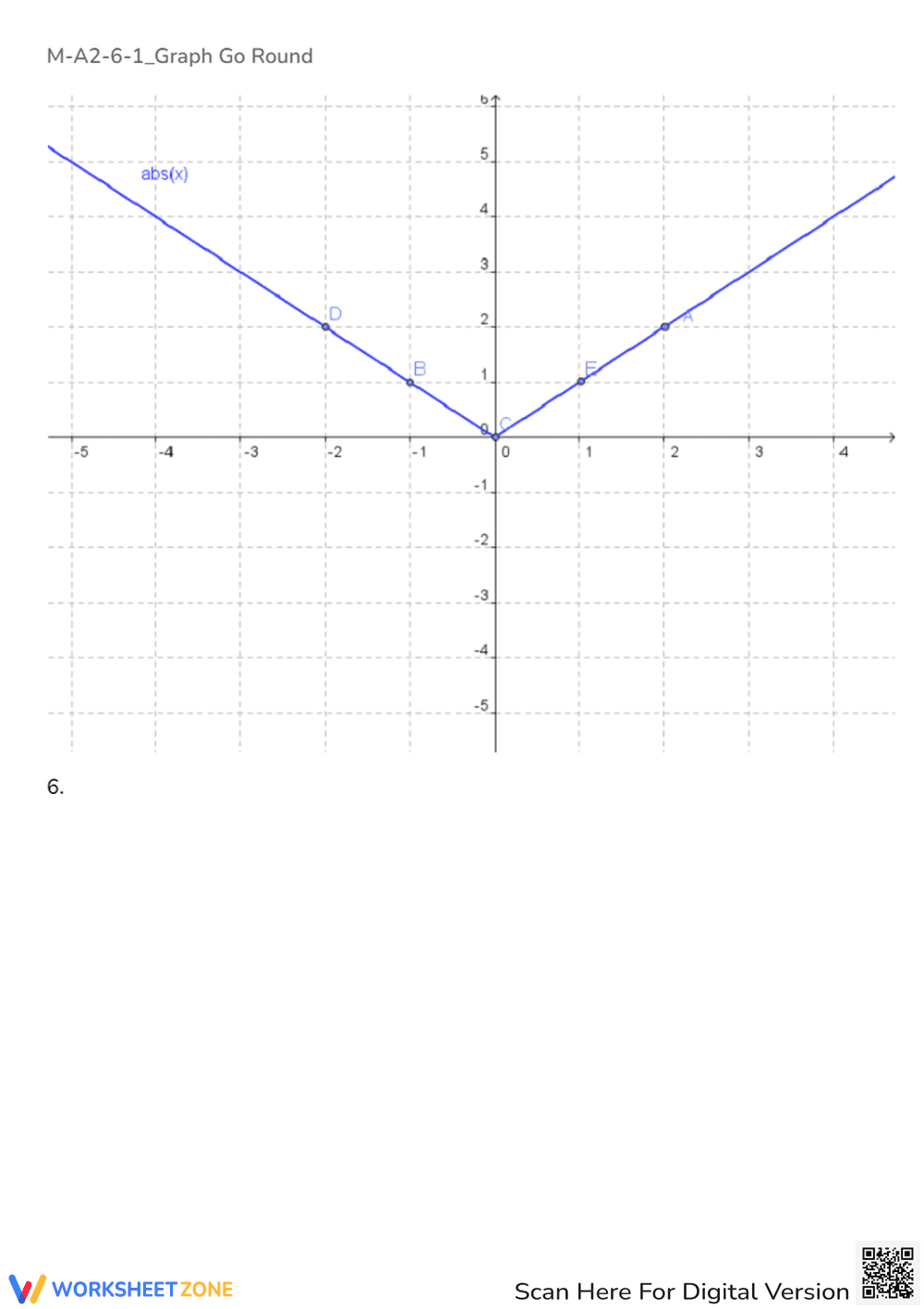
This is an educational worksheet titled 'Graph Go Round' that provides instructions for a group activity involving graphs. The activity requires students to read points on a graph, express them in function notation (e.g., f(1) = 5), record the coordinates, and complete assigned tasks within a time limit. Possible tasks include making a table for the function, writing points in function notation, finding zeros, describing end behavior, naming the function, estimating slopes, and reflecting the graph over the x-axis.
Grade Level Suitability:
This worksheet is suitable for high school grades, specifically Algebra 2 or Precalculus (grades 10-12). The content requires understanding of function notation, coordinate systems, and graph analysis, which are typically taught in these levels. The complexity of the tasks, such as finding zeros and describing end behavior, also aligns with high school curriculum.
Why Use It:
This worksheet promotes active learning and collaborative problem-solving skills. It helps students practice reading and interpreting graphs, expressing coordinates in function notation, and applying various analytical techniques to understand the properties of functions. The 'Graph Go Round' game format encourages repeated practice and reinforces learning through multiple exposures to different graphs.
How to Use It:
Print and, ideally, laminate the graph sheets. Divide students into groups. Each group starts with a different graph. Students read points and express them in function notation, recording their work. After a set time (30 seconds or 1 minute), groups pass their graph to the next group. The receiving group writes the sequence number of the graph on their answer sheet and continues with the task. Repeat until each group has worked with all graphs.
Target Users:
The target users are high school math teachers (specifically Algebra 2 or Precalculus) and their students. It is beneficial for students who need practice with function notation, graph interpretation, and function analysis. The group activity format makes it suitable for classroom use and encourages peer learning.
This is an educational worksheet titled 'Graph Go Round' that provides instructions for a group activity involving graphs. The activity requires students to read points on a graph, express them in function notation (e.g., f(1) = 5), record the coordinates, and complete assigned tasks within a time limit. Possible tasks include making a table for the function, writing points in function notation, finding zeros, describing end behavior, naming the function, estimating slopes, and reflecting the graph over the x-axis.
Grade Level Suitability:
This worksheet is suitable for high school grades, specifically Algebra 2 or Precalculus (grades 10-12). The content requires understanding of function notation, coordinate systems, and graph analysis, which are typically taught in these levels. The complexity of the tasks, such as finding zeros and describing end behavior, also aligns with high school curriculum.
Why Use It:
This worksheet promotes active learning and collaborative problem-solving skills. It helps students practice reading and interpreting graphs, expressing coordinates in function notation, and applying various analytical techniques to understand the properties of functions. The 'Graph Go Round' game format encourages repeated practice and reinforces learning through multiple exposures to different graphs.
How to Use It:
Print and, ideally, laminate the graph sheets. Divide students into groups. Each group starts with a different graph. Students read points and express them in function notation, recording their work. After a set time (30 seconds or 1 minute), groups pass their graph to the next group. The receiving group writes the sequence number of the graph on their answer sheet and continues with the task. Repeat until each group has worked with all graphs.
Target Users:
The target users are high school math teachers (specifically Algebra 2 or Precalculus) and their students. It is beneficial for students who need practice with function notation, graph interpretation, and function analysis. The group activity format makes it suitable for classroom use and encourages peer learning.


