


























1 / 7
0
Views
0
Downloads



0.0
0
Save
0 Likes
Share
Understanding Odd and Even Functions
0 Views
0 Downloads
Paste this activity's link or code into your existing LMS (Google Classroom, Canvas, Teams, Schoology, Moodle, etc.).
Students can open and work on the activity right away, with no student login required.
You'll still be able to track student progress and results from your teacher account.
Information
Description
What It Is:
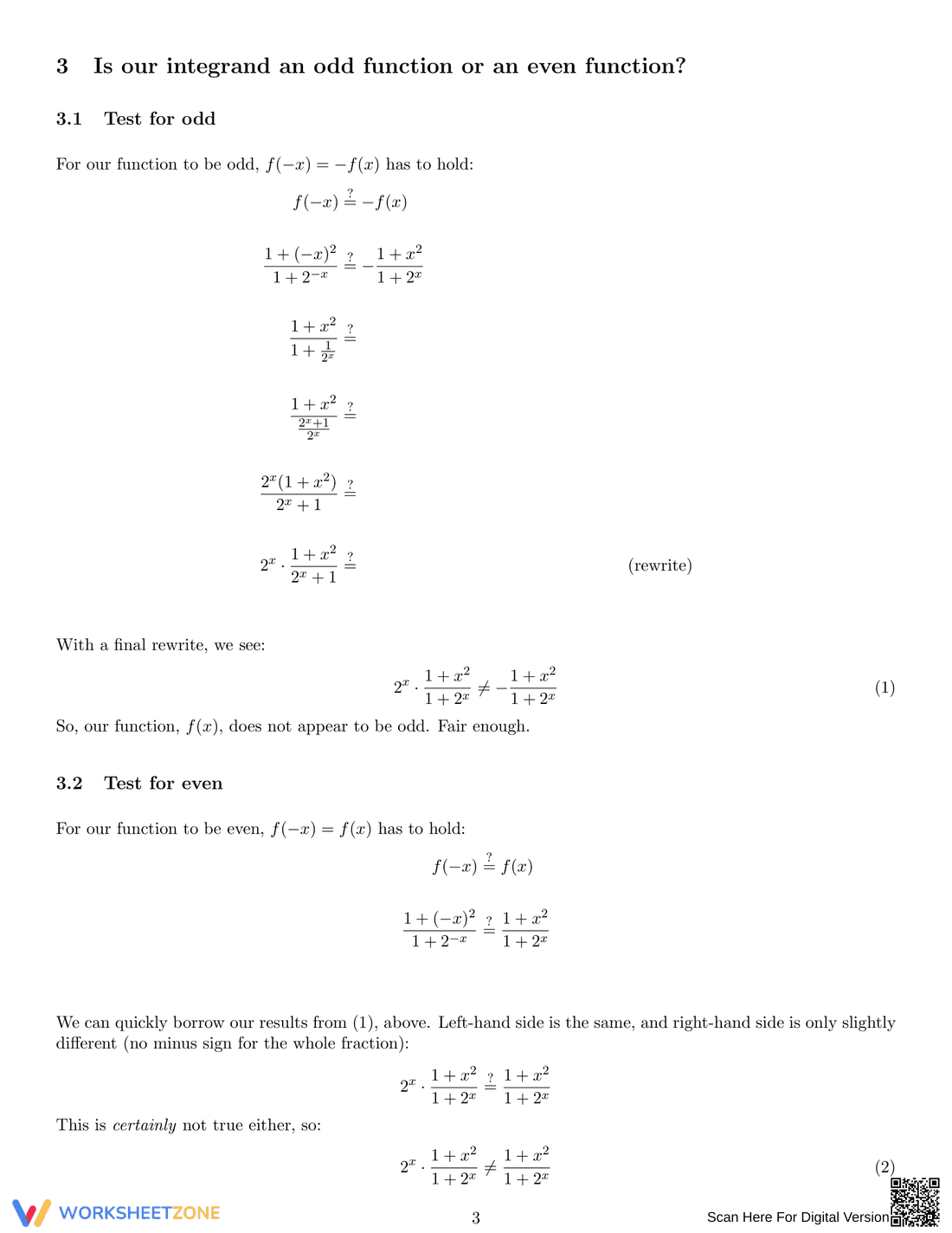
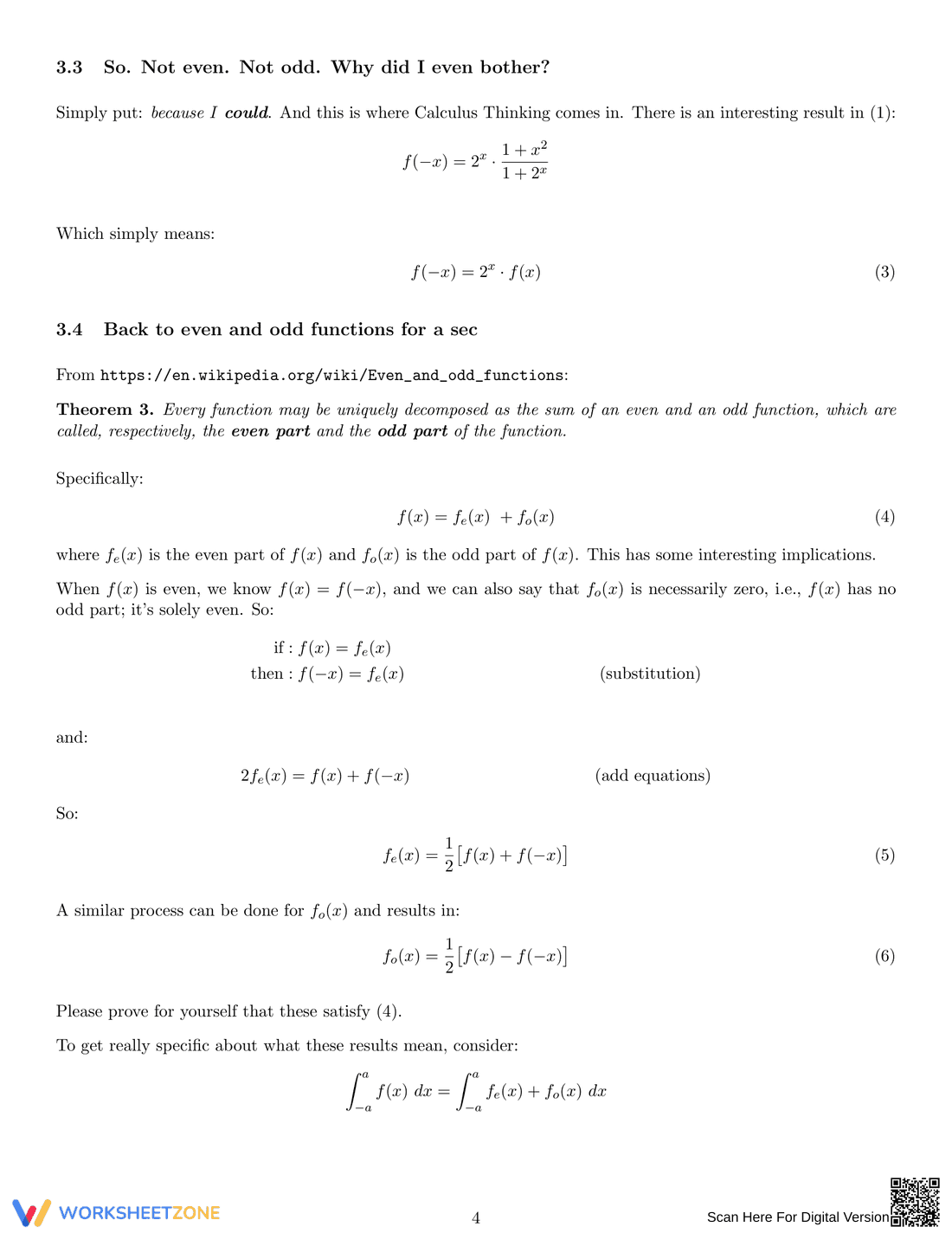
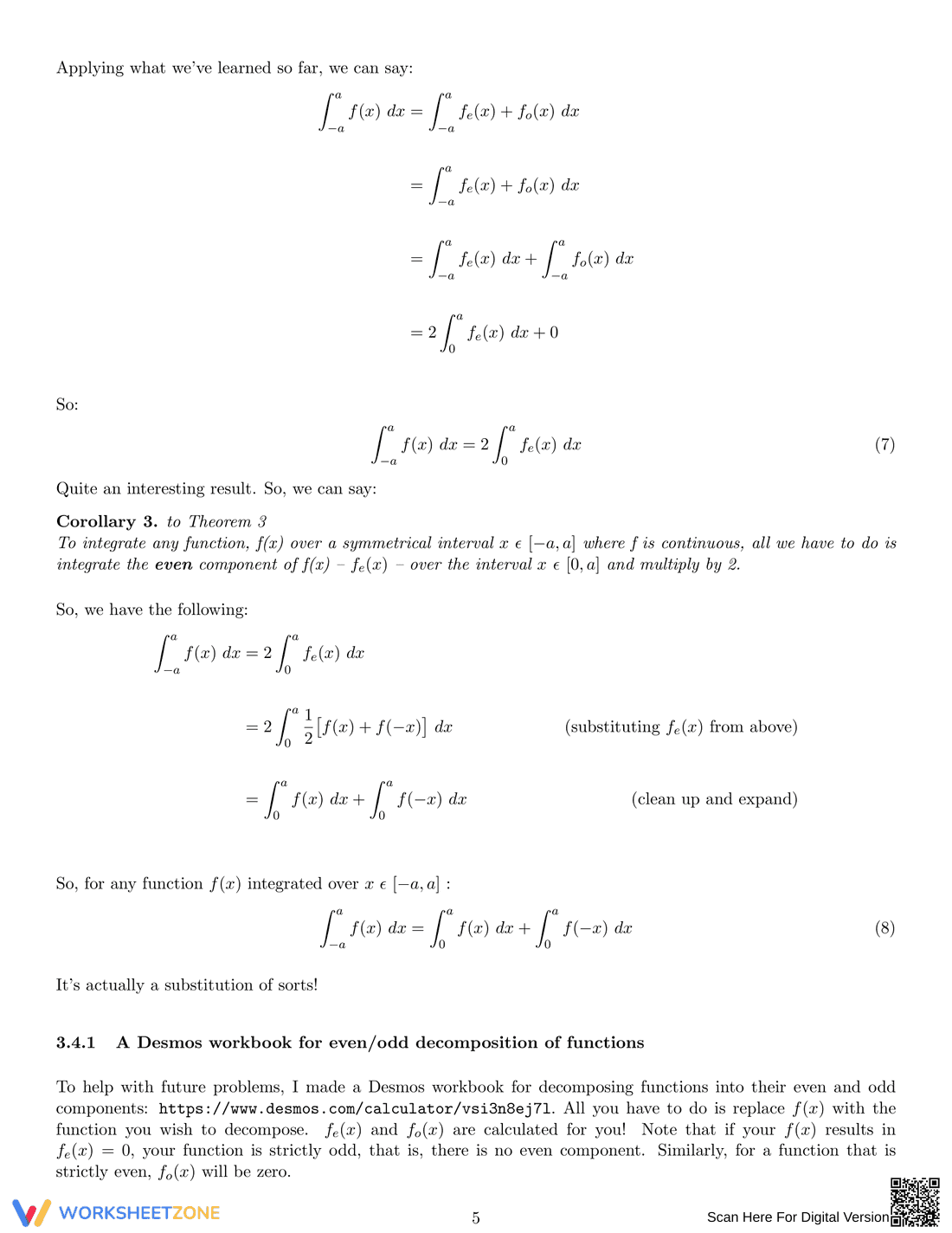
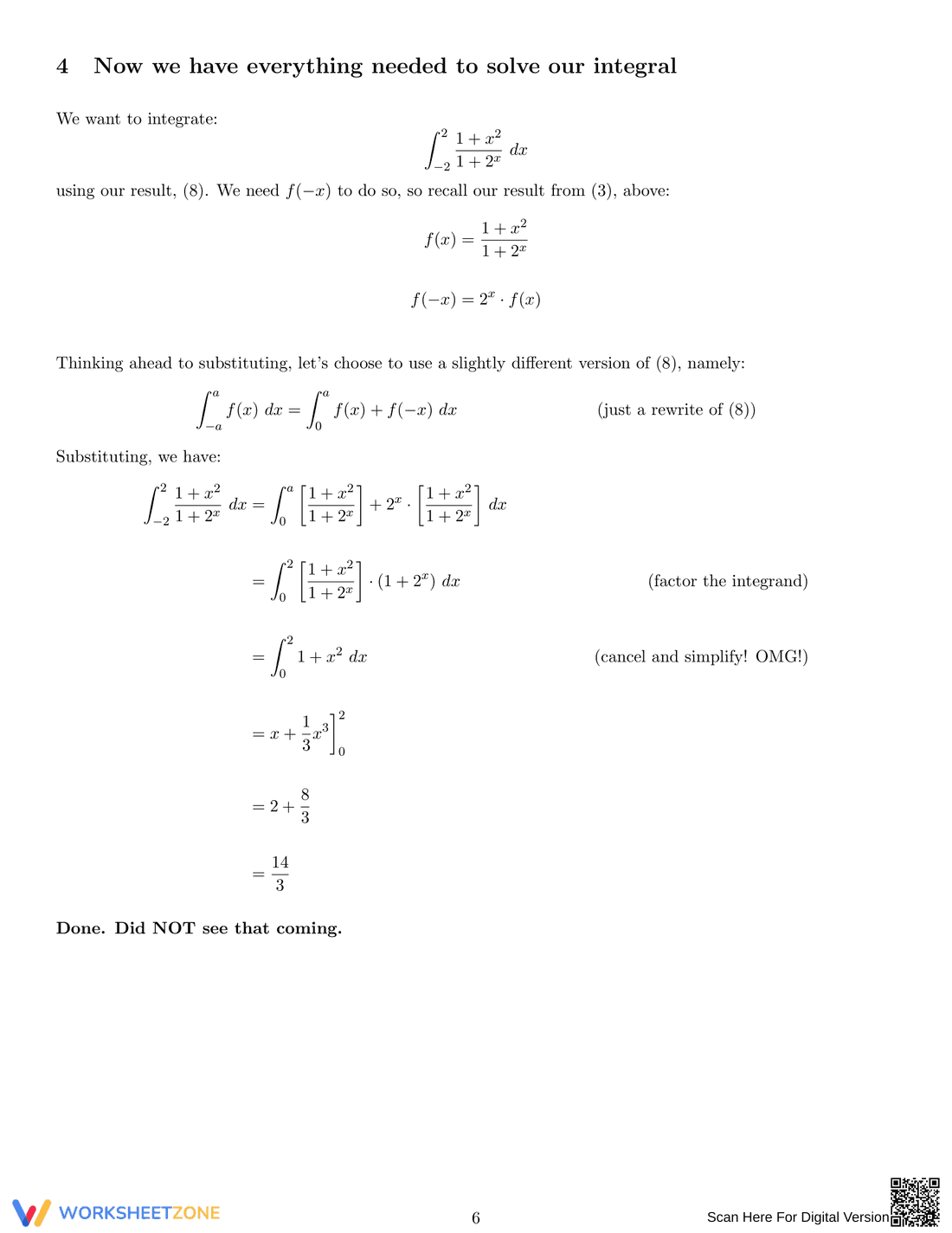
This is a calculus worksheet focusing on integration, specifically addressing odd and even functions. It presents a single integration problem involving a definite integral from -2 to 2 of (1+x^2)/(1+2^x) dx. The worksheet then provides a section titled 'Struggle... then, breakthrough' which discusses calculus thinking and problem-solving strategies, including rephrasing problems and leveraging intuition. It also defines 'Calculus Thinking' and discusses its importance in dealing with indeterminate forms and non-trivial integration problems.
Grade Level Suitability:
This worksheet is suitable for late high school or early college calculus students (Grades 11-13). The integration problem requires a strong understanding of calculus concepts, and the discussion of problem-solving strategies is geared towards students with some experience in calculus.
Why Use It:
This worksheet helps students practice integration techniques and develop problem-solving skills in calculus. It emphasizes the importance of 'Calculus Thinking,' encouraging students to approach problems creatively and strategically. It also highlights the value of intuition and perseverance in solving complex mathematical problems.
How to Use It:
Students should first attempt to solve the integration problem using standard calculus techniques. After struggling, they can read the 'Struggle... then, breakthrough' section for guidance and inspiration. The worksheet encourages reflection on the problem-solving process and the application of 'Calculus Thinking.'
Target Users:
The target users are calculus students, particularly those who are looking to improve their problem-solving skills and develop a deeper understanding of calculus concepts. It is also useful for instructors who want to introduce students to more strategic approaches to calculus problems.
This is a calculus worksheet focusing on integration, specifically addressing odd and even functions. It presents a single integration problem involving a definite integral from -2 to 2 of (1+x^2)/(1+2^x) dx. The worksheet then provides a section titled 'Struggle... then, breakthrough' which discusses calculus thinking and problem-solving strategies, including rephrasing problems and leveraging intuition. It also defines 'Calculus Thinking' and discusses its importance in dealing with indeterminate forms and non-trivial integration problems.
Grade Level Suitability:
This worksheet is suitable for late high school or early college calculus students (Grades 11-13). The integration problem requires a strong understanding of calculus concepts, and the discussion of problem-solving strategies is geared towards students with some experience in calculus.
Why Use It:
This worksheet helps students practice integration techniques and develop problem-solving skills in calculus. It emphasizes the importance of 'Calculus Thinking,' encouraging students to approach problems creatively and strategically. It also highlights the value of intuition and perseverance in solving complex mathematical problems.
How to Use It:
Students should first attempt to solve the integration problem using standard calculus techniques. After struggling, they can read the 'Struggle... then, breakthrough' section for guidance and inspiration. The worksheet encourages reflection on the problem-solving process and the application of 'Calculus Thinking.'
Target Users:
The target users are calculus students, particularly those who are looking to improve their problem-solving skills and develop a deeper understanding of calculus concepts. It is also useful for instructors who want to introduce students to more strategic approaches to calculus problems.


