




























1 / 2
0
Views
0
Downloads

0.0
0
Save
0 Likes
Share
Exponential Decay: Bacteria Experiment & Asymptotes Worksheet
0 Views
0 Downloads

Paste this activity's link or code into your existing LMS (Google Classroom, Canvas, Teams, Schoology, Moodle, etc.).
Students can open and work on the activity right away, with no student login required.
You'll still be able to track student progress and results from your teacher account.
Information
Description
What It Is:
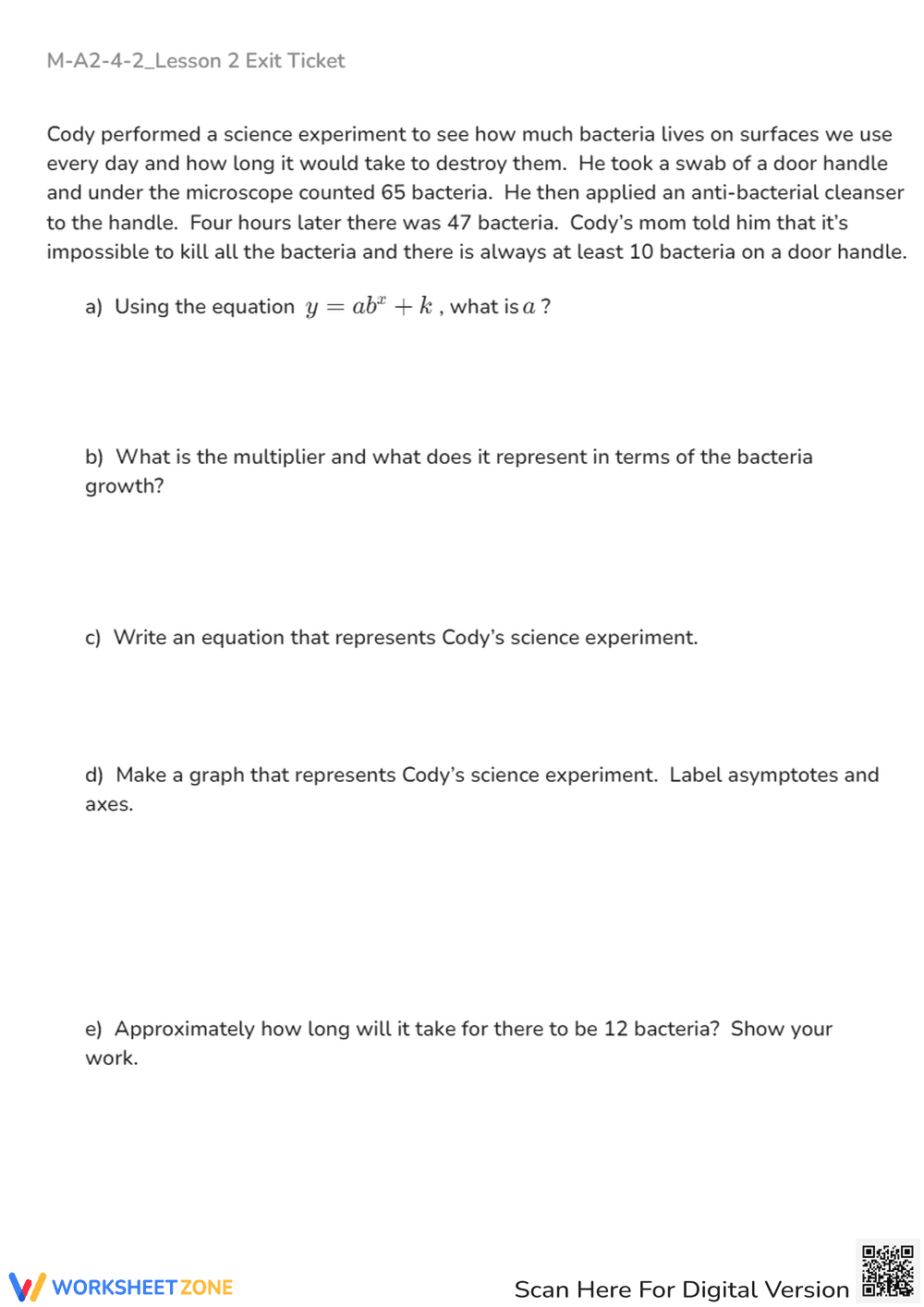
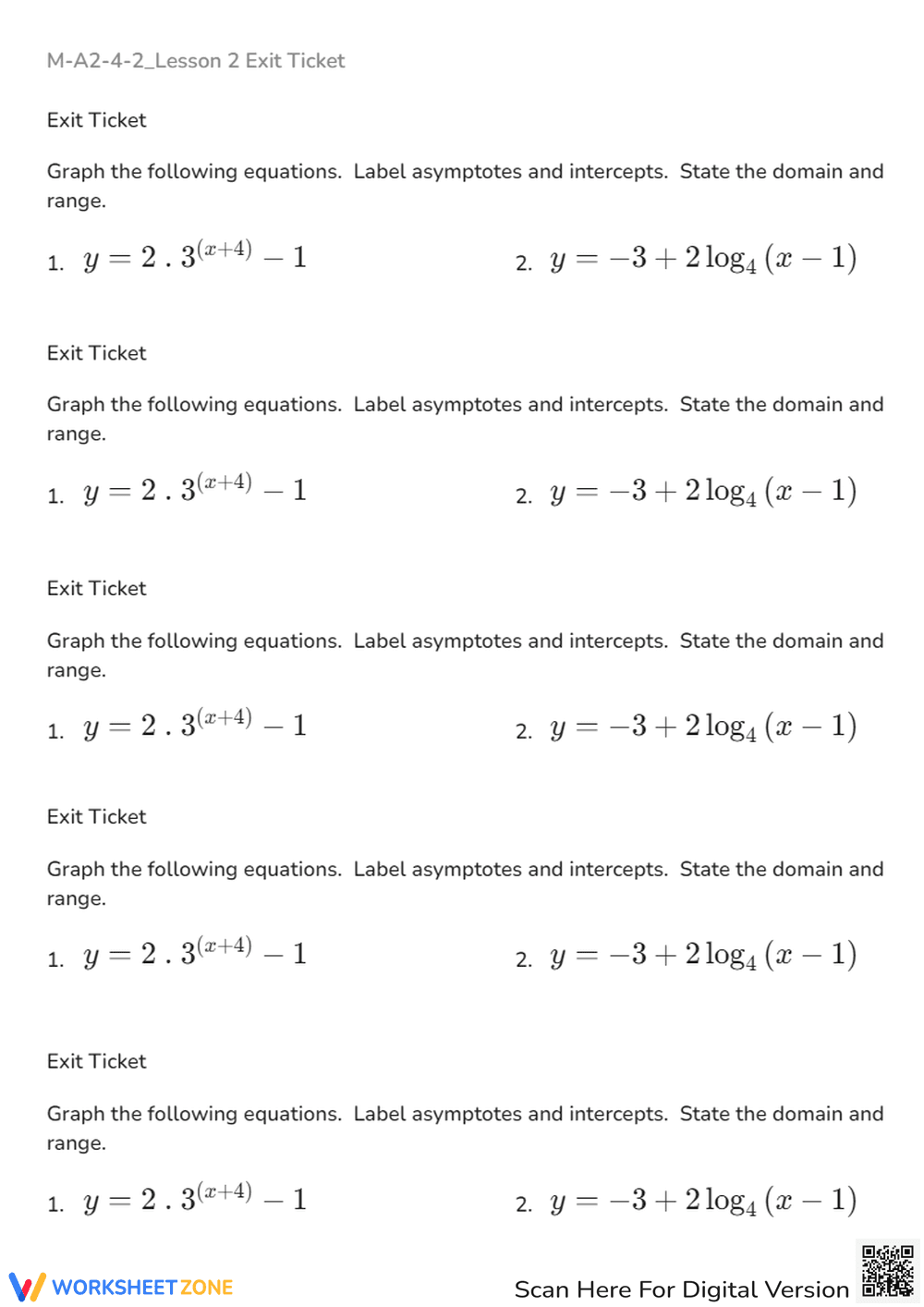
This is an exit ticket worksheet focusing on exponential decay and asymptotes in the context of a science experiment involving bacteria. The worksheet presents a scenario where a student, Cody, observes bacteria on a door handle and applies an antibacterial cleanser. Students are asked to identify parts of an exponential equation, determine the multiplier, write an equation representing the experiment, create a graph (labeling asymptotes and axes), and estimate the time it takes for the bacteria population to reach a specific level.
Grade Level Suitability:
This worksheet is suitable for high school grades, specifically Algebra 2 (9-12). It requires understanding of exponential functions, asymptotes, and their application to real-world scenarios, which are concepts typically covered in Algebra 2.
Why Use It:
This worksheet reinforces understanding of exponential decay, modeling real-world scenarios with mathematical equations, and interpreting graphs of exponential functions. It connects abstract mathematical concepts to a practical, relatable example (bacteria and cleaning), enhancing student engagement and comprehension.
How to Use It:
Students should read the provided scenario about Cody's experiment. Then, they need to answer the questions in order, applying their knowledge of exponential equations and graphing. For the graphing question, they should create a graph with labeled axes and asymptotes, accurately reflecting the exponential decay of the bacteria population. For the last question, students should show the steps they took to approximate the time it takes for the bacteria to reach 12.
Target Users:
This worksheet is designed for Algebra 2 students who are learning about exponential functions, exponential decay, and graphing exponential functions. It can also be used for students reviewing these concepts or as a quick assessment of their understanding.
This is an exit ticket worksheet focusing on exponential decay and asymptotes in the context of a science experiment involving bacteria. The worksheet presents a scenario where a student, Cody, observes bacteria on a door handle and applies an antibacterial cleanser. Students are asked to identify parts of an exponential equation, determine the multiplier, write an equation representing the experiment, create a graph (labeling asymptotes and axes), and estimate the time it takes for the bacteria population to reach a specific level.
Grade Level Suitability:
This worksheet is suitable for high school grades, specifically Algebra 2 (9-12). It requires understanding of exponential functions, asymptotes, and their application to real-world scenarios, which are concepts typically covered in Algebra 2.
Why Use It:
This worksheet reinforces understanding of exponential decay, modeling real-world scenarios with mathematical equations, and interpreting graphs of exponential functions. It connects abstract mathematical concepts to a practical, relatable example (bacteria and cleaning), enhancing student engagement and comprehension.
How to Use It:
Students should read the provided scenario about Cody's experiment. Then, they need to answer the questions in order, applying their knowledge of exponential equations and graphing. For the graphing question, they should create a graph with labeled axes and asymptotes, accurately reflecting the exponential decay of the bacteria population. For the last question, students should show the steps they took to approximate the time it takes for the bacteria to reach 12.
Target Users:
This worksheet is designed for Algebra 2 students who are learning about exponential functions, exponential decay, and graphing exponential functions. It can also be used for students reviewing these concepts or as a quick assessment of their understanding.


