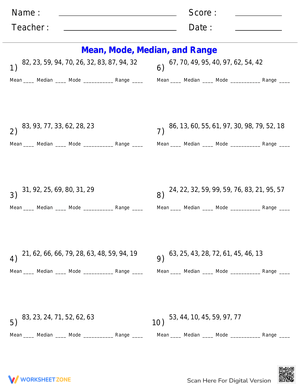
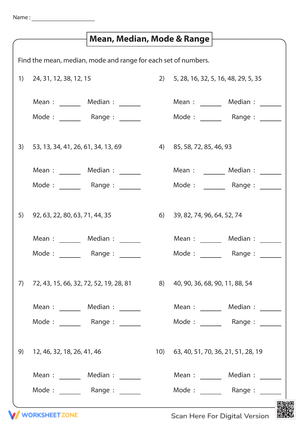
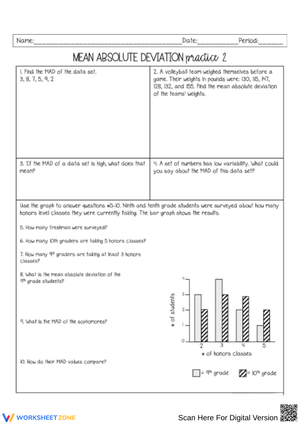
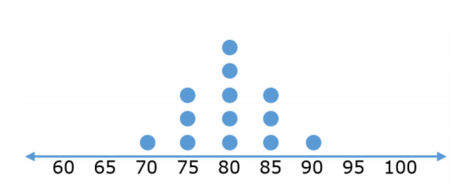
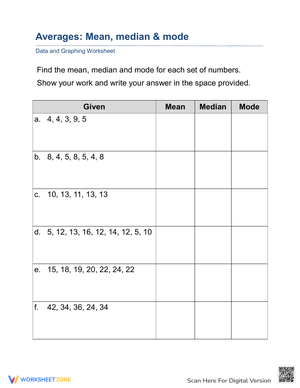
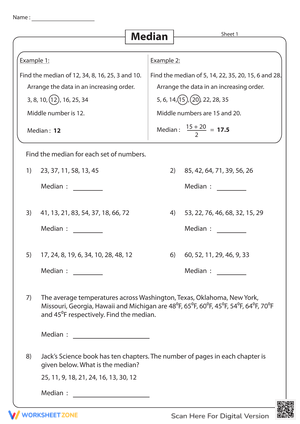
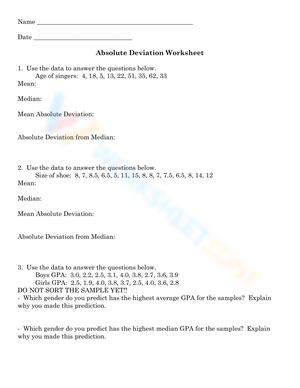
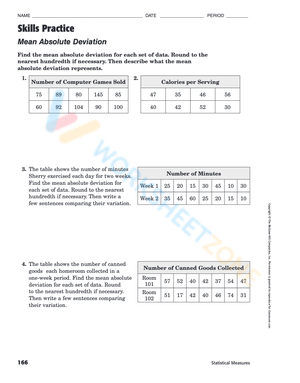
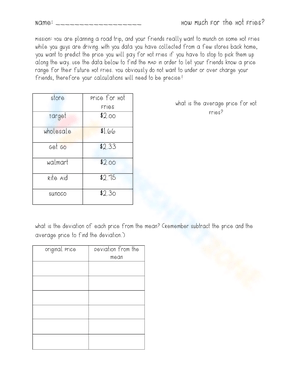
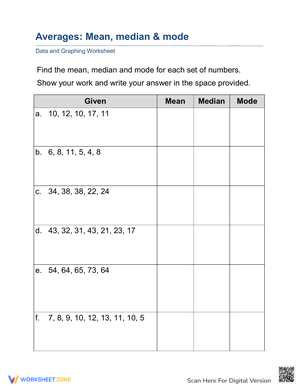
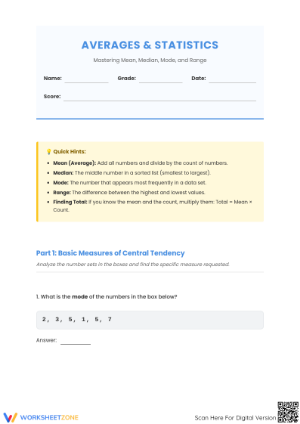
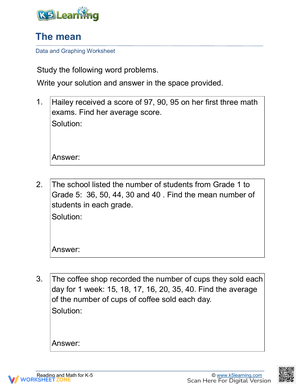
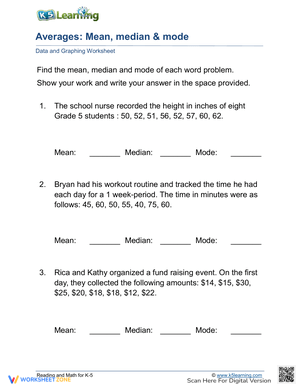
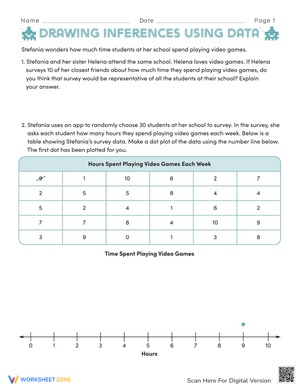
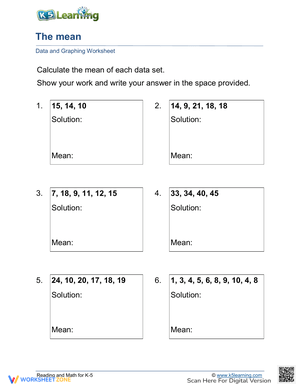
If you teach grade 5, 6, or 7 math, you already know that mean, median, mode, and range trip up more students than almost any other early statistics skill. Averages worksheets give you a low-prep way to build repeated practice into your unit on measures of center and variability, whether you are introducing the concept for the first time or reviewing it before a data analysis assessment. Students need multiple exposures before they stop confusing the four terms, and a well-sequenced set of worksheets is often the most efficient way to get there.
These worksheets work well in whole-class instruction, small-group intervention, and independent review stations. Because the underlying skill is procedural, students can practice it with minimal teacher scaffolding once the steps are modeled, which frees you up to circulate and support struggling learners during class.
How Averages Worksheets Support the CCSS 6.SP.A.3 Progression
CCSS.Math.Content.6.SP.A.3 establishes that a measure of center, meaning the mean or the median, summarizes a numerical data set with a single number, while a measure of variation, such as range, describes how the values in that set vary. This standard sits inside the grade 6 Statistics and Probability cluster, which is the primary place in the Common Core sequence where mean, median, mode, and range are formally introduced and practiced.
Averages worksheets are most effective when they mirror this exact progression. Start with worksheets that ask students to calculate a single measure of center from a simple data set. Once that is automatic, move to worksheets that require comparing a measure of center against a measure of variation, since that comparison is the real target of 6.SP.A.3, not just the computation itself. Worksheets that skip straight to comparison tasks without building the computational foundation first tend to produce shallow understanding.
Sequencing Worksheet Practice From Simple to Complex
A common mistake is handing students a mixed-difficulty averages worksheet before they have mastered the basics. Instead, sequence your worksheet practice in stages.
- Whole-number data sets with five to seven values, no ties in the mode
- Data sets that include a repeated value to reinforce mode identification
- Decimal data sets, which slow students down and expose weak division skills
- Negative numbers, useful once you connect averages to temperature or elevation data
- Real-world data such as grades, sports statistics, or weekly weather readings
This kind of staged sequencing lets you use the same worksheet format across several days, which reduces the cognitive load of learning new directions each time and keeps the focus on the math itself.
Differentiating Averages Worksheets for Mixed-Ability Classrooms
In a mixed-ability classroom, a single averages worksheet rarely serves every student well. Consider tiering your worksheet sets.
- Below grade level: straightforward computation with small, whole-number data sets and clear labels for mean, median, mode, and range
- On grade level: mixed computation plus one or two comparison questions asking which measure best represents the data
- Above grade level: multi-step word problems, such as finding a missing data point when the mean is given, or comparing two data sets using both center and variation
Because the underlying skill is the same across tiers, you can run one lesson and hand out different worksheet versions without losing instructional coherence. This also makes averages worksheets a strong choice for stations or choice boards.
Frequently Asked Questions
1. What grade level typically learns mean, median, mode, and range worksheets?
Grade 6 is the primary grade where mean, median, mode, and range are formally introduced under the Statistics and Probability cluster, though many grade 5 classrooms preview the concept and grade 7 classrooms use it for review and extension into interquartile range.
2. How many practice problems should a mean or median or mode worksheet include for mastery?
For initial instruction, six to ten problems that isolate one measure at a time work well. For review or intervention, four to six mixed problems are usually enough to diagnose and reinforce understanding without overwhelming students.
3. How can teachers use averages worksheets to prepare students for standardized test data analysis questions?
Rotate short averages problems into weekly spiral review throughout the year, not only during the statistics unit, and include word-problem versions that mirror the data analysis, statistics, and probability content area assessed on exams like NAEP.
4. What is the difference between measures of center and measures of variation in these worksheets?
Measures of center, mean and median, summarize a data set with a single typical value, while measures of variation, such as range, describe how spread out the values are. Worksheets that ask students to compare both give a fuller picture of a data set than computation alone.
5. How can averages worksheets be adapted for small-group math intervention?
Shorten the worksheet to four to six problems, isolate one measure per problem set so you can pinpoint the specific error pattern, and include an answer key so students can self-check before a one-on-one conference with the teacher.












 Interactive Worksheet Maker
 Quiz Maker
 Word Search Maker
 Crossword Puzzle Maker
 Word Scramble Generator
 Sentence Scramble Generator
 Handwriting Worksheet Generator
 Name Tracing Generator
 Fill In The Blank Generator