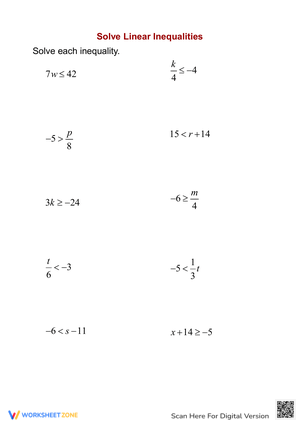
These inequalities worksheets give middle and high school students structured practice moving from one-step problems on a number line all the way through compound inequalities and systems — the full arc of how this topic actually develops across grades 6 through Algebra 2.
What Students Practice Across the Set
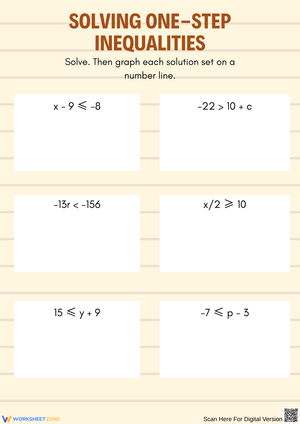
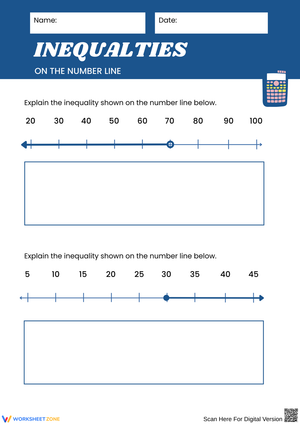
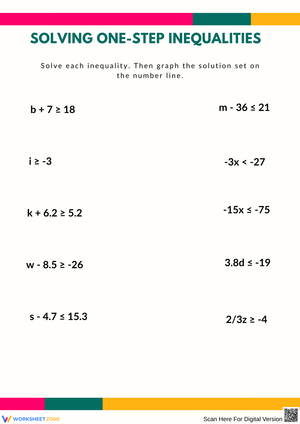
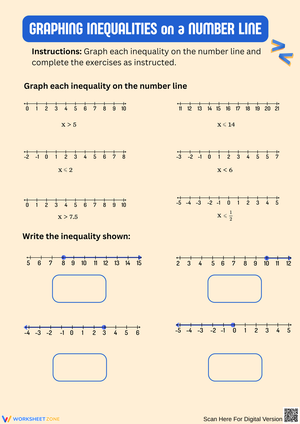
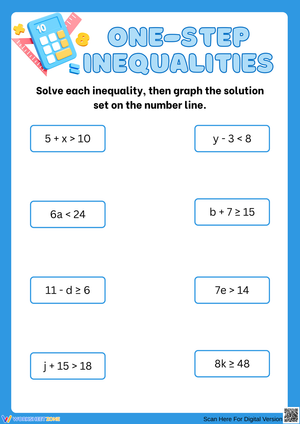
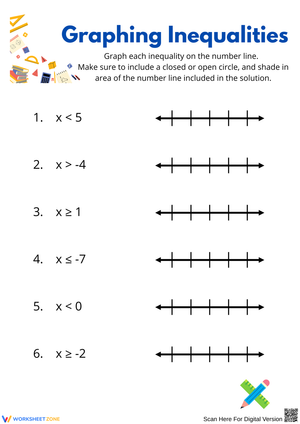
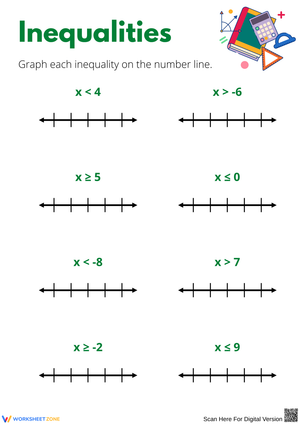
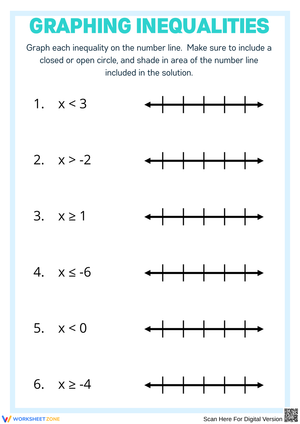
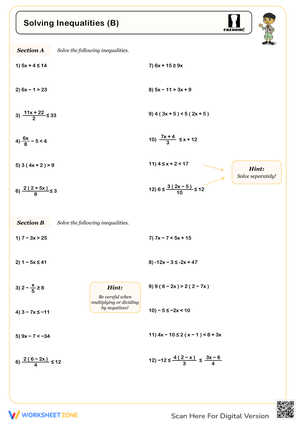
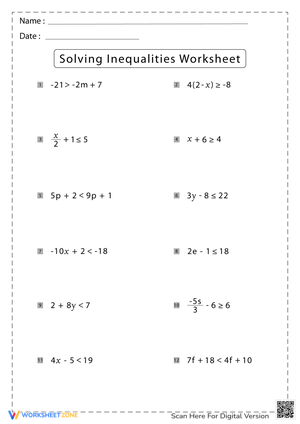
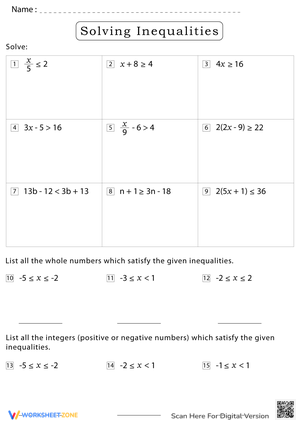
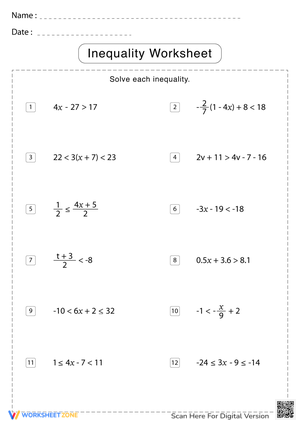
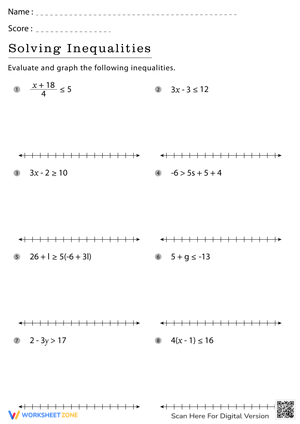
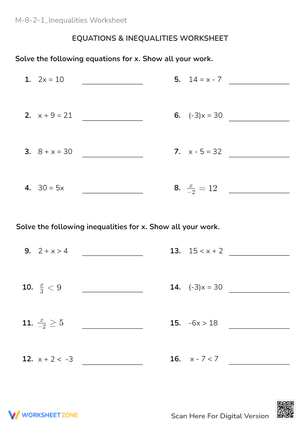
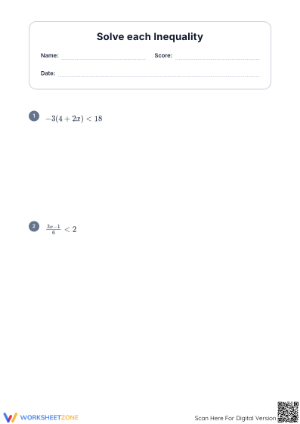
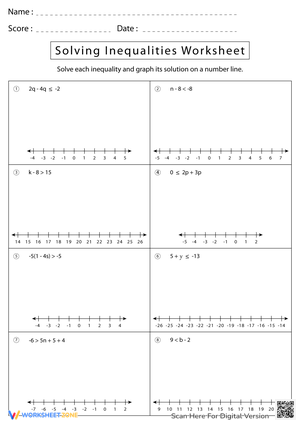
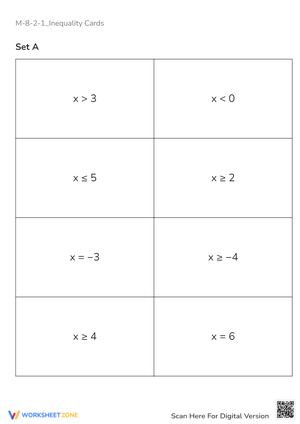
The pages are sequenced by skill demand. Early worksheets focus on single-variable inequalities: students identify the correct symbol, isolate the variable using one operation, and graph the solution with an open or closed circle and directional shading. The scaffolding matters here because students who can graph x > 4 correctly will still place a closed circle on a strict inequality two pages later — the automaticity hasn't formed yet.
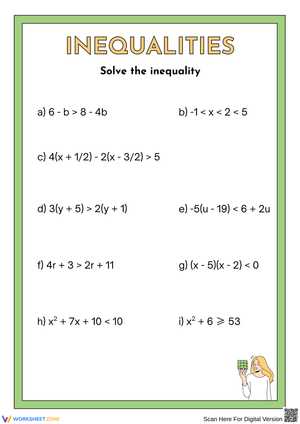
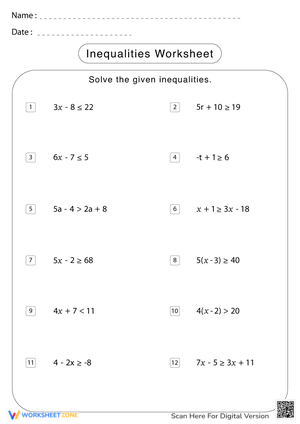
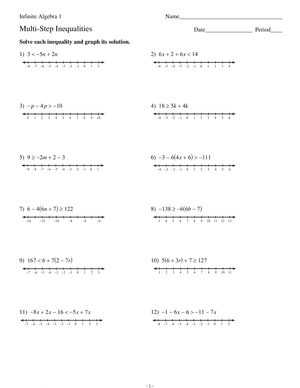
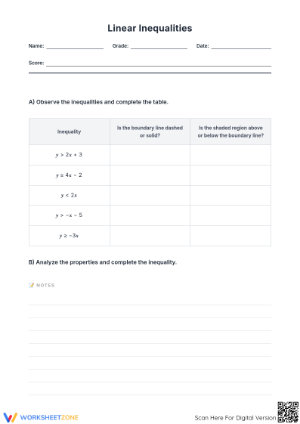
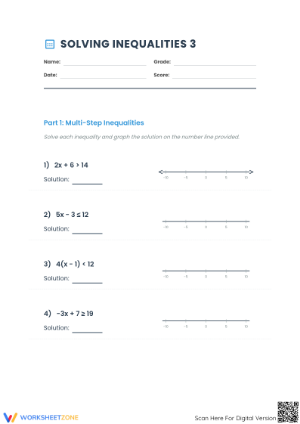
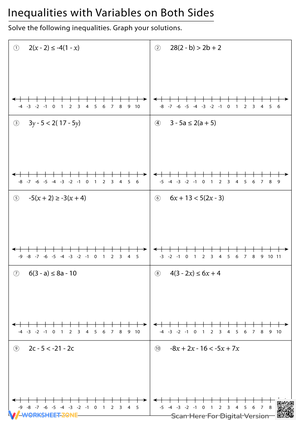
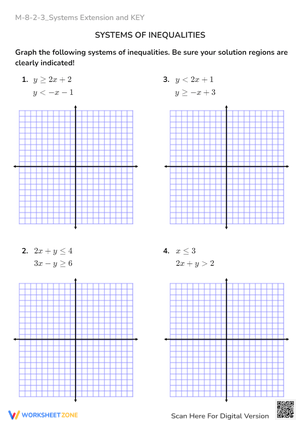
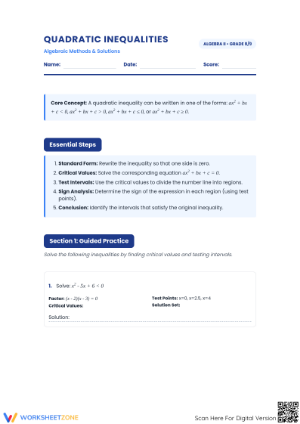
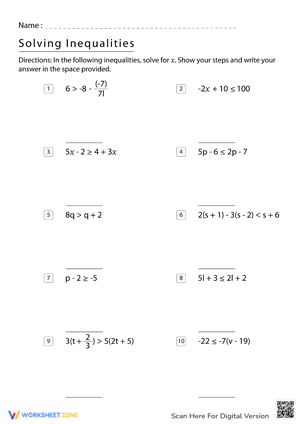
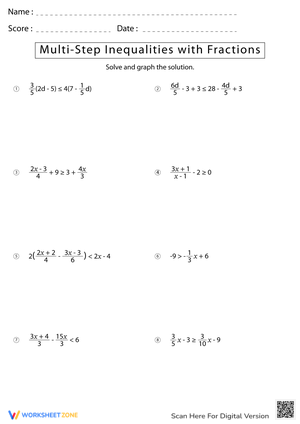
From there, the set moves into two-step and multi-step inequalities that require distributing, combining like terms, and handling variables on both sides. Later pages cover compound inequalities (both "and" and "or" forms) and, for Algebra students, systems of linear inequalities graphed on a coordinate plane. Each compound inequality page prompts students to write the solution using interval notation and graph it — so they're representing the same solution two ways on the same page, which reinforces the connection between symbolic and visual forms.
Where These Fit in the Curriculum
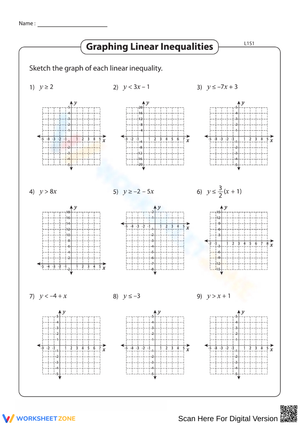
The sequencing maps directly to the progression in the Common Core standards. Grade 6 standard 6.EE.B.8 is where students first write inequalities to represent real-world constraints and place solutions on a number line — these early pages in the set live there. Standard 7.EE.B.4 pushes students into multi-step work with rational numbers and the distributive property. The high school standard HSA-REI.D.12 — graphing solution sets as half-planes and identifying the intersection region in a system — is the target for the final pages. Teachers using the full set across two years of instruction will find that later pages assume fluency with skills from earlier ones, which is by design rather than oversight.
The Negative Multiplication Rule — Why Students Keep Getting It Wrong
This is the single most reliable source of errors in student work on inequalities, and it's worth being honest about why worksheets alone don't fix it: most students who flip the sign incorrectly do so because they learned it as an arbitrary exception rather than a consequence of how the number line works. Telling a student "flip the sign when you multiply by a negative" produces the same kind of brittle recall as telling them to "carry the one" — it works until the problem looks slightly different.
A concrete demonstration helps. Start with the true statement 3 < 5. Multiply both sides by -1. You get -3 and -5. Ask students to place both values on a number line — they'll see immediately that -3 sits to the right of -5, meaning -3 is larger. The symbol must reverse to keep the statement true. Running this with two or three numerical examples before students touch a variable gives the rule a logical foundation instead of a memorization peg. The worksheets include space for this kind of check, and the instructions prompt students to verify their direction with a test point before shading.
Open Circle or Closed Circle — and Why Students Still Mix Them Up
Students who have heard the rule — open for strict, closed for "or equal to" — will still mark the wrong circle on a timed exercise, because the decision requires a moment of deliberate attention that speeds and automaticity work against. The pattern we see most often: a student solves a multi-step inequality correctly, arrives at something like x ≥ -2, and draws an open circle because the solving steps involved subtraction and the "open" choice felt recent. The symbol on the final line didn't register.
One approach that reduces this: before graphing, have students circle the inequality symbol in the final simplified statement and label it "open" or "closed" as a distinct step. It slows the process slightly, which is the point — the error is a speed error, not a knowledge error, for most students past early instruction.
How Teachers Use These Pages
The most common use is independent practice following direct instruction — ten to fifteen minutes at the end of a lesson period, or as homework the night a new inequality type is introduced. The early pages work well as Monday warm-ups during the inequalities unit, since the quick number line problems take under five minutes and surface over-the-weekend forgetting before it compounds.
The multi-step pages, particularly those covering variables on both sides, work well as formative checkpoints. Because each problem requires four to six visible steps, a teacher scanning thirty papers during the last eight minutes of class can spot within seconds whether students are collapsing steps, losing the negative when distributing, or arriving at correct algebra but graphing the wrong direction. That kind of step-visible work is harder to get from a digital platform that accepts a final answer without showing the path.
For compound inequalities, the "and" pages typically take longer than anticipated in a single class period — the concept of intersection trips students who can handle each individual inequality separately but don't yet have a mental model for what it means to satisfy both simultaneously. Assigning the "or" pages as follow-up the next day, rather than back-to-back in the same sitting, tends to produce cleaner initial work.
Frequently Asked Questions
Should students use interval notation or set-builder notation when writing solutions?
The worksheets include space for both and prompt students to write the solution in whichever form the course requires. For most middle school courses aligned to 7.EE.B.4, graphical representation is sufficient and interval notation is optional. For high school Algebra courses, especially those that feed into precalculus, interval notation is worth building in early — the same notation reappears with domain and range, and students who encounter it first in the inequalities unit arrive at functions with less symbol-processing overhead.
How do you handle compound inequalities when students haven't yet solidified "and" versus "or"?
The language distinction is harder than the math for many students. "And" means both conditions must hold — the solution is the overlap, typically a bounded segment. "Or" means either condition holds — the solution is the union, typically two outward-pointing rays. A useful anchor: write an example of each on the board with a real-world frame. "The temperature must be above 50 and below 90" produces a middle segment. "The alarm goes off if the temperature drops below 30 or rises above 100" produces two separate regions. Students who can construct their own contextual examples usually have the logic; students who can't yet are still working at the symbolic level.
Do these pages work as test prep?
For state assessments that include algebraic reasoning — most 7th- and 8th-grade standardized tests do — the one-step and two-step pages align directly to tested material. For the SAT and ACT, compound inequalities and systems appear regularly enough that the later pages give targeted practice in the exact format those tests use. The key is using the pages in spaced intervals rather than in a single pre-test cram, since inequality graphing is the kind of procedural skill that degrades quickly without distributed retrieval practice.













 Interactive Worksheet Maker
 Quiz Maker
 Word Search Maker
 Crossword Puzzle Maker
 Word Scramble Generator
 Sentence Scramble Generator
 Handwriting Worksheet Generator
 Name Tracing Generator
 Fill In The Blank Generator