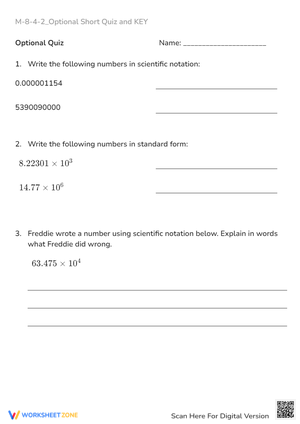
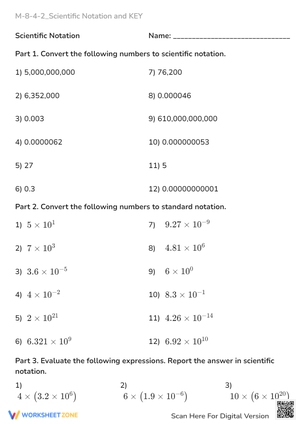
These scientific notation worksheets give 8th graders the structured repetition they need to move from shaky first exposure to genuine fluency — converting between forms, applying exponent rules to operations, and working with the kind of numbers that actually appear in science class. The set covers both the mechanical and the conceptual, so students aren't just following a procedure they'll forget by Friday.
What's on Each Page
The worksheets build in sequence rather than dumping every skill at once. Early pages ask students to identify the coefficient and exponent separately before writing the full expression — a small step that pays off when the numbers get messier. Later pages move into operations, and the final set mixes problem types so students can't lean on context to figure out what to do.
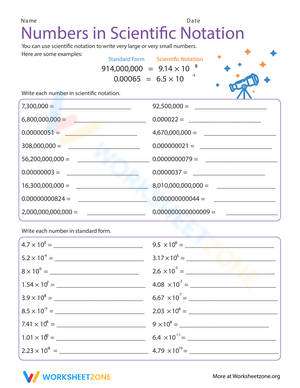
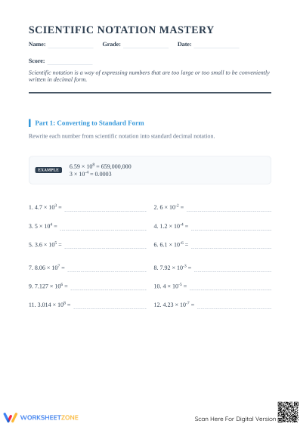
- Converting large numbers from standard form: values like planetary distances and national debt figures that students have seen referenced but never calculated with.
- Converting small numbers from standard form: measurements in the range of cell sizes, wavelengths, and atomic radii, where negative exponents trip up most students.
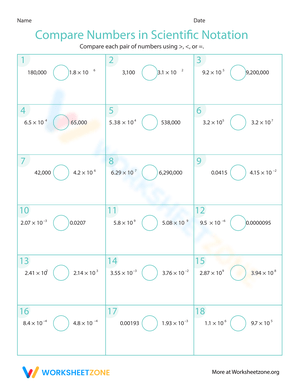
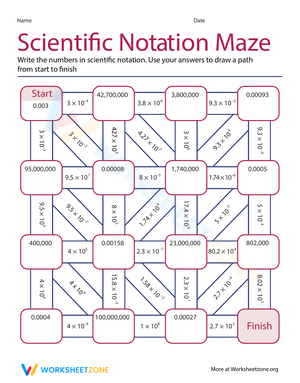
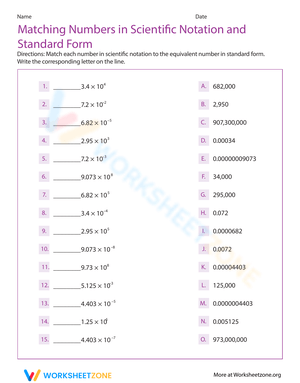
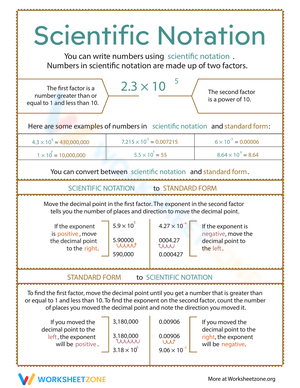
- Converting in both directions on the same page, which catches students who've memorized one direction but can't reverse the process.
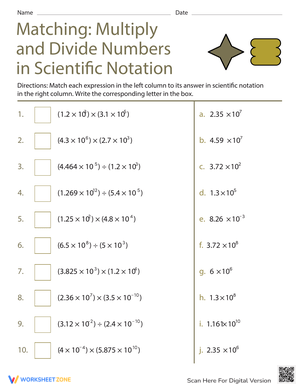
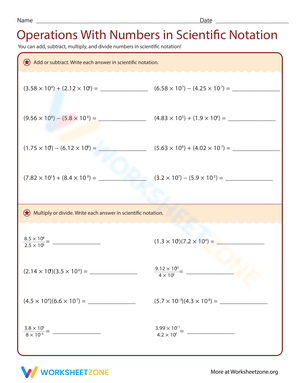
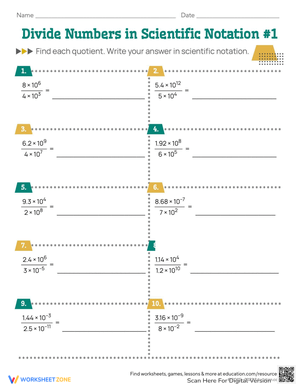
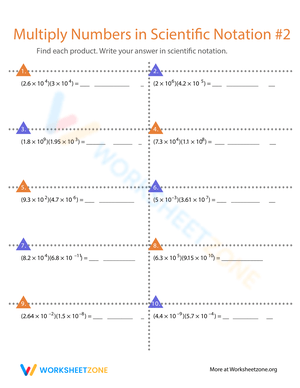
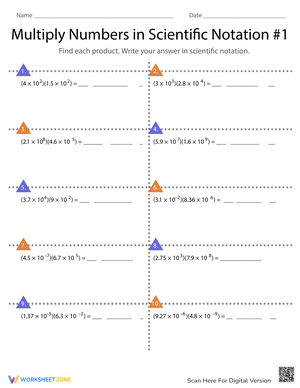
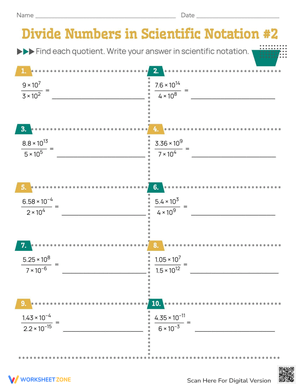
- Multiplication and division in scientific notation, including problems where the product or quotient requires adjusting the coefficient back into proper form.
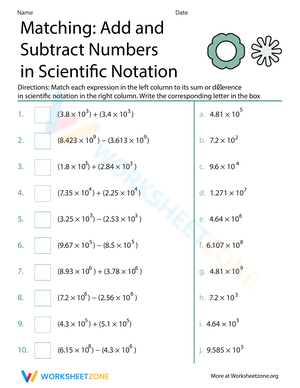
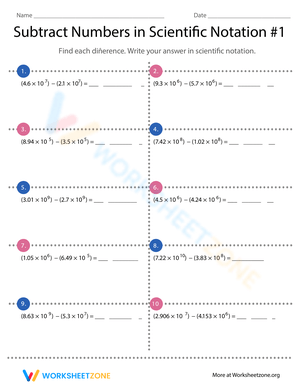
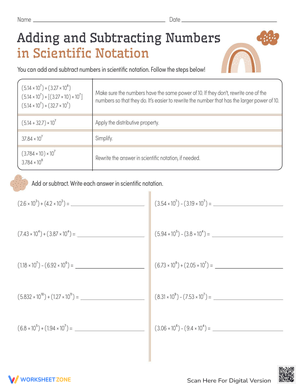
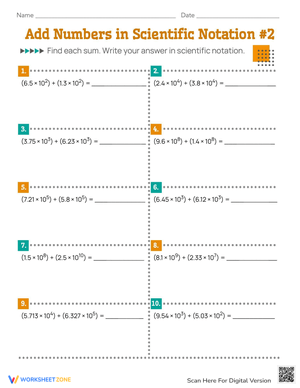
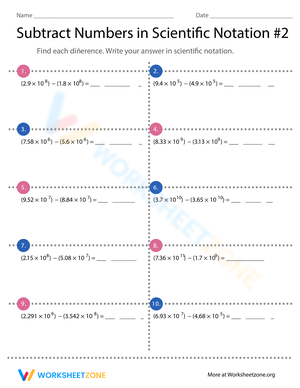
- Addition and subtraction with unlike exponents, scaffolded so students rewrite one number before combining.
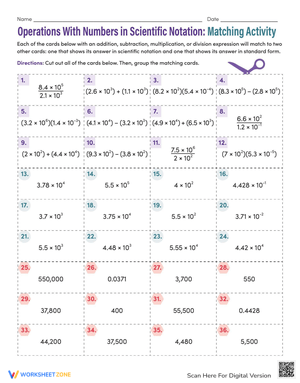
- Mixed operations and estimation, where students predict the approximate magnitude before calculating.
Where Students Get Stuck — and What These Pages Catch
The most reliable error isn't the one teachers expect. Students who correctly write 93,000,000 as 9.3 × 10⁷ will turn around and write 0.000047 as 4.7 × 10⁵ — positive exponent, wrong direction — because they counted decimal places correctly but forgot that moving right means a negative exponent. The mistake is in the sign, not the count. Worksheets that only practice one direction at a time don't surface this; the mixed-conversion pages do.
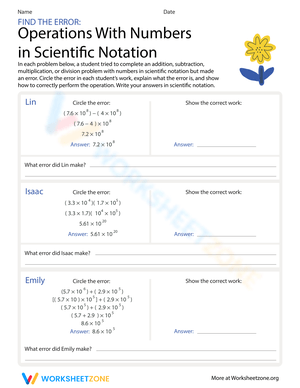
A second pattern shows up during multiplication: students multiply the coefficients and add the exponents correctly, then arrive at something like 18.4 × 10⁶ and write it down without adjusting. The coefficient is out of bounds — it needs to be rewritten as 1.84 × 10⁷ — but students don't recognize this as an error because nothing in the calculation felt wrong. The operations pages include a "check your coefficient" prompt that forces students to verify their answer is actually in scientific notation before moving on.
Addition and subtraction with unlike exponents is where the most students stall entirely. The procedure asks them to rewrite one of two numbers — which involves deliberately making a coefficient look "wrong" — before they can combine anything. That deliberate wrongness feels counterintuitive. The scaffolded version on these worksheets walks students through rewriting and labels the intermediate step explicitly, so they're not holding three mental tasks at once.
Standards Placement and Why This Unit Sits Where It Does
The core standards here are 8.EE.A.3 and 8.EE.A.4 from the Common Core. 8.EE.A.3 asks students to use numbers in the form of a single digit times an integer power of 10 to estimate very large or very small quantities — estimation being the word that often goes under-taught. 8.EE.A.4 adds operations with those numbers and requires students to interpret results in context. In practice, this means a student can't just compute 2.5 × 104 times 3.0 × 103 and call it done; they need to know what 7.5 × 10⁷ actually represents in the problem scenario.
This unit lands in Grade 8 because it requires two prior foundations to be stable: integer exponent rules (including negative exponents as reciprocals) and fluency with decimal place value. Both of those are solidified by the end of 7th grade in most scope-and-sequence plans. Students who arrive in 8th grade still uncertain about whether 10-3 equals 0.001 or -1000 will struggle here regardless of how clearly conversion is explained — which is why the early worksheet pages include a brief exponent review row before any scientific notation appears.
How Teachers Use These Pages in the Actual School Day
The conversion pages work well as warm-up material during the first week of the unit — five problems takes about eight minutes, which fits the window before direct instruction begins. Starting class this way also surfaces who is still confused from the previous day before new content lands on top of the confusion.
During guided practice, the scaffolded operations pages work well under a document camera. Working the first problem aloud, narrating every decision including the ones that feel obvious, gives students a model for the self-talk they need to use when they work independently. Then releasing the next two problems to partner work before going fully independent keeps cognitive load manageable — students who freeze when shown an unfamiliar setup have a chance to hear a classmate's reasoning before they're on their own.
The mixed-operations pages serve a different purpose: they belong later in the unit, a day or two before the assessment, when students need to practice choosing a strategy rather than following a prompted procedure. Used too early, they produce frustration; used at the right moment, they're the most useful review in the set.
Scaling for Different Learners
For students who need more support, isolating coefficient identification as a separate step before any exponent work appears reduces the number of things competing for attention. Have those students annotate each standard-form number first — circle the significant digits, underline the place-value position of the first digit — before touching the scientific notation format at all.
Students who are ready to move faster benefit from the estimation column: before computing, they write a rough prediction of the magnitude (the power of 10 the answer should be near) and then check their computed answer against it. This builds number sense rather than just procedural speed, and it mirrors exactly how scientists actually use scientific notation — as a sanity check on calculations, not just a formatting requirement.
Frequently Asked Questions
1. Do students need a strong grasp of exponent rules before starting these worksheets?
Yes, and it's worth a brief diagnostic before the unit opens. Students who believe that 10-2 means negative one hundred will produce systematically wrong answers that look like careless errors but are actually a conceptual gap. A half-page review of negative exponents as fractions — 10-2 = 1/100 = 0.01 — done at the start of the unit prevents a week of confusion. Several pages in this set include that review row at the top precisely for this reason.
2. How do you handle the calculator's E notation so it doesn't confuse students?
Teach the translation immediately and explicitly. When a calculator returns 3.2E5, have students write 3.2 × 10⁵ directly above it before doing anything else with the answer. Treating E notation as a separate dialect — one that says exactly the same thing in a different script — keeps students from interpreting the E as a variable or ignoring it entirely. This comes up most often on the operations pages, where calculator-assisted checking is a reasonable part of the workflow.
3. Is adding and subtracting in scientific notation actually tested at this grade level?
It is assessed under 8.EE.A.4, though it appears less frequently on standardized tests than conversion and multiplication do. That relative rarity can make it tempting to rush the instruction. The better argument for spending real time here is that the skill of rewriting equivalent expressions — making two numbers look different so they can be combined — is exactly the kind of algebraic reasoning that pays off in high school. Students who understand why they're adjusting the exponent are practicing something more durable than a test prep skill.













 Interactive Worksheet Maker
 Quiz Maker
 Word Search Maker
 Crossword Puzzle Maker
 Word Scramble Generator
 Sentence Scramble Generator
 Handwriting Worksheet Generator
 Name Tracing Generator
 Fill In The Blank Generator