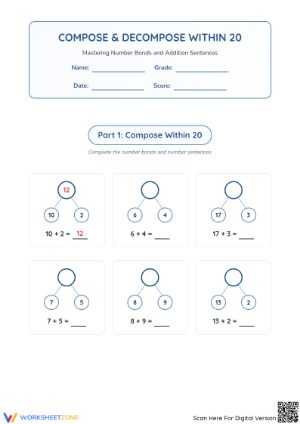
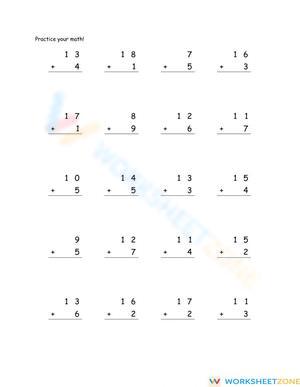
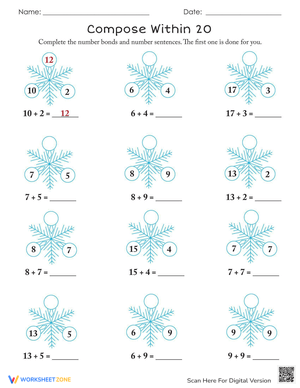
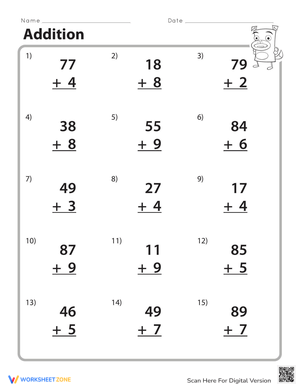
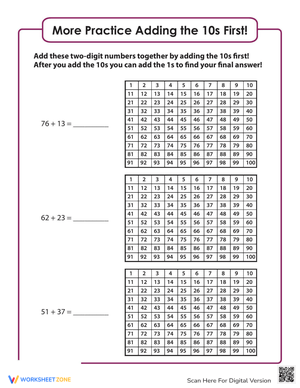
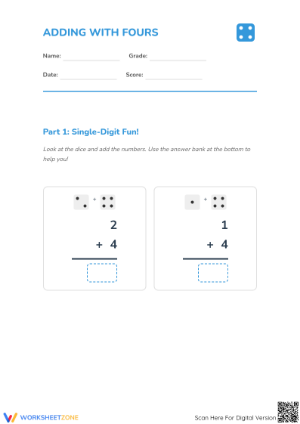
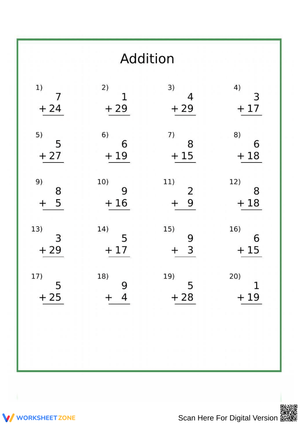
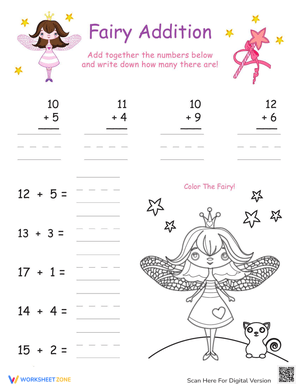
Two digit by one digit addition worksheets give 1st and 2nd grade teachers a direct path to one of early math's most consequential skills: helping students see that 23 + 6 and 23 + 9 demand two completely different cognitive moves. This collection covers both non-regrouping and regrouping problems, with layouts designed to surface exactly where individual students break down so instruction can stay targeted.
Skills Covered in These Two Digit by One Digit Addition Worksheets
- Ones-column isolation — Students practice identifying which digit receives the incoming addend before any calculation begins, combating the persistent habit of adding to the tens place by mistake.
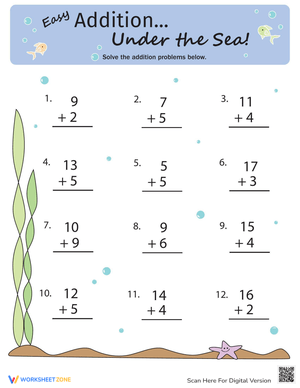
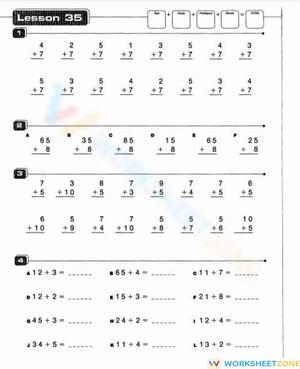
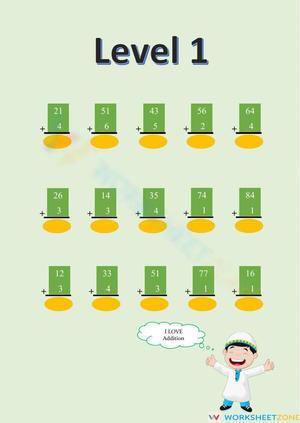
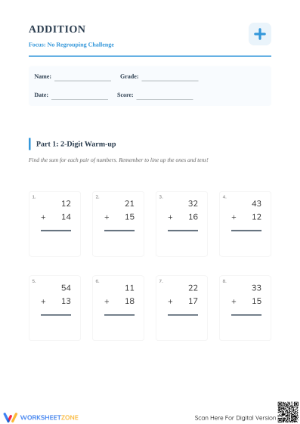
- Non-regrouping fluency — Problems where ones-column sums stay at nine or below let students build procedural confidence and correct column alignment before regrouping enters the picture.
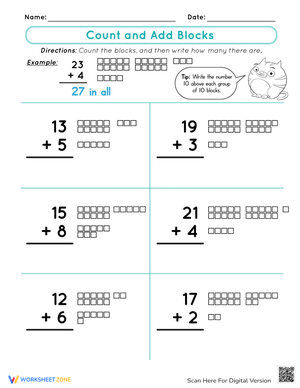
- Regrouping with a recording box — Structured problems include a small box above the tens column so students track the carried ten explicitly rather than holding it in working memory.
- Number-line jumps — Selected pages ask students to show their thinking on an open number line, reinforcing the "make a ten" bridge strategy alongside the standard vertical algorithm.
- Partial-sums decomposition — Students add ones first, record the partial sum, then combine it with the tens value — a method that makes place value visible rather than procedural.
- Mixed word problems — Short, readable contexts (tallying stickers, counting steps) require students to extract the equation before solving, connecting symbolic math to quantity reasoning.
Why Column-Structured Practice Works Best With the 1st and 2nd Graders
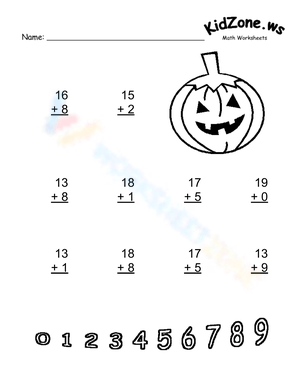
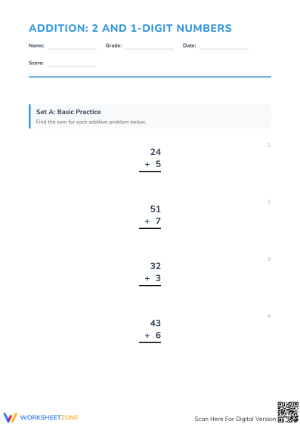
First and second graders are simultaneously building procedural skill and conceptual understanding of the base-ten system — and those two goals can work against each other if the worksheet format doesn't support both at once. Vertical problems with clearly delineated ones and tens columns reduce the spatial-organization load, freeing working memory for the actual arithmetic. When students aren't fighting their own handwriting to line up digits, they attend more closely to whether or not their ones-column sum crosses ten — the decision point that separates a correct answer from a regrouping error.
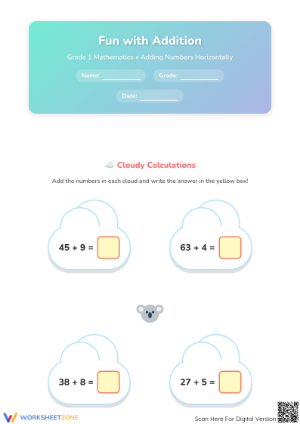
Many generic addition sheets present equations in horizontal form or mix operation types on the same page without clear progression. That format may assess flexibility in older students, but at the 1st–2nd grade level it tends to produce random-looking errors that are hard to diagnose. A worksheet organized around a single operation type — first without regrouping, then with — lets a teacher scan a completed page in under a minute and immediately tell whether a student is misaligning columns, forgetting the carried ten, or adding the single digit directly to the tens digit. Each of those errors points to a different next instructional move.
How Teachers Use These Single-Digit and Two-Digit Addition Worksheets
- Bell ringer — Post three to four non-regrouping problems on the board while students settle in; the short completion time gives you a quick read on who retained yesterday's lesson before new instruction begins.
- Exit ticket — One regrouping problem and one non-regrouping problem at the end of a lesson reveals whether students can correctly sort the two problem types — a common stumbling block even after initial mastery.
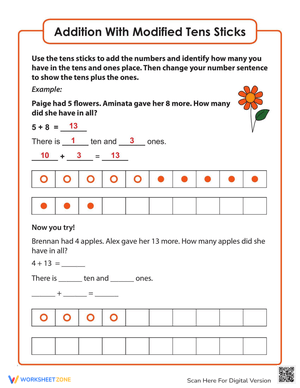
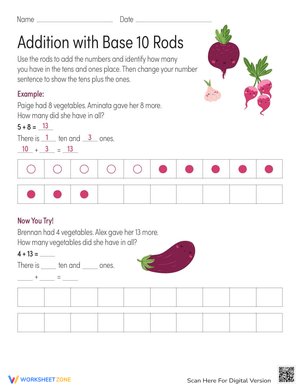
- Math center rotation — Laminate a page and pair it with base-ten block stamps or linking cubes so students build each addend physically before recording the equation, keeping manipulative and symbolic work connected.
- Homework — The vertical layout is immediately readable to parents and caregivers, reducing the support burden at home and making it easier for families to spot and describe the specific step where their child gets stuck.
- Sub plans — Self-contained pages with clear directions allow a substitute to run independent practice without needing background in the current unit's pacing or instructional model.
- Intervention groups — Pull a small group with a no-regrouping sheet to diagnose column-alignment issues separately from regrouping confusion, then target only the skill that's actually breaking down.
Common Errors These Worksheets Target
- Adding the single-digit number to the tens digit rather than the ones digit — for example, writing 23 + 6 = 83 because the student added 6 to the 2 in the tens place.
- Forgetting to add the carried ten to the existing tens digit after regrouping — a student solves 47 + 8 correctly in the ones column (15), carries the 1, but then writes 5 instead of 5 + 4 = 9 in the tens column, producing 55 instead of 55.
- Recording the entire ones-column sum without splitting it — writing 15 in the ones column of 47 + 8 rather than recording 5 and carrying 1.
- Treating the ones digit of a two-digit number as the full number — a student sees 34 + 5 and computes 4 + 5 = 9, then writes 9 as the answer, losing the tens value entirely.
- Reversing addend order during number-line jumps — starting at 6 and jumping 28 spaces forward instead of starting at 28 and jumping 6, which works mathematically but often leads to miscounting on a bounded number line.
- Inconsistent column alignment in horizontal-to-vertical transcription — when students rewrite a horizontal equation in vertical form themselves, misaligned digits produce errors that look like calculation mistakes but are actually spatial-organization errors.
Standards Alignment
These worksheets address two adjacent Common Core standards. Non-regrouping pages target 1.NBT.C.4, which requires first graders to add a two-digit number and a one-digit number using concrete models, drawings, or strategies based on place value. Regrouping pages step into 2.NBT.B.5, which expects second graders to fluently add and subtract within 100 using strategies derived from place value properties and the relationship between addition and subtraction. Because both standards appear in this collection, teachers can use the same resource set across a full school year or across a mixed-readiness class without sourcing separate materials.
Frequently Asked Questions
1. At what point in the school year should I introduce regrouping problems?
Most first-grade pacing guides introduce non-regrouping two-digit plus one-digit addition in the second quarter, after students can reliably identify tens and ones in a two-digit number. Regrouping is typically held until late first grade or early second grade, once students have used physical base-ten blocks to trade ten ones for a single ten several times — that concrete experience is what makes the symbolic carry meaningful rather than arbitrary.
2. How do I know when a student is ready to move from non-regrouping to regrouping problems?
Look for two consistent behaviors: the student adds to the ones column first without being prompted, and they can explain in their own words why the tens digit stays the same when there's no regrouping. If either of those is shaky, more non-regrouping practice will build the foundation that regrouping instruction needs.
3. Are these worksheets useful for students who already know the standard algorithm but make careless errors?
Yes — the structured column layout and the explicit recording box for the carried ten help students slow down and document each step, which reduces the specific class of errors that come from skipping steps mentally. For fluent students, the mixed-format pages with number lines and word problems are the better fit, since they add variety without reducing rigor.
4. Can these pages be used with students who have IEPs that address math computation?
The visual scaffolds built into these sheets — labeled column headers, regrouping boxes, and grid lines — align with common accommodations for students with learning disabilities in math. Check your district's guidance on whether additional modifications such as reduced problem sets or enlarged print are needed for individual students.













 Interactive Worksheet Maker
 Quiz Maker
 Word Search Maker
 Crossword Puzzle Maker
 Word Scramble Generator
 Sentence Scramble Generator
 Handwriting Worksheet Generator
 Name Tracing Generator
 Fill In The Blank Generator