Building Strong Foundations in Elementary Math
Transitioning from two-digit to three-digit arithmetic marks a significant milestone in elementary education. Students begin to interact with larger numbers, requiring a deeper conceptual grasp of place value. When learners advance to adding hundreds, tens, and ones, they rely heavily on their foundational knowledge of base-ten concepts. Mastering this skill requires students to visualize numbers and understand how individual digits represent different values depending on their position. Teachers must present this material with clarity, providing ample opportunities for guided practice and independent application. By focusing on place value foundations early on, educators can prevent common errors and help students develop numerical fluency.
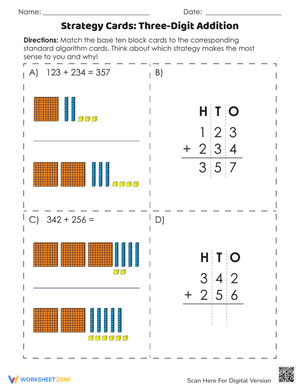
In many classrooms, educators observe that students who struggle with regrouping often lack a concrete understanding of place value. They might treat each column as an isolated addition problem rather than understanding that a group of ten in the ones place must be moved to the tens place. To address this, instruction must bridge the gap between concrete manipulatives and abstract written equations. Base-ten blocks and place value disks serve as excellent tools for this transition. Providing a structured approach ensures that no student is left behind as the math curriculum becomes more demanding.
Strategies for Teaching Addition with Regrouping
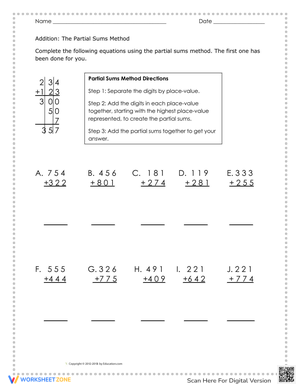
Introducing addition with regrouping requires a blend of visual, auditory, and kinesthetic instructional methods. One highly effective approach is the partial sums method, where students add the hundreds, then the tens, and finally the ones before combining the results. This strategy reinforces place value by making the value of each digit explicit. Another popular technique is using a number line, which allows learners to jump by hundreds, tens, and ones, providing a visual representation of the addition process.
Transitioning to the standard algorithm should be a gradual process. Teachers often use color-coded columns to help students keep their numbers aligned properly. For example, writing the hundreds in blue, tens in red, and ones in green visually separates the place values, making the regrouping process more obvious. When a student adds the ones and gets a two-digit number, the color coding prompts them to place the extra ten in the correct column. Providing clear models ensures that students understand the reasoning behind three-digit addition.
Classroom Implementation
Begin the instructional sequence with a brief, engaging mini-lesson that models the targeted skill. Use think-aloud strategies to make the internal cognitive process visible to students. Following the mini-lesson, transition into guided practice where students solve problems on individual whiteboards while the teacher provides immediate feedback. This formative assessment allows educators to identify which students are ready for independent work and which require further small-group instruction.
According to the Core Standards for Math (2nd Grade), students must fluently add and subtract within 1000 using strategies based on place value, properties of operations, and the relationship between addition and subtraction.
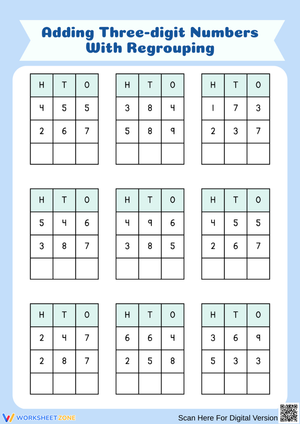
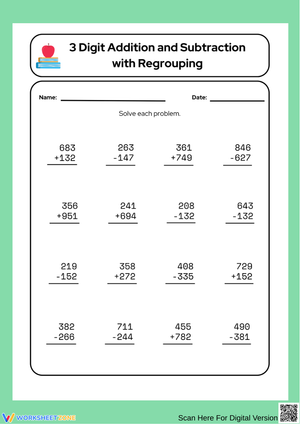
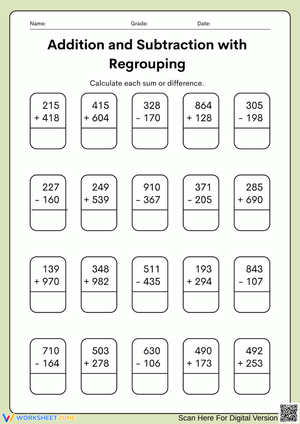
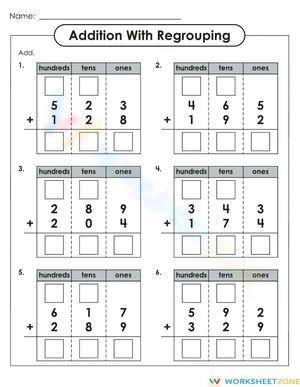
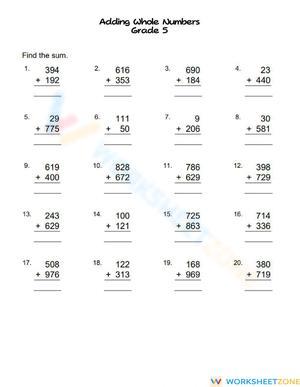
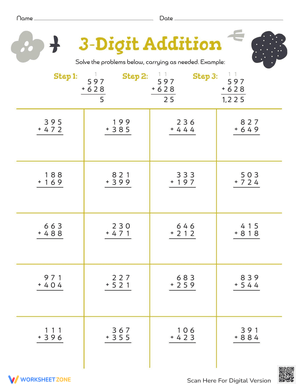
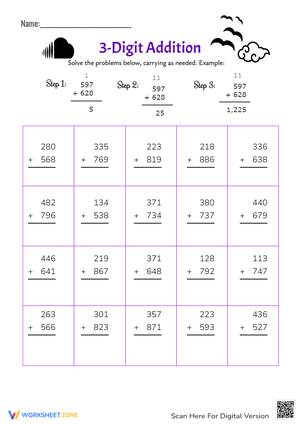
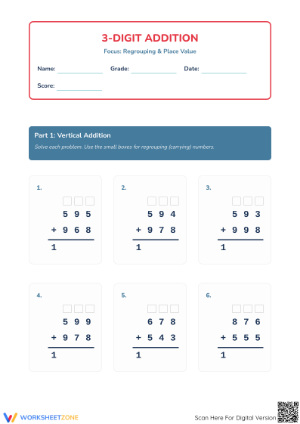
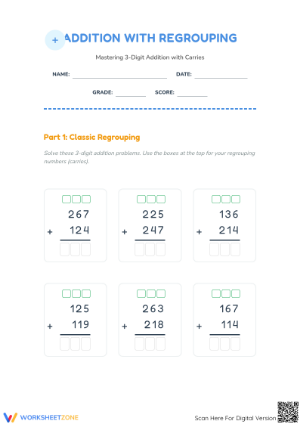
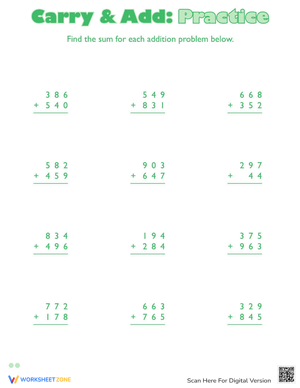
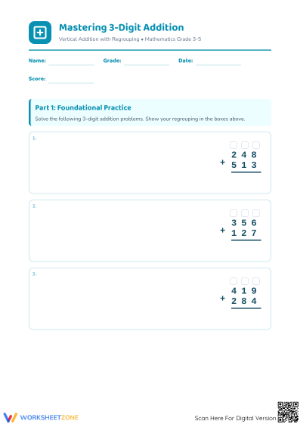
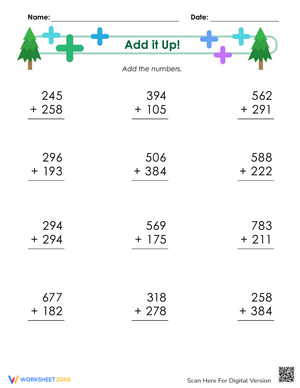
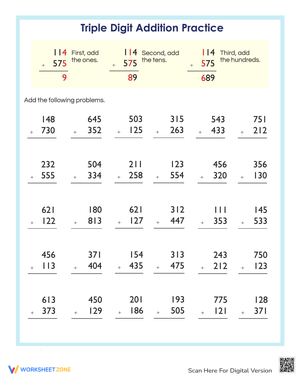
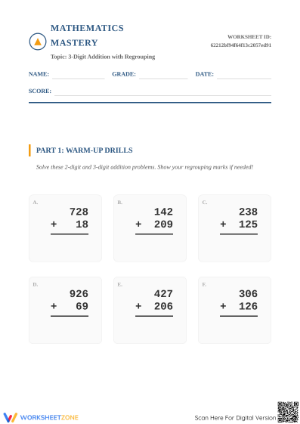
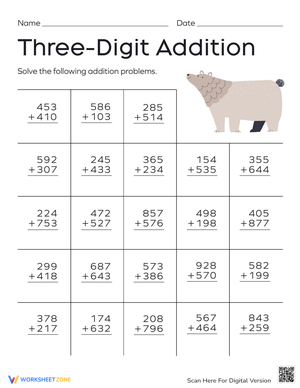
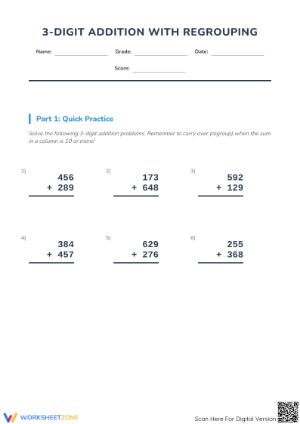
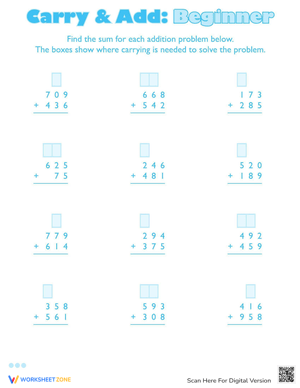
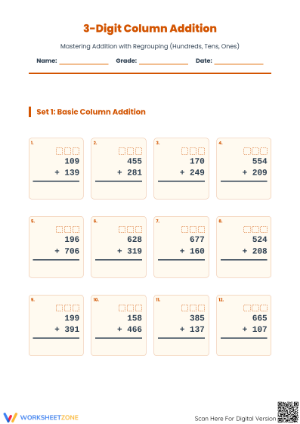
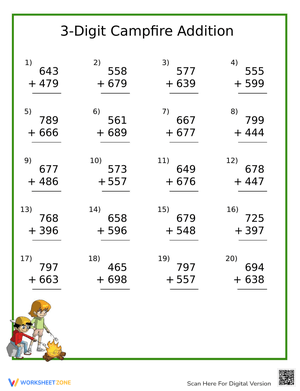
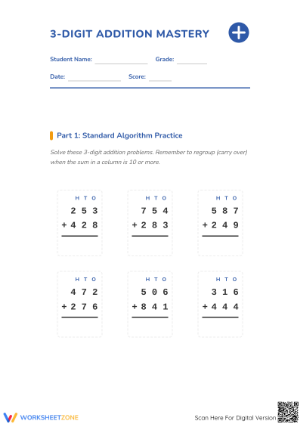
During independent practice, circulating the room to monitor progress is essential. When students use a three digit addition with regrouping worksheet, encourage them to show all their work, including the regrouped digits. Peer tutoring can also be an effective strategy during this time; pairing a student who has mastered the concept with one who is still learning provides benefits for both learners. Creating a collaborative and supportive classroom culture enhances the overall learning experience.
Breaking Down the Regrouping Process
Educational research indicates that students who verbalize their mathematical thinking while solving problems are 40 percent less likely to make procedural errors during complex regrouping tasks. By requiring learners to explain out loud why they are moving a one to the tens or hundreds column, teachers can instantly diagnose misconceptions and correct them before they become ingrained habits.
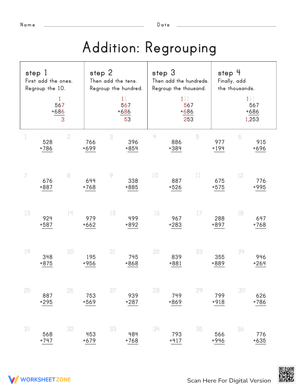
After successfully regrouping from the ones to the tens, the process repeats. Students add the tens column, including the newly regrouped ten, and determine if the sum is ten or greater. If necessary, they regroup again into the hundreds column. Regular practice with problems that require regrouping helps students build their stamina and competence progressively.
Common Misconceptions and How to Address Them
When learning to add three-digit numbers, students frequently exhibit predictable misconceptions. The most prevalent error is failing to align the digits correctly according to their place value. If a student writes a two-digit number underneath a three-digit number but aligns it to the left instead of the right, their calculation will be incorrect. Providing graph paper or worksheets with pre-drawn columns can eliminate this alignment issue while students are still developing spatial organization skills.
Another common mistake is ignoring the regrouped number altogether. Students might correctly determine that 8 plus 5 equals 13, write down the 3, and place the 1 above the tens column, but then forget to include it when adding the tens. To combat this, teachers can instruct students to circle the regrouped number in a bright color so it stands out visually. Addressing these misconceptions directly during whole-group instruction is vital for student success.
Frequently Asked Questions
1. How can I simplify addition with regrouping for struggling students?
To simplify the process, start by returning to concrete manipulatives like base-ten blocks. Allow students to physically trade ten ones for a ten rod before attempting written algorithms. You can also provide worksheets with grid lines or color-coded columns from Worksheetzone to help them keep their numbers properly aligned. Focus on single-column regrouping until they build enough confidence.
2. Why is mastering regrouping so important in elementary math?
Mastering regrouping is a fundamental building block for all subsequent arithmetic operations. It solidifies a student's conceptual understanding of the base-ten number system and place value. Without this solid foundation, students will invariably struggle with subtraction with borrowing, multi-digit multiplication, and long division in later grades. It is an essential prerequisite for higher-level mathematical thinking.
3. What are the best practices for differentiating math instruction?
Effective differentiation involves tailoring both the instruction and the practice materials to meet varied learning needs. For advanced learners, offer complex word problems or missing-digit puzzles that require critical thinking. For students needing support, reduce the number of problems per page, provide visual aids like place value charts, and offer small-group guided practice.













 Interactive Worksheet Maker
 Quiz Maker
 Word Search Maker
 Crossword Puzzle Maker
 Word Scramble Generator
 Sentence Scramble Generator
 Handwriting Worksheet Generator
 Name Tracing Generator
 Fill In The Blank Generator