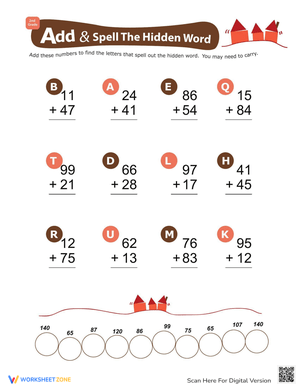
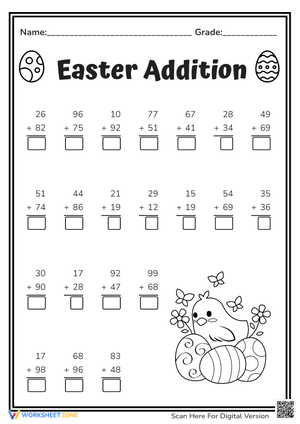
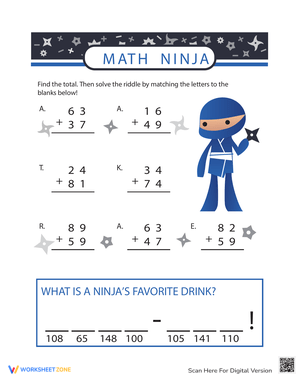
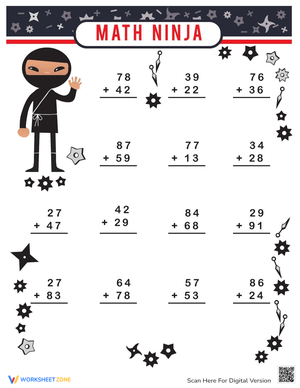
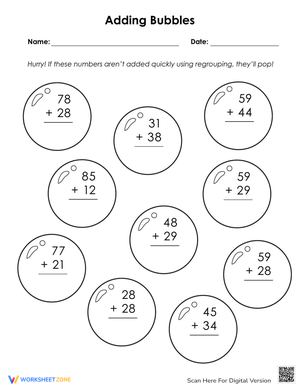
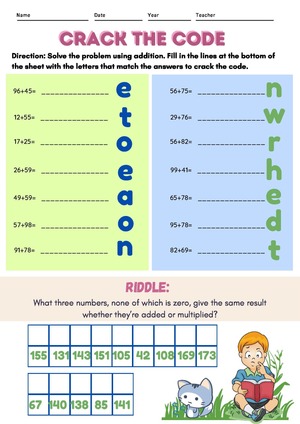
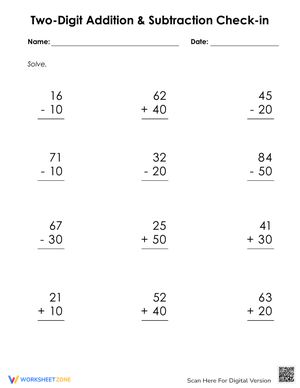
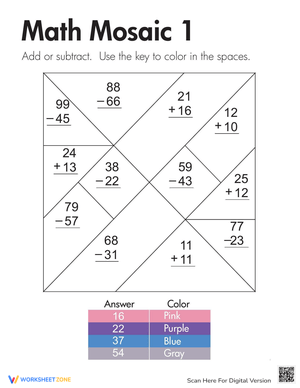
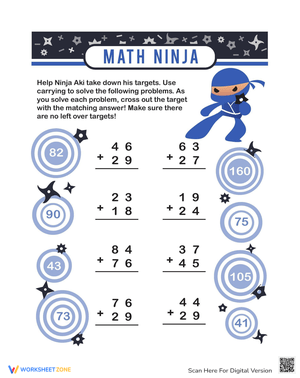
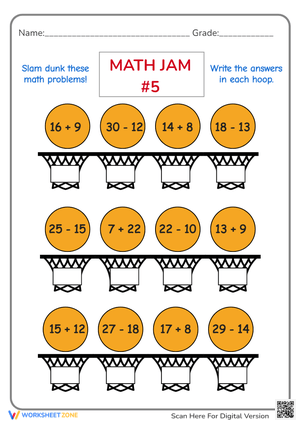
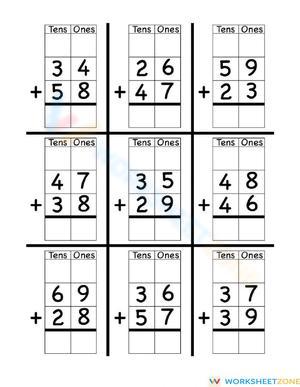
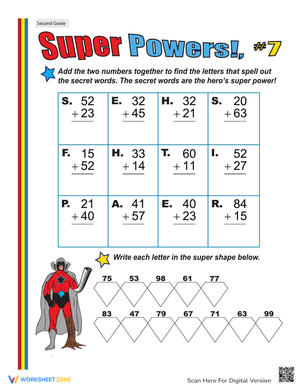
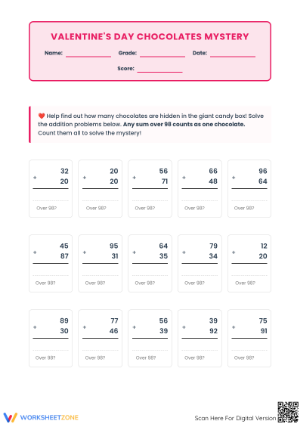
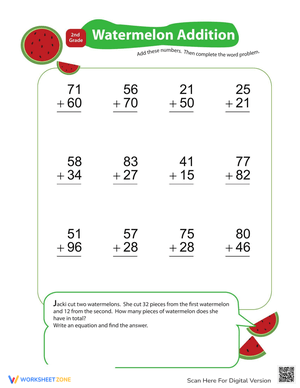
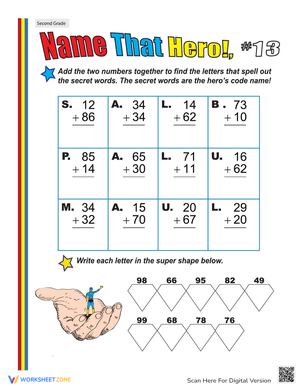
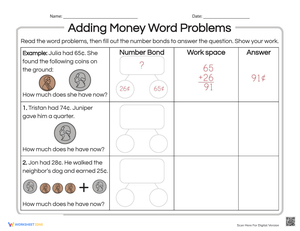
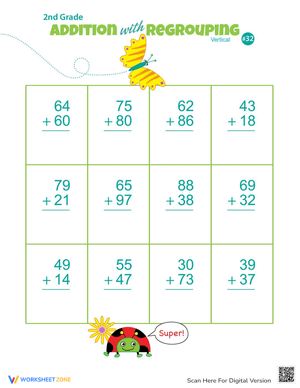
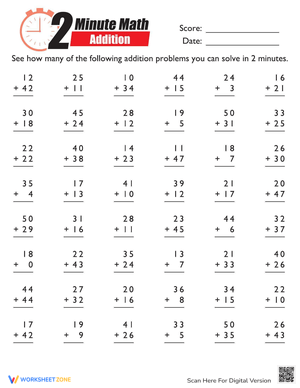
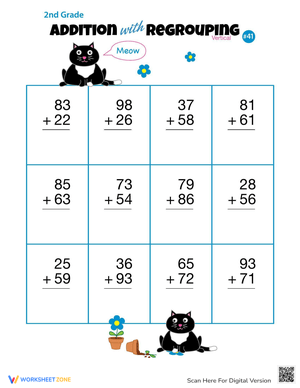
Two digit addition with regrouping worksheets give second-grade teachers a direct path to one of the year's most demanding computation benchmarks — the moment students stop treating two-digit numbers as single units and start decomposing them by place value. This collection covers every instructional phase, from picture-supported introduction to independent algorithmic fluency, so you can stop hunting for separate resources and run a coherent unit from first lesson to assessment.
Skills Covered in These Two Digit Addition with Regrouping Worksheets
- Ones-column evaluation — Students determine whether the ones digits sum to ten or more before deciding how to proceed, building the habit of inspecting a problem rather than automatically applying a procedure.
- Trading ten ones for one ten — Practice pages reinforce that regrouping is a physical exchange of equal value, not an arbitrary rule, using a visual place-value column alongside the standard algorithm.
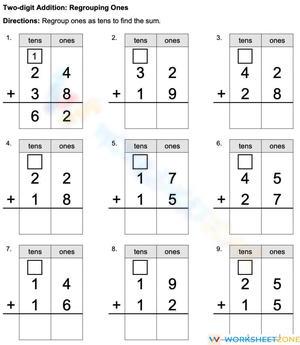
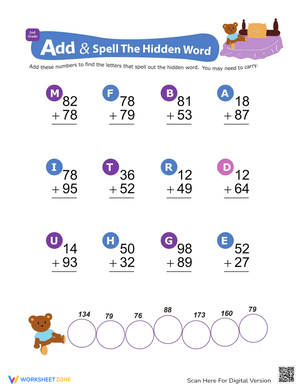
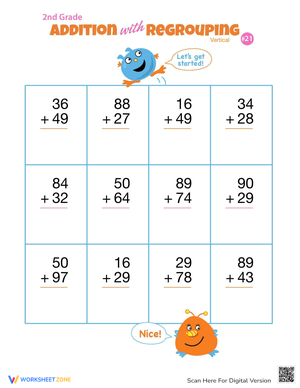
- Carried-digit placement and inclusion — Dedicated carrying boxes prompt students to record the regrouped ten above the tens column and then add it, targeting the single most common omission in student work at this stage.
- Discrimination between regrouping and non-regrouping problems — Mixed sets require students to evaluate every problem before solving, preventing the automaticity error of always carrying regardless of the ones sum.
- Two-digit addition in context — Word problems embed the computation in classroom-realistic scenarios so students practice extracting numbers, choosing the correct operation, and interpreting answers as quantities rather than digits.
- Error identification and correction — Error-analysis tasks ask students to locate and explain mistakes in pre-worked problems, demanding a level of reasoning that standard drill pages cannot reach.
Why Graduated Visual Support Works Better with The Second Graders
Second graders who appear to understand regrouping often reveal gaps the moment visual aids disappear. That failure point is predictable: they learned the steps with base-ten blocks on the desk, then transferred those steps to paper without ever internalizing why a ten ones-to-one ten exchange preserves value. Worksheets that begin with labeled tens-and-ones illustrations, then move to algorithm-only problems across the same unit, force students to rebuild their reasoning from quantities to symbols — the Concrete-Pictorial-Abstract progression that research on place-value instruction consistently supports. The carried digit stops feeling like a floating number and starts representing a specific quantity they can name.
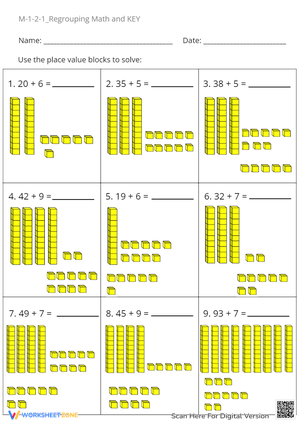
Many worksheets available elsewhere collapse this progression into a single format: either all base-ten pictures (no bridge to abstraction) or all bare algorithms (no conceptual anchor). Pages with base-ten images on one side and symbol-only problems on the other are common but flawed — students treat them as two unrelated tasks. The sequence here links both modes explicitly, requiring students to match a pictorial trade to the digit they write in the carrying box before any purely abstract problems appear.
How Teachers Use These Addition with Regrouping Worksheets
- Bell ringer — Project a single two-digit problem with a partially filled carrying box and ask students to identify what the written digit represents before instruction begins; surfaces overnight misconceptions in under three minutes.
- Exit ticket — Two mixed problems — one requiring regrouping, one not — reveal in a single page whether a student can discriminate as well as compute, giving you a clear sort for the next day's small groups.
- Math center — Slide pages into dry-erase pockets so students self-check, erase, and reattempt without consuming paper; rotate in the error-analysis version once the class has completed initial fluency practice.
- Homework — A six-problem page with a carrying box already drawn signals to parents exactly what their child should be doing, reducing the "I don't know how" phone calls and making family practice accurate rather than well-intentioned but incorrect.
- Sub plans — Because each page includes its own visual reference for the procedure, a substitute does not need content knowledge to facilitate — students have everything they need on the sheet itself.
- Intervention groups — Print the base-ten-illustration pages and pair them with physical linking cubes; students work the picture on paper first, then rebuild the same problem in cubes, reinforcing that both representations show an identical quantity.
Common Regrouping Errors These Worksheets Target
- Writing the full ones sum (e.g., writing 14 below the ones column instead of placing a 1 above the tens column and 4 in the ones answer box) — the most consistent two-digit addition error visible in first-draft student work.
- Carrying a one to the tens column even when the ones digits sum to nine or less, revealing that the student memorized "always carry" from watching problems that all required regrouping.
- Adding the carried digit to only one of the tens-column addends rather than to the full tens-column sum, typically resulting in answers that are exactly ten less than the correct value.
- Misaligning digits when writing problems horizontally before solving vertically, so a tens digit lands in the ones column and the computation operates on wrong place values entirely.
- Omitting the carried digit entirely on a second or third regrouping problem in the same session — a fatigue-driven error that appears in student work after the first few problems are correct.
- Recording the carried digit in the answer space rather than above the addends, so it gets added a second time or ignored depending on how the student reads the page.
Standards Alignment
These materials directly address Common Core State Standard 2.NBT.B.5, which requires second graders to fluently add and subtract within 100 using strategies grounded in place value, properties of operations, and the inverse relationship between addition and subtraction. The progression from pictorial place-value support to standard algorithm practice maps to the standard's expectation of fluency — a term that implies both accuracy and conceptual understanding, not speed alone. The error-analysis and discrimination tasks additionally support the Standards for Mathematical Practice, particularly MP3 (construct viable arguments) and MP6 (attend to precision).
Frequently Asked Questions
1. At what point in a unit should I introduce these worksheets?
Start with the illustrated base-ten pages only after students can correctly name how many tens and ones are in any two-digit number without counting individual unit marks. Introducing the algorithm before that check passes reliably leads to the carried-digit errors described above — students apply a procedure they cannot explain, and the errors become entrenched before you catch them.
2. How do I help a student who keeps forgetting to add the carried digit?
Use a different-color pencil specifically for the carried digit throughout an entire practice session — the visual contrast makes the written one harder to skip. After two or three sessions where the student records and includes it correctly in color, switch back to a single pencil. The habit is usually established by then and transfers to standard pencil work.
3. What is the difference between regrouping and carrying, and does the vocabulary matter?
Both terms describe the same process: when a column sum reaches ten or more, you record the tens portion above the next column and write only the ones digit in the answer. Carrying is the older procedural term; regrouping emphasizes the conceptual exchange of ten ones for one ten, which is why current standards-aligned instruction prefers it. Using regrouping consistently helps students connect the algorithm to the place-value meaning rather than treating it as an isolated trick.
4. Can these pages work for students who are just starting second grade versus those finishing it?
The illustrated pages with base-ten visuals are appropriate early in the year when the standard algorithm is first introduced; the mixed discrimination and error-analysis pages suit mid-to-late year when students are consolidating fluency. Using the end-of-year pages too early creates performance anxiety and skips the conceptual groundwork; using the introductory pages too late in the year underestimates students and limits their growth toward the 2.NBT.B.5 fluency expectation.













 Interactive Worksheet Maker
 Quiz Maker
 Word Search Maker
 Crossword Puzzle Maker
 Word Scramble Generator
 Sentence Scramble Generator
 Handwriting Worksheet Generator
 Name Tracing Generator
 Fill In The Blank Generator