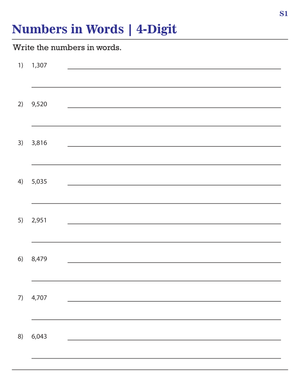
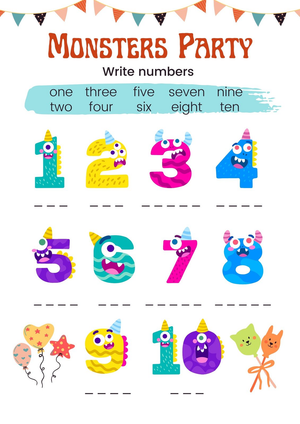
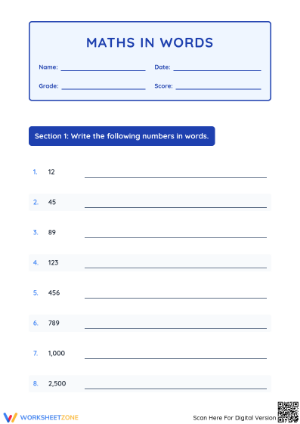
These kindergarten number names worksheets give teachers a print-ready set that connects number recognition with early word reading — two skills kindergartners develop simultaneously, even though most curricula treat them as belonging to separate subjects. The set covers zero through twenty, with four distinct activity formats spread across the worksheets, so the same number vocabulary gets practiced in genuinely different ways throughout the week. Each worksheet targets one skill rather than combining several at once, which matters for five- and six-year-olds who are still sorting out letter formation, phonics, and quantity recognition all at the same time.
The Specific Skills These Worksheets Build
Four worksheet types make up the set, each drawing on a different aspect of number word knowledge.
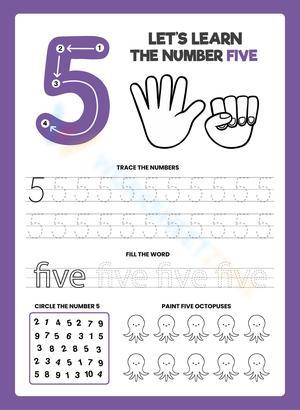
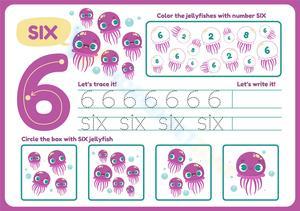
- Tracing and copying: Students trace the number word using directional cues, then write it independently below. The font is large enough that letter formation problems show up clearly — useful for a quick formative check without pulling students aside during independent work time.
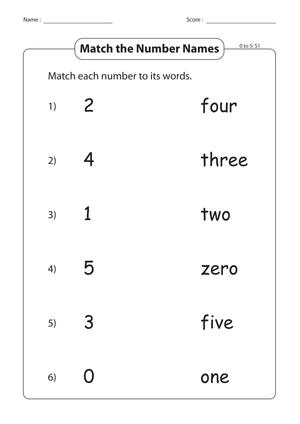
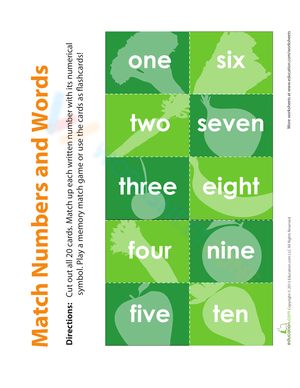
- Matching: Students draw lines or paste cutouts connecting the written word to the numeral or to a quantity shown in a ten-frame. These worksheets surface students who have memorized the visual shape of a word without understanding what that word represents.
- Color-by-word: Students read a number name and use the corresponding color on a section of an illustration. The format keeps reading as the primary task rather than making it incidental to the coloring.
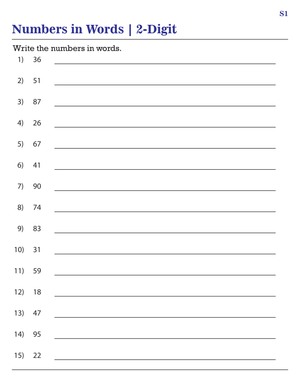
- Fill-in-the-blank: Students complete partially spelled number words from memory. These worksheets sit later in the sequence, after students have had enough exposure to attempt a spelling rather than copy one.
Ten-frames serve as the main quantity reference throughout the set. A student who can already subitize a group of seven uses the frame to anchor the word to something already familiar — they aren't decoding the numeral, the word, and the quantity from scratch all at once.
Spelling Errors That Surface With These Number Words
The most stubborn problems cluster around phonetically irregular words. Students who decode "six" and "nine" without hesitation will write "wun" for one, "tu" or "too" for two, and "for" for four. Each of those guesses makes phonetic sense for a child in the early stages of phonics instruction — which is exactly why these three words need to be flagged as exceptions from the start, handled more like sight words than decodable ones.
Eight deserves its own brief lesson. Both "eigt" and "ait" are phonetically reasonable attempts from a student who has recently learned that ai makes the long-A sound. Repeated practice on a worksheet doesn't fix this reliably; pairing the written work with a classroom chant or hand gesture reserved just for "eight" anchors the spelling faster than visual exposure alone. The teen words bring a separate complication: "eleven" and "twelve" look and sound nothing like the rest of the series, and students routinely write "elven" or "twelv" — or swap them with each other entirely. A quick word-sort on those two before students encounter them on the worksheets saves correction time later.
How to Build These Worksheets Into Your Lesson Plans
Tracing and matching worksheets work well as morning work in the first few months of school, when a short and well-defined task helps students settle into the day. One worksheet per morning gives the daily contact with the words without running long. The fill-in-the-blank worksheets are a natural fit for the weeks surrounding winter break — by then, most students have seen the zero-through-ten words enough to try spelling from memory rather than copying.
Color-by-word worksheets belong in math centers. Once you model the format twice, students work through them without needing direction, freeing you to run small groups. Keep a laminated number word reference card at each center station so students can self-check without coming to you. When you send a kindergarten number names worksheets home on Fridays, attach a brief note identifying the words as the same ones on your classroom word wall — parents who understand what is being practiced are more likely to point those words out in books or on signs, adding repetition outside school hours without adding homework pressure.
Standard Alignment
The worksheets in this kindergarten number names worksheets set address CCSS.MATH.CONTENT.K.CC.A.3, which requires students to write numbers from 0 to 20 and represent a number of objects with a written numeral. The number-word work here makes explicit what that standard implies: the numeral and the written word are two representations of the same quantity, and students need deliberate practice moving between them. The matching worksheets provide the most direct alignment — students connect all three forms (word, numeral, quantity image) within a single task. Teachers working with state-adapted standards will find the progression from zero through ten to eleven through twenty maps onto most kindergarten math frameworks without adjustment.
Tailoring the Set for Different Readiness Levels
Students still developing letter formation get the most from the tracing worksheets. For these students, the expectation should be tracing and saying the word aloud — don't push toward independent writing until the fine motor control is there. These students often already understand quantity and can count reliably; the bottleneck is the physical act of forming letters, so the worksheet task shouldn't pile on additional demands.
On-level students move through the set in sequence without changes. Students who have already internalized zero through ten can skip the tracing and matching worksheets for those numbers and work directly from the fill-in-the-blank format. A practical extension: ask these students to write the number word in a sentence on the back. A kindergarten number names worksheets used this way gives a prepared student a genuine writing challenge rather than repeated review of vocabulary they already control, while the rest of the class builds recognition through the structured sequence.
Frequently Asked Questions
Which number words do kindergartners need to read and write by the end of the year?
Most kindergarten standards expect students to read and write number words for zero through twenty. In practice, solid fluency with zero through ten is the realistic benchmark for most students by spring, with eleven through twenty still in progress for many. The words that appear most often in assessments are in the zero-to-ten range, so prioritize those before spending significant time on teen words.
Should students know the numerals before working with the written words?
Yes — introduce the numeral first. Students need the quantity-to-numeral connection stable before adding a third representation. Asking a student to link a quantity, a numeral, and a word all at once before any of those pairs is secure adds more to manage than most kindergartners can handle at one time. Once a student reliably reads and writes "7," introducing seven gives them something concrete to attach the new word to.
Do irregular number words need direct instruction beyond worksheet practice?
They do. Words like one, two, four, and eight need to be flagged explicitly as words that don't follow the phonics rules students are learning. Treating them the way you treat high-frequency sight words — word wall placement, flash card review, spotting them in shared reading texts — closes the gap faster than tracing practice alone. The worksheet reinforces what explicit instruction establishes; it doesn't replace it.
When in the year do the fill-in-the-blank worksheets make sense?
After students have had consistent exposure to a word across multiple formats. For most kindergartners, the fill-in-the-blank worksheets for zero through five are appropriate by mid-fall, while those covering teen words may not be ready until late winter or early spring. A useful indicator: watch performance on the matching worksheets first. If students connect words to quantities quickly and accurately, they're ready to attempt spelling from memory.













 Interactive Worksheet Maker
 Quiz Maker
 Word Search Maker
 Crossword Puzzle Maker
 Word Scramble Generator
 Sentence Scramble Generator
 Handwriting Worksheet Generator
 Name Tracing Generator
 Fill In The Blank Generator