


























Views
Downloads

Essential Numbers in Words Worksheet | Grade 4 Math
Paste this activity's link or code into your existing LMS (Google Classroom, Canvas, Teams, Schoology, Moodle, etc.).
Students can open and work on the activity right away, with no student login required.
You'll still be able to track student progress and results from your teacher account.
This comprehensive math practice resource empowers students to bridge the gap between numerical symbols and written language. By focusing on multi-digit numbers up to the thousands place, this worksheet ensures learners build a robust understanding of place value and standard notation. Students will develop the fluency required for advanced mathematical communication and number sense.
At a Glance
- Grade: Grade 4 · Subject: Math
- Standard:
CCSS.MATH.CONTENT.4.NBT.A.2— Read and write multi-digit whole numbers using base-ten numerals and number names- Skill Focus: Number notation and place value proficiency
- Format: 3 printable pages · 20 problems · Answer key included · PDF
- Best For: Independent practice and formative skills assessment
- Time: 15–25 minutes
What's Inside
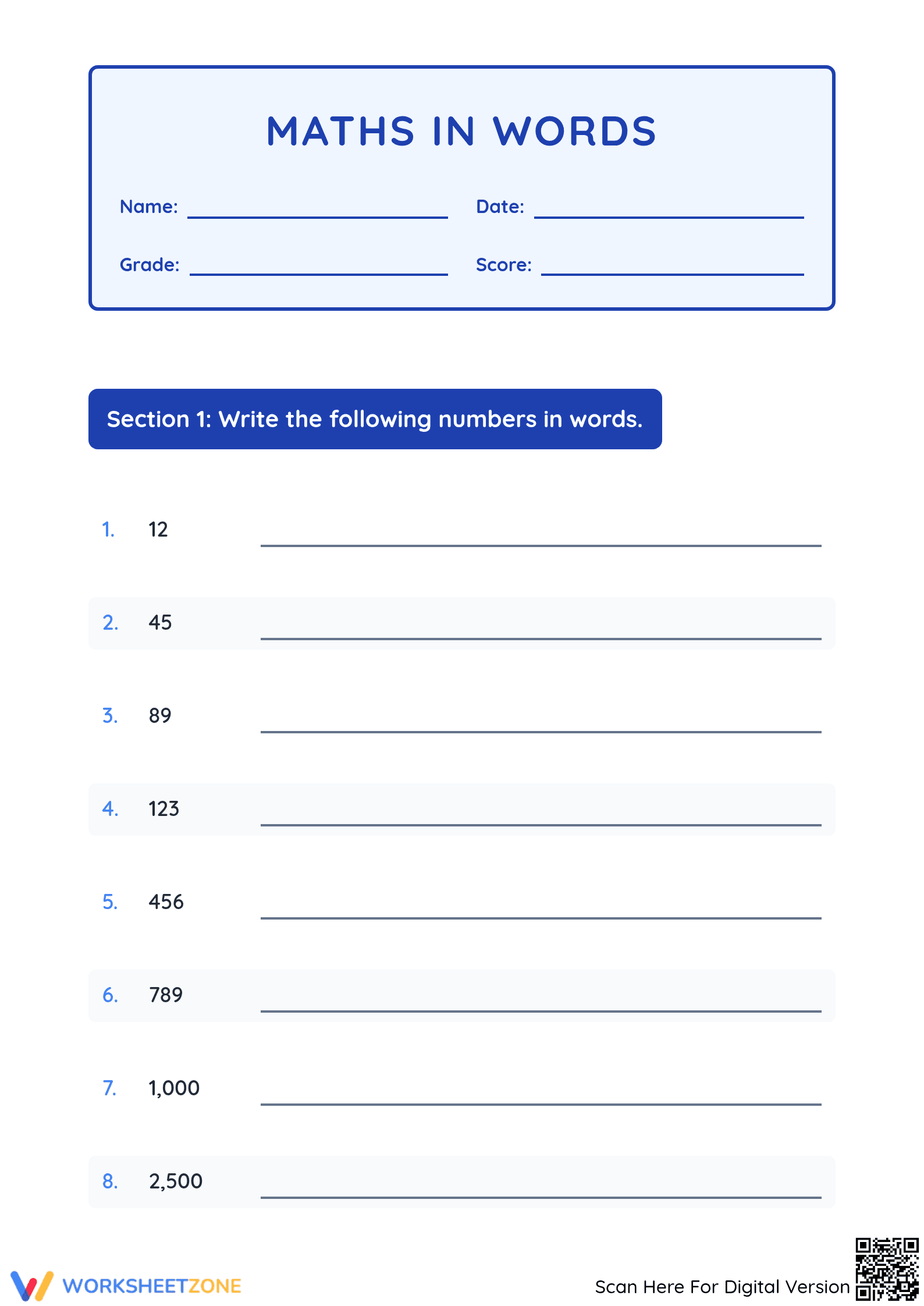
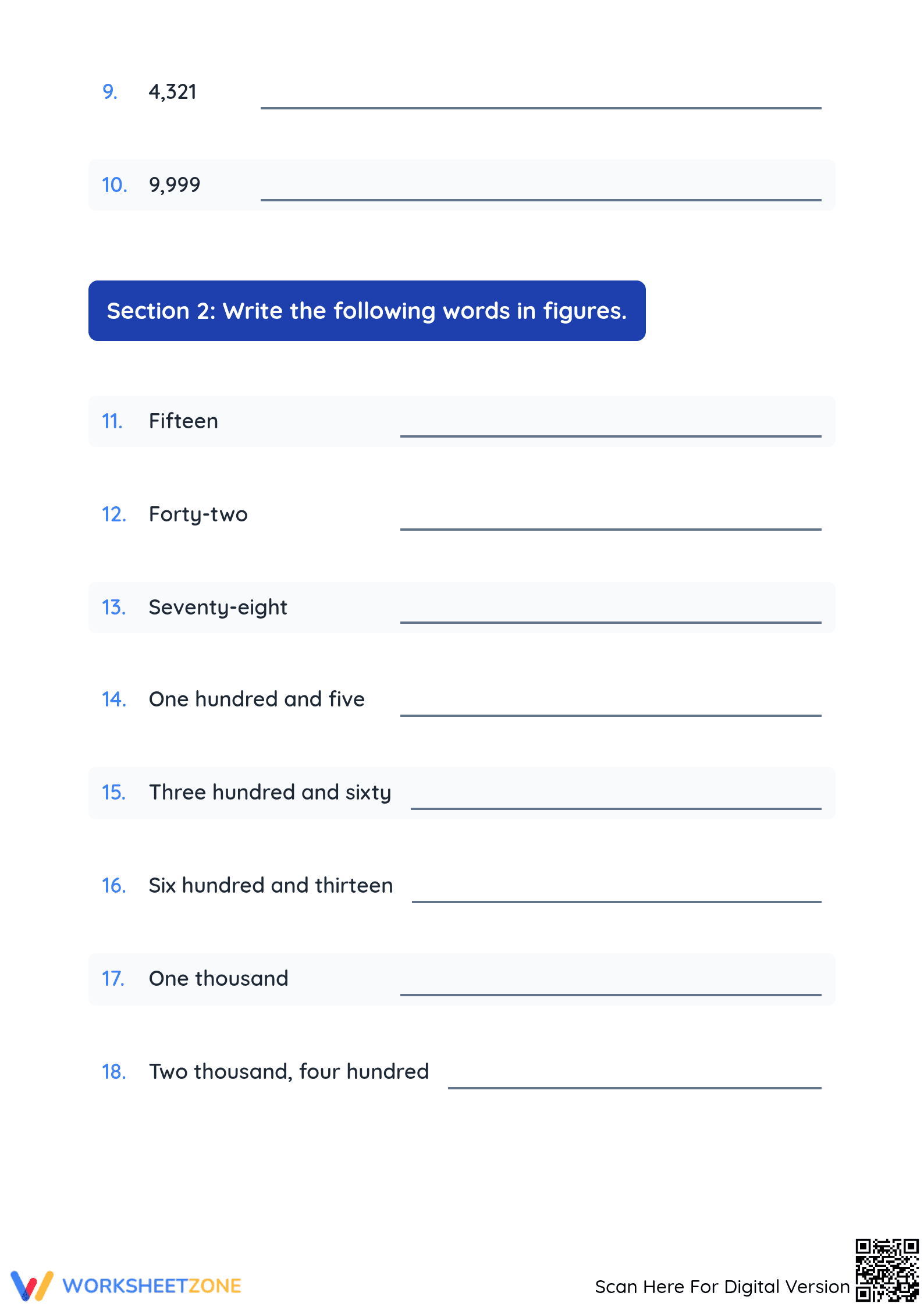
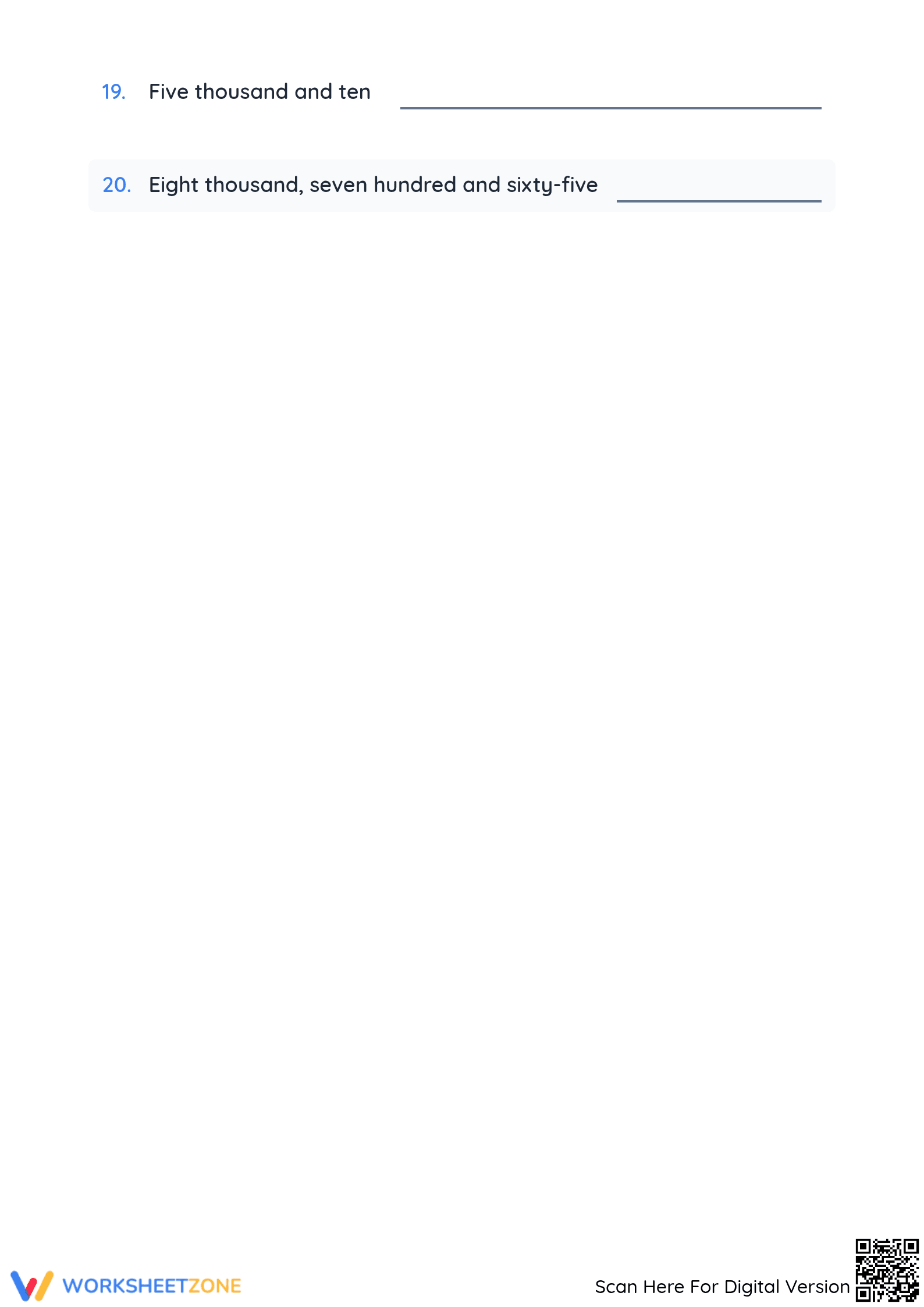
This three-page PDF provides a dual-approach to number literacy. Section 1 features ten problems where students translate numerals into their written word equivalents, ranging from simple two-digit integers to complex four-digit values. Section 2 reverses the cognitive demand with ten additional tasks requiring students to interpret written phrases and record the corresponding figures. A complete answer key is provided for immediate feedback and grading.
Skill Progression
- Guided practice begins with familiar two-digit numbers, allowing students to recall basic naming conventions and hyphenation rules.
- Supported practice introduces hundreds and thousands, requiring focus on the correct placement of zero as a placeholder.
- Independent practice concludes with complex four-digit numbers that test mastery of place value boundaries and linguistic translation.
This gradual-release approach ensures that students move from simple recall to the independent application of mathematical grammar rules.
Standards Alignment
Primary alignment is to CCSS.MATH.CONTENT.4.NBT.A.2: "Read and write multi-digit whole numbers using base-ten numerals, number names, and expanded form." This worksheet specifically targets the translation between numerals and names, which is a foundational requirement for comparing multi-digit numbers. Both standard codes can be copied directly into lesson plans, IEP goals, or district curriculum mapping tools.
How to Use It
Assign this worksheet as a quiet independent practice session following a direct instruction lesson on place value. Teachers should circulate during the first few problems to observe if students are correctly identifying the thousands place or mistakenly inserting "and" between whole number values. The expected completion time is approximately 20 minutes, making it an ideal exit ticket or homework assignment to gauge fluency.
Who It's For
This resource is designed for Grade 4 students mastering multi-digit notation but serves as an excellent intervention for Grade 5 learners or an enrichment activity for advanced Grade 3 students. It pairs naturally with place value anchor charts or short reading passages involving statistics to provide real-world context for numerical literacy.
The ability to translate between abstract numerals and linguistic number names is a critical component of mathematical literacy. According to EdReports 2024, high-quality materials that emphasize the connection between base-ten numerals and number names significantly improve student performance in multi-digit operations and algebraic thinking. This worksheet directly addresses the CCSS.MATH.CONTENT.4.NBT.A.2 standard by requiring students to demonstrate precise number notation. Research from the NAEP indicates that students mastering these foundational place value skills in early elementary grades are better prepared for the complexities of decimals and fractions in middle school. By providing structured practice that moves from recognition to production, this resource supports the cognitive shifts necessary for mathematical fluency. Educators can utilize these tasks to identify specific misconceptions in place value understanding before they impact more complex calculation tasks or higher-order word problems and quantitative reasoning.


