


























Views
Downloads

Printable Number Words Worksheet | Grade K Math
Paste this activity's link or code into your existing LMS (Google Classroom, Canvas, Teams, Schoology, Moodle, etc.).
Students can open and work on the activity right away, with no student login required.
You'll still be able to track student progress and results from your teacher account.
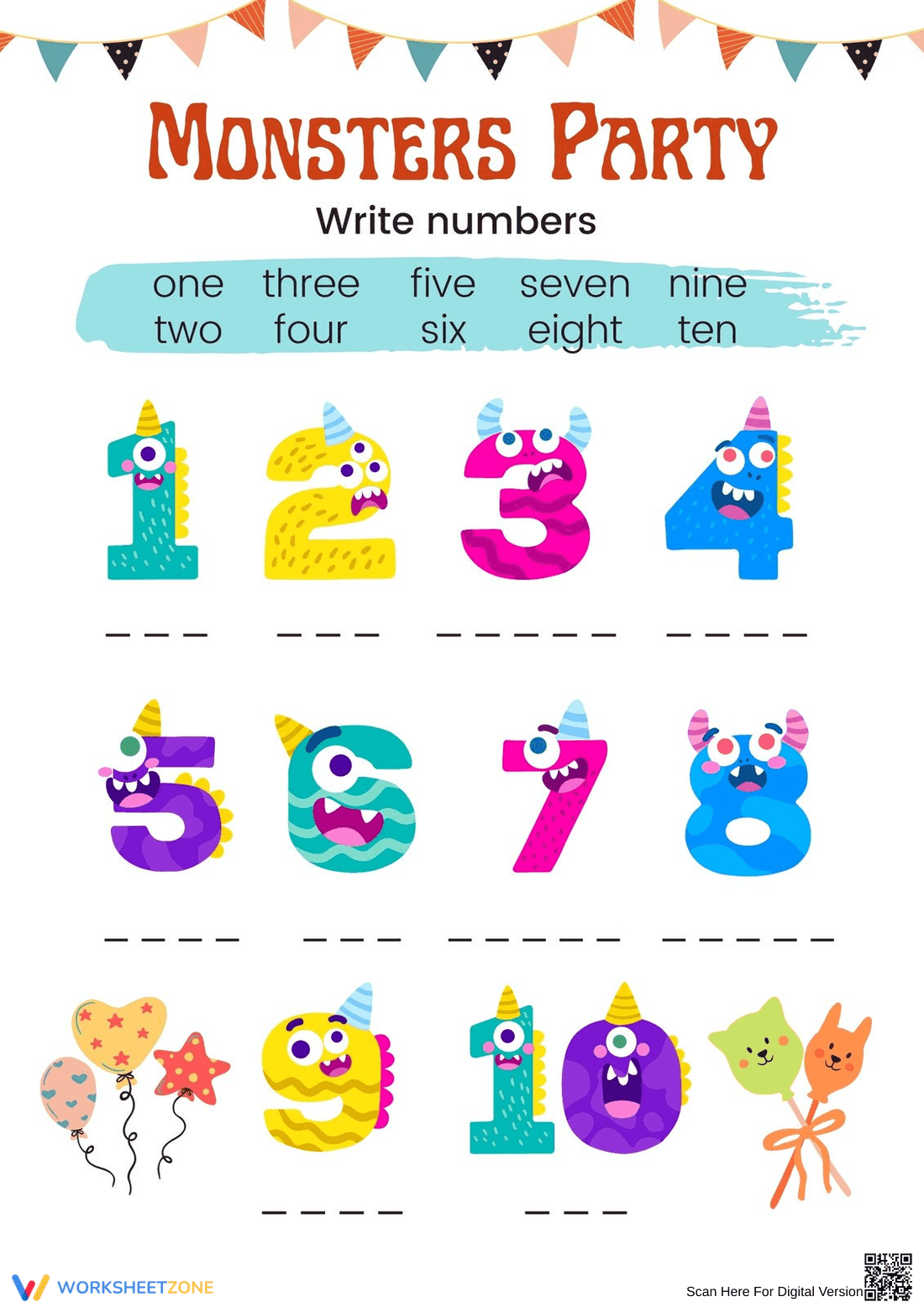
This engaging Kindergarten math worksheet helps students master spelling number words from one to ten. By matching the correct word from the provided word bank to the corresponding monster-themed digit, young learners build essential number recognition and early literacy skills simultaneously in a fun, approachable format.
At a Glance
- Grade: K · Subject: Math
- Standard:
CCSS.MATH.CONTENT.K.CC.A.3— Write numbers from 0 to 20- Skill Focus: Spelling number words 1-10
- Format: 1 page · 10 problems · PDF
- Best For: Independent practice or centers
- Time: 10–15 minutes
This single-page resource features ten distinct problems where students identify a colorful, monster-shaped numeral and write its corresponding English name. A clear, easy-to-read word bank is positioned at the top of the page, providing necessary scaffolding for early writers. The playful monster illustrations keep young students engaged while they practice their handwriting and spelling on the provided dashed lines beneath each character.
This resource offers a zero-prep workflow for busy educators.
- Print (1 minute): Simply download the PDF and print the required number of copies. The vibrant colors also print well in grayscale.
- Distribute (1 minute): Hand out the sheets during math centers or morning work. The clear instructions and word bank mean students can begin immediately.
- Review (3 minutes): Quickly check student work as a whole class or collect for easy grading.
Total teacher prep time is under two minutes. It is also highly suitable for emergency sub plans since it requires no prior teacher setup or complex explanations.
This activity aligns with CCSS.MATH.CONTENT.K.CC.A.3, requiring students to write numbers and represent quantities with written numerals. It also supports early literacy by reinforcing sight word recognition for number names. Both standard codes can be copied directly into lesson plans, IEP goals, or district curriculum mapping tools.
Teachers can utilize this worksheet during morning work to gently transition students into the school day with a familiar, structured task. Alternatively, it serves as an excellent independent math center activity after direct instruction on number words. As a formative assessment observation tip, watch how students use the word bank; note whether they cross out words as they use them, which indicates developing executive function and self-monitoring skills. Expected completion time ranges from 10 to 15 minutes.
This resource is primarily designed for Kindergarten students developing their foundational math and reading skills. The inclusion of a word bank provides built-in differentiation, offering necessary support for English Language Learners or students who struggle with spelling from memory. It pairs perfectly with a whole-class reading of a counting book or a direct instruction lesson using a number word anchor chart.
Mastering the ability to write numbers from 0 to 20 is a critical milestone in early childhood education, directly supported by CCSS.MATH.CONTENT.K.CC.A.3. When young learners practice spelling number words 1-10, they bridge the gap between quantitative reasoning and literacy. According to an EdReports 2024 analysis of foundational math curricula, integrating visual scaffolds like word banks and engaging thematic elements significantly increases task persistence among early elementary students. This worksheet leverages those exact strategies by combining playful monster imagery with structured handwriting practice. By requiring students to actively select and write the correct vocabulary word, the activity reinforces neural pathways associated with both symbol recognition and phonetic spelling. This dual-coding approach ensures that foundational math concepts are firmly established, preparing students for more complex arithmetic and word problems in subsequent grade levels.


