Kindergarten Teen Numbers PDF Worksheets
These kindergarten teen numbers pdf worksheets address what is arguably the most linguistically loaded moment in early math instruction: the point where students must stop treating eleven through nineteen as extended counting words and begin recognizing them as a complete ten plus a specific number of extras. The set includes double ten-frame completion tasks, number bond decomposition activities, numeral tracing practice, and equation writing — all tied directly to K.NBT.A.1. Teachers reach for them during morning warm-ups, small-group instruction, and independent center rotations.
Why English Makes These Numbers Hard to Teach
The names English assigns to eleven through nineteen actively undermine place-value reasoning, and this is worth stating plainly because it changes the instructional response. "Eleven" and "twelve" carry no auditory trace of ten whatsoever — a student cannot hear a tens relationship in those syllables. The "-teen" ending in thirteen through nineteen at least signals a connection to ten, but it arrives after the ones sound, which reverses the expected mathematical order. Students hear "four-teen," process four first and ten second, and write 41. This is not a careless mistake. It is a direct transcription of sounds in the sequence they arrive. Recognizing that reversal as a language-structure problem — not a number-sense failure — changes the correction: students need a visual model where ten always appears first, always fills the top or left position, and is always named before the extra ones.
What These Worksheets Ask Students to Do
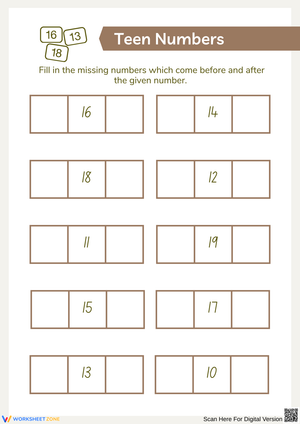
Kindergarten teen numbers pdf worksheets in this set cover five distinct activity types, each targeting a different representation of the same underlying concept — one complete ten plus a specific number of additional ones.
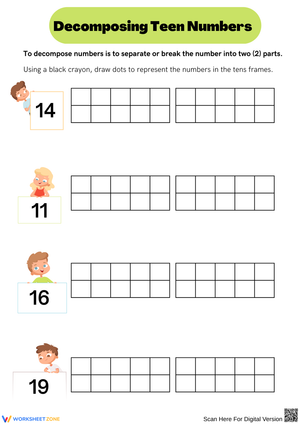
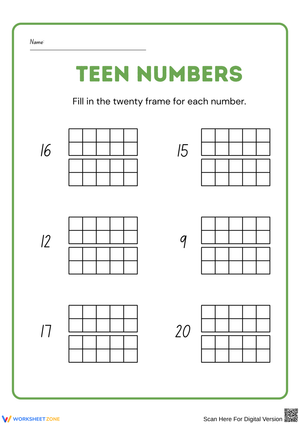
- Double ten-frame completion: students fill in dots to match a given numeral, with the top frame always representing a full ten and the bottom frame showing the remaining ones
- Number bond decomposition: given the whole, students write both parts — always ten and a single-digit number — making the consistent split point explicit
- Numeral tracing: each number appears with a decomposition equation printed beneath it; students trace the numeral and read the equation aloud before moving on
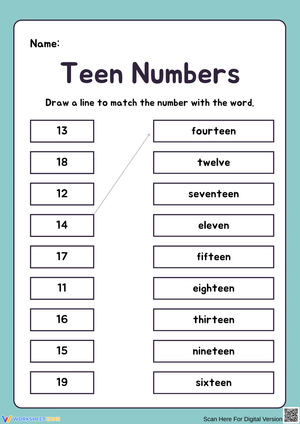
- Numeral-to-image matching: students draw lines connecting a written numeral to the correct ten-frame diagram and its word name
- Equation writing from ten-frames: given a completed double ten-frame drawing, students write the addition sentence (10 + 5 = 15) rather than counting the total dots
The set is ordered from heavily supported tasks — partially completed frames, pre-drawn dots — to more open-ended work that leaves frames blank and asks students to generate the equation without visual assistance. That progression gives teachers a natural path from guided group work to independent practice without restructuring anything.
Frequent Errors Worth Catching Before They Harden
The reversal error gets the most attention, but a second mistake appears just as consistently in actual student work and receives far less discussion. When students see a double ten-frame showing fourteen and write the matching equation, many produce 10 + 14 = 14 instead of 10 + 4 = 14. The ten-frame has done its job — students know the answer is fourteen — but they copy that whole numeral into the ones slot rather than reading the bottom frame separately. The ten-frame has become transparent to them; they see through it to the total rather than isolating the parts. A reliable correction: cover the printed numeral with a sticky note during equation-writing tasks so students must read from the frames alone.
A separate pattern surfaces during word-name activities. Students who correctly identify fifteen on a ten-frame will consistently write "fiveteen." Every other teen number starts with a sound close to its single-digit name — four-teen, six-teen, seven-teen — but fifteen breaks that pattern. When "fiveteen" shows up in student writing, that student is deriving the name by analogy, which is actually a sign of active mathematical reasoning. The fix is simply explicit instruction on the irregular form, not a return to decomposition work.
Standard Alignment
These resources align with K.NBT.A.1 from the Common Core State Standards for Mathematics, which requires students to compose and decompose numbers from eleven to nineteen into ten ones and some further ones, and to record each composition or decomposition through a drawing or equation. The placement in kindergarten is deliberate — this is not first-grade content pushed earlier. Students are not yet working with two-digit addition or formal place-value columns. The entire instructional target is one repeatable idea: any teen number is one complete group of ten plus a small count of ones. The equation format used across the set (10 + ___ = ___) mirrors the recording method the standard explicitly describes, so teachers can use completed work directly as formative evidence of mastery.
Planning Strategies for Getting the Most From These Worksheets
Kindergarten teen numbers pdf worksheets work best as a recurring short routine rather than a concentrated two-day unit. Returning to them in brief daily segments — five minutes of ten-frame fill-in before the main math block, a number bond task during small-group time later in the week — distributes practice across several weeks and builds retention far more durably than massed review in a single push.
Small-group instruction is the right moment for equation-writing activities because the 10 + 14 error needs to be caught as it happens, not discovered after a stack of completed work comes back already wrong. Number bond tasks belong here too, with the teacher present to ask "what part is the ten?" before students default to writing the whole number in both slots.
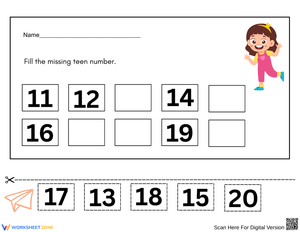
Cut-and-paste matching tasks work well at an independent center and carry a low-prep extension: once a student finishes, the cut pieces can be flipped and used as flash cards with a partner. For take-home practice, ten-frame fill-in activities communicate most clearly to families — the task is visually self-evident in a way that number bond diagrams are not for parents unfamiliar with that format. One addition worth building in regardless of setting: during numeral tracing, ask students to read the printed decomposition equation aloud before lifting the pencil. A student tracing 16 says "ten and six make sixteen." Without that spoken step, tracing risks becoming pure shape-copying — a student develops fluent digit formation while retaining no understanding of the quantity the numeral represents.
Adjusting the Set for Different Starting Points
For students still uncertain about quantities up to ten, limit early work to eleven, twelve, and thirteen only. These students need a firm sense that a full ten-frame means exactly ten — not "a lot" or "full" — before a second frame carries any meaning. Moving to higher teen numbers before that anchor is secure produces students who complete the visual correctly but cannot say what the top frame represents.
Students who move through basic decomposition tasks quickly benefit from working in reverse: given 10 + 8 = ___, they write the numeral and then draw the ten-frame that matches it. Constructing a ten-frame from a written equation is harder than reading a ten-frame to write an equation, and it checks whether understanding holds in both directions.
Kindergarten teen numbers pdf worksheets in this set include blank ten-frames alongside pre-dotted versions, giving teachers a direct way to adjust demand within the same activity format. A student who needs more support uses the pre-dotted worksheet; a student working above grade expectation uses the blank version and generates the equation independently. Both practice the same mathematical concept — the level of visual support is what shifts, not the goal.
Frequently Asked Questions
Why do students so consistently reverse teen numerals when they write them?
English teen number names place the ones sound before the ten marker — "four-teen" rather than "ten-four." Students transcribe sounds in the order they hear them, so writing 41 for fourteen is not random. It is the logical output of the naming system. Consistent use of a left- or top-anchored ten-frame — where the full ten always appears first — builds a visual habit that corrects the auditory one over time.
Should students use physical objects alongside each worksheet?
Yes, particularly early in the unit. Base-ten blocks or towers of ten linking cubes give students a physical referent before the printed ten-frame carries independent meaning. The transition from objects to a drawn ten-frame is itself a meaningful conceptual step. Moving past it too quickly produces students who complete each worksheet correctly but cannot explain what the dots represent.
Which activity type should I introduce first?
Start with double ten-frame completion before introducing number bonds or equation writing. The ten-frame establishes the visual anchor — a complete top row, a partial bottom row — that every other format in the set depends on. If students do not have that picture firmly in mind, number bond and equation tasks become abstract symbol work with nothing concrete behind them.
How long should the class spend on teen numbers before moving on?
Research on early number sense consistently points toward distributed practice over several weeks rather than a concentrated unit. A brief daily encounter with decomposition — five minutes at morning meeting, a quick partner check at transitions — builds retention more reliably than two full math lessons scheduled close together. Plan to cycle back to these activities across four to six weeks rather than closing the chapter after the set is finished once.
Clear All