


























Views
Downloads
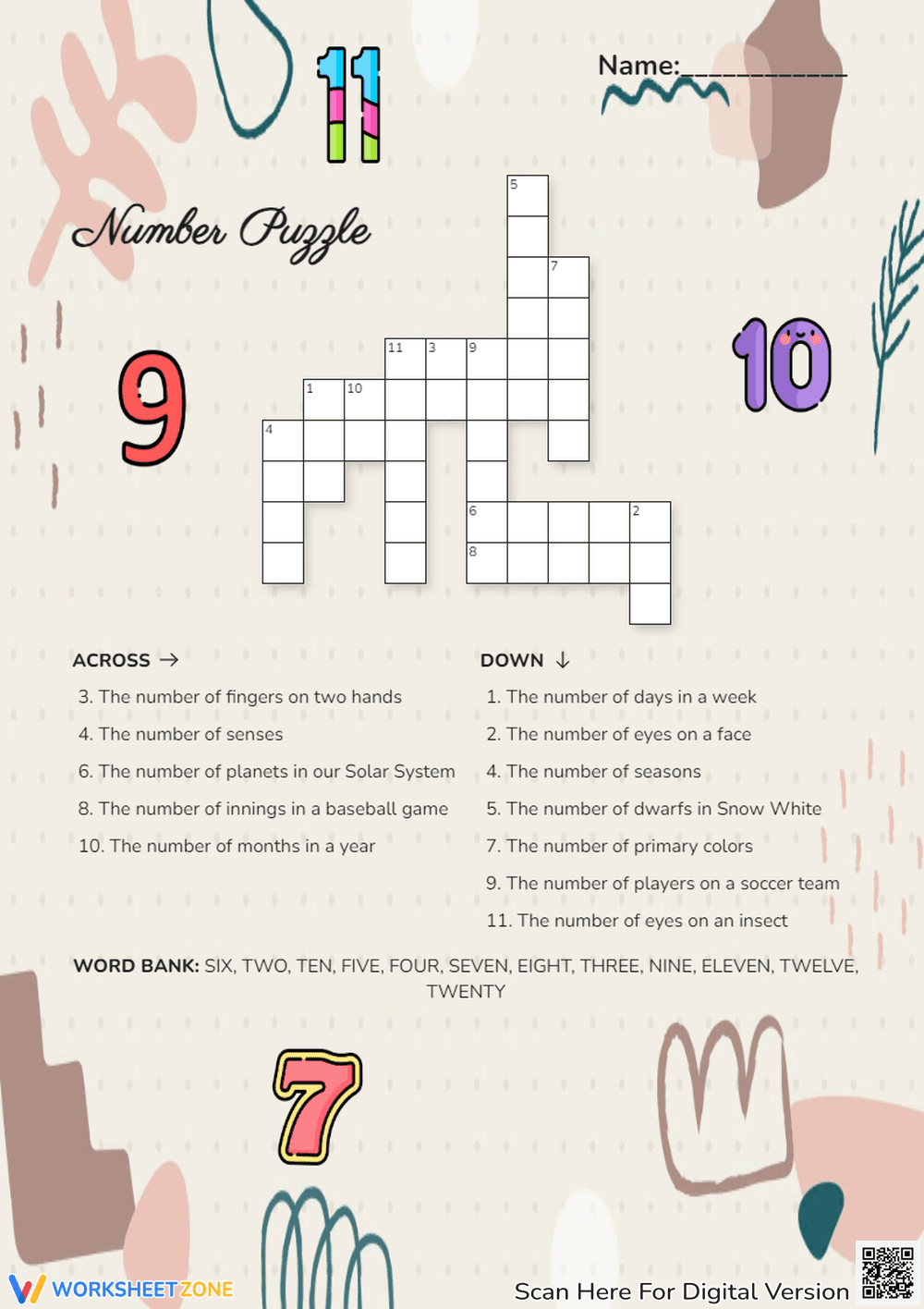

Printable Number Crossword Puzzle for Grades 1-2
Paste this activity's link or code into your existing LMS (Google Classroom, Canvas, Teams, Schoology, Moodle, etc.).
Students can open and work on the activity right away, with no student login required.
You'll still be able to track student progress and results from your teacher account.
This printable number crossword puzzle helps early elementary students master number word recognition and basic counting concepts. By matching real-world clues to written number words from one to twenty, children build essential math vocabulary and spelling skills. This engaging activity turns standard number practice into an interactive puzzle game.
At a Glance
- Grade: 1–2 · Subject: Math
- Standard:
CCSS.MATH.CONTENT.1.NBT.A.1— Read and write numerals and represent a number of objects with a written numeral- Skill Focus: Number word spelling and counting associations
- Format: 1 page · 10 problems · Answer key included · PDF
- Best For: Independent math centers and morning work
- Time: 15–20 minutes
What's Inside
This single-page worksheet features a clean, colorful crossword grid. Below the grid, students find ten clues split evenly between across and down directions, prompting them to identify numbers based on common knowledge, such as the number of fingers on two hands. A helpful word bank containing twelve number words is positioned at the bottom to scaffold spelling and support independent completion.
Zero-Prep Workflow
- Print: Print the single-page PDF for your class, taking less than one minute.
- Distribute: Hand out the sheets to students as they arrive, requiring only thirty seconds of transition time.
- Review: Go over the answers as a whole group using the included answer key, taking about five minutes.
The entire setup takes under two minutes, making it ideal for emergency sub plans.
Standards Alignment
This activity aligns directly with the Common Core State Standard CCSS.MATH.CONTENT.1.NBT.A.1, which requires students to read and write numerals. It also supports CCSS.MATH.CONTENT.2.NBT.A.3 by helping students read and write numbers to 100 using base-ten numerals, number names, and expanded form. Both standard codes can be copied directly into lesson plans, IEP goals, or district curriculum mapping tools.
How to Use It
Use this worksheet during the independent practice portion of a lesson on number words, or as a post-instruction formative assessment to check spelling accuracy. Teachers can observe students during completion to note who relies heavily on the word bank versus who can spell the number words independently. The activity takes fifteen to twenty minutes to complete.
Who It's For
This puzzle is designed for first and second-grade students learning to connect quantities to written words. It serves as an excellent remedial tool for third graders needing spelling support or as an enrichment activity for kindergarteners. Pair this worksheet with a physical counting manipulative or a number line anchor chart to support visual learners.
This educational resource targets CCSS.MATH.CONTENT.1.NBT.A.1 by integrating number word recognition with contextual clues. According to research from Fisher & Frey (2014) on the gradual release of responsibility, structured scaffolds like word banks allow young learners to successfully bridge the gap between conceptual counting and formal mathematical orthography. By solving ten distinct clues, students practice retrieving numerical vocabulary from memory, reinforcing the cognitive pathways necessary for fluent mathematical literacy. The puzzle format increases student engagement and task persistence compared to traditional rote worksheets. Educators can confidently integrate this tool into early childhood math curricula to support vocabulary acquisition and spelling precision. This self-contained activity provides measurable data on a student's ability to translate real-world quantities into written English number words, serving as a reliable formative assessment tool.


