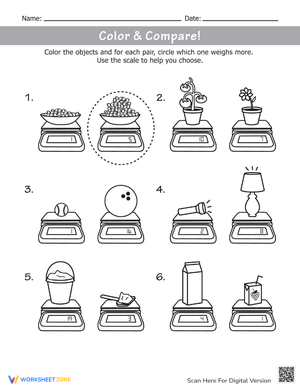
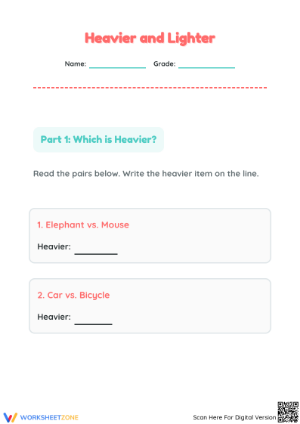
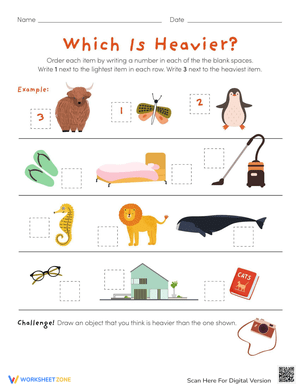
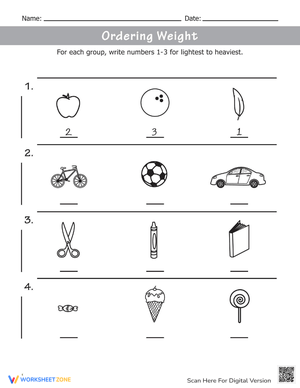
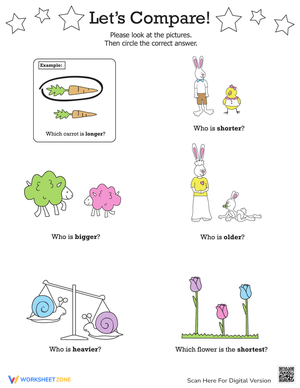
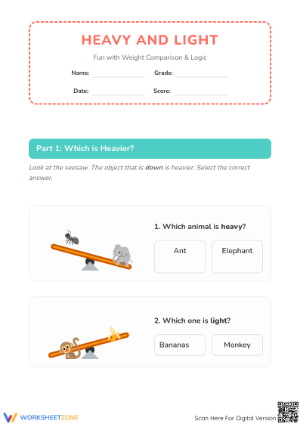
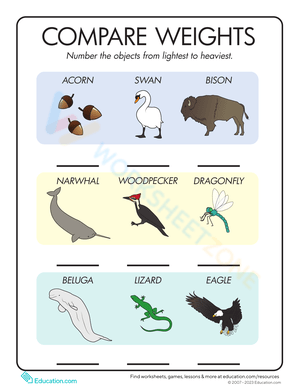
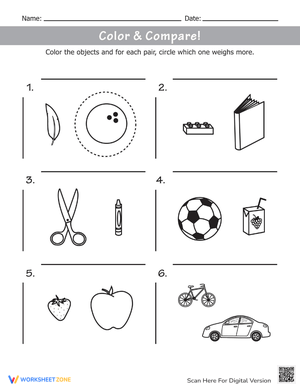
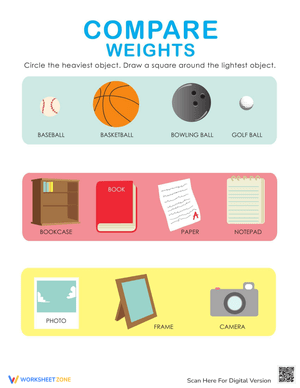
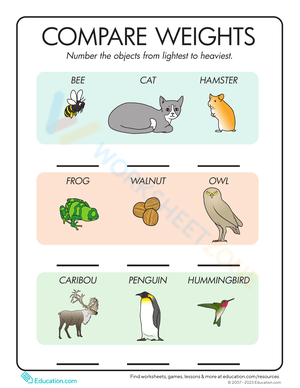
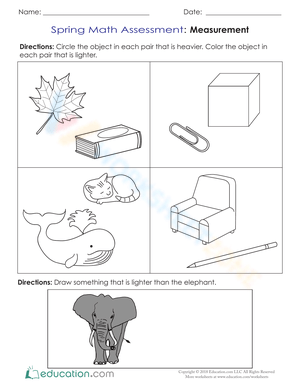
These comparing weight printable worksheets for kindergarten give teachers focused, print-ready activities that move students from holding objects in their hands to interpreting weight comparisons on paper. Each worksheet stays narrow in scope — one skill, familiar images, clear comparison language — so kindergarteners build real footing before the work gets more demanding.
What Each Worksheet Targets
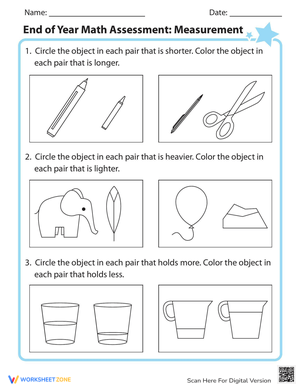
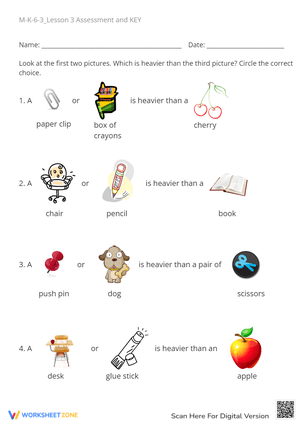
The set covers three distinct layers of weight comparison. The first is the binary heavy/light judgment: looking at two pictured objects and marking which is heavier or coloring the lighter one. These activities use familiar everyday items — a feather and a stapler, a balloon and a brick — so children spend their working memory on the comparison itself rather than decoding unfamiliar images.
The second layer introduces heavier than and lighter than as language tools. Students draw lines from objects to comparison labels or fill in sentence frames: "The _____ is heavier than the _____." This language practice matters because the vocabulary is the thinking — children who can name the relationship are much closer to explaining it.
The third layer uses balance-scale illustrations. One side tips lower; students identify which side holds the heavier object, then circle or label it. Reading a balance scale is a genuinely distinct skill from simply knowing that rocks are heavier than feathers. A child can hold that background knowledge and still misread the image if the visual convention hasn't been taught directly.
Mistakes Students Make That These Worksheets Help You Catch
The most persistent misconception in early weight work is the size-equals-weight error. When a worksheet shows a large pillow next to a small iron, a significant portion of kindergarteners will mark the pillow as heavier — not because they don't understand weight, but because visual size is the dominant cue their eyes give them. This error is worth addressing before any worksheet goes out: hold up a small rock and a large piece of foam and let students feel both. That ten-second moment does more to disrupt the assumption than a correction written in pencil ever will.
A second error appears specifically on balance-scale worksheets. Some children believe the higher side of the scale holds the heavier object — possibly because they associate "up" with effort or because they've watched adults lift heavy things overhead. When you model scale reading aloud and say "this side sinks down, so it's carrying more weight," you're building the visual schema the whole unit depends on, not just explaining a single problem.
Fitting These Worksheets Into Your Measurement Unit
The most effective sequence is concrete first, paper second — and the shorter the gap between them, the better. Set up a small center with four or five object pairs and a pan balance. Students compare each pair physically, then walk directly to a nearby table and complete a matching worksheet while the sensory memory is still fresh. Waiting until the afternoon to hand out worksheets from a morning center activity costs real transfer.
Exit slips drawn from the comparing weight printable worksheets for kindergarten set work particularly well for pacing decisions. A half-sheet showing one balance scale takes students about two minutes to complete at the end of a lesson. The data — who circled the heavier side correctly, who wrote a comparison sentence, who left it blank — tells you exactly where tomorrow's lesson needs to land, without any additional assessment tool.
For whole-group introduction, project a balance-scale worksheet on your document camera and think aloud through the first two problems before students work independently. The specific language you use during that think-aloud — "this side is lower, so this object is heavier" — becomes the pattern students reach for when they're on their own.
Standard Alignment
These worksheets align to K.MD.A.2 from the Common Core State Standards for Mathematics, which asks kindergarteners to directly compare two objects that share a measurable attribute and describe the difference using appropriate language. Weight comparison sits early in the Measurement and Data strand because it relies on physical intuition rather than tools or standard units — kindergarteners can make valid comparisons by holding objects long before they understand what a gram is. Mastery here prepares students for the ordering and indirect comparison work that appears in first grade math.
Adapting the Set Across Different Readiness Levels
Students who are still building the basic concept benefit from worksheets that present only two objects per problem, print comparison words in bold near each image, and draw from a very familiar object set — things every child in the room has actually touched, like a shoe, a pencil, or a book. Reducing visual clutter and keeping vocabulary prominent lets these students focus on the comparison rather than the reading demands of the worksheet itself.
For students who have the heavy/light distinction solidly and are ready for more, offer worksheets with three objects to rank from lightest to heaviest, or balance-scale problems where one pan is empty and students choose from a picture bank to make the scale balance. Both formats ask children to hold multiple weights in working memory at once, which is a meaningfully harder cognitive task than a two-object comparison.
The comparing weight printable worksheets for kindergarten set fits naturally into differentiated stations. Assign binary-comparison worksheets to students who need more time with the concept and ranking or scale-balancing worksheets to those ready for more. Both groups can work at the same center simultaneously without either one waiting.
Frequently Asked Questions
How do I introduce balance-scale worksheets to students who have never seen a real scale?
Bring in a physical balance — even a simple hanger-and-cups version — and let students load each side and watch what happens. Do this before introducing any comparing weight printable worksheets for kindergarten that use scale illustrations. Once students have seen the tray tip and felt what caused it, the printed image makes sense as a picture of something real rather than an abstract symbol. Two or three minutes of hands-on time removes the guesswork that slows students down when they encounter scale problems independently.
What should students who finish quickly do while the rest of the class is still working?
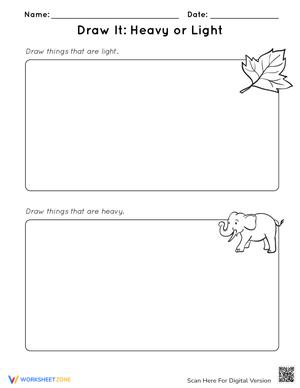
Each worksheet extends naturally into a brief independent task. Ask early finishers to flip the sheet over and draw two objects of their own choosing, circle the heavier one, and write a sentence explaining why they think so. This keeps them working with the same concept rather than drifting into unrelated activity, and it gives you an additional informal assessment piece to review — one that shows reasoning, not just a circled answer.
Are these worksheets accessible for students who are behind in fine-motor development?
The circle-and-color format puts the lowest fine-motor demand on students — they're marking a response, not forming letters. Cut-and-paste sorting activities ask a bit more coordination but still fall within the range most kindergarteners manage. If a particular child finds cutting genuinely difficult, pre-cut the picture cards before the lesson so all the cognitive effort goes toward weight comparison rather than scissor technique.













 Interactive Worksheet Maker
 Quiz Maker
 Word Search Maker
 Crossword Puzzle Maker
 Word Scramble Generator
 Sentence Scramble Generator
 Handwriting Worksheet Generator
 Name Tracing Generator
 Fill In The Blank Generator