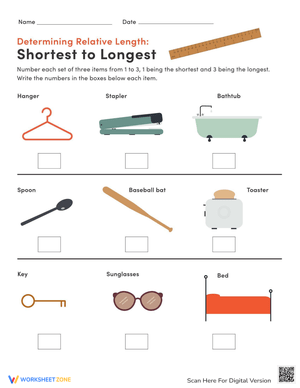
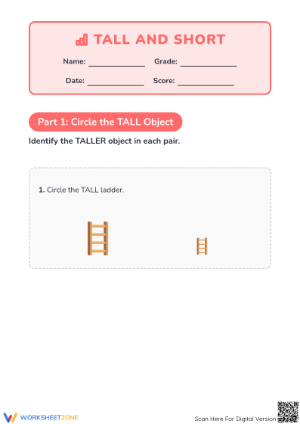
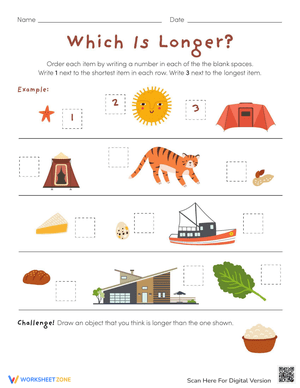
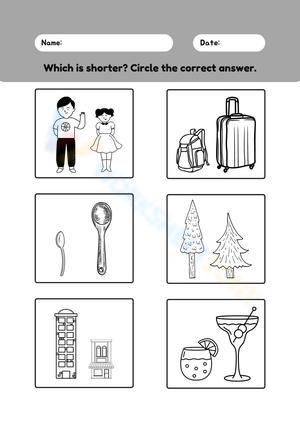
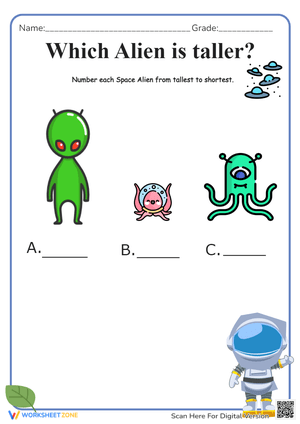
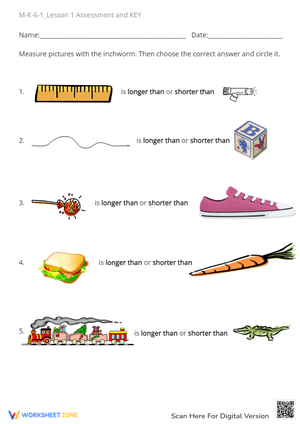
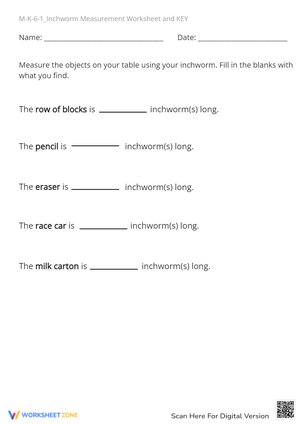
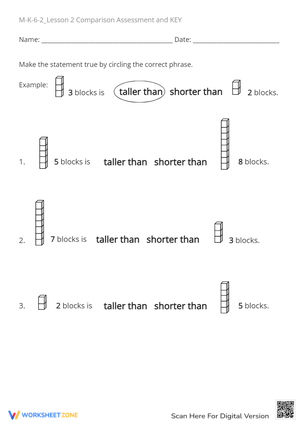
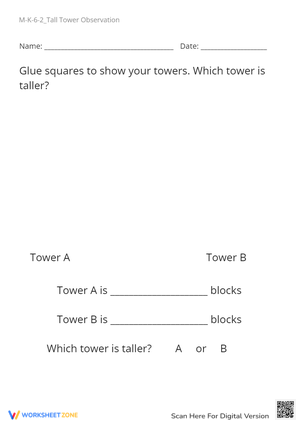
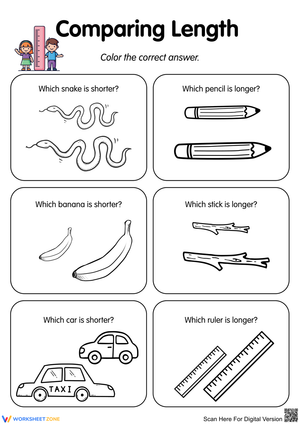
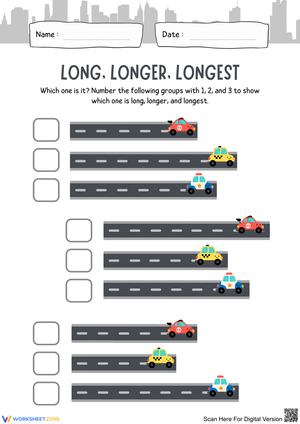
These kindergarten comparing length printable worksheets give teachers a set of visual, low-prep resources that fit directly into the measurement unit — not as a first introduction to length, but as the practice that follows hands-on exploration. Students circle the longer object, shade the shorter one, cut and sort picture cards, or arrange three items from shortest to longest. Taken together, the tasks are concrete enough for five-year-olds and structured enough to show quickly what each child actually understands.
The Specific Skills These Worksheets Build
Length comparison in kindergarten sits at the very start of the measurement progression. Children at this stage are learning to attend to one attribute at a time — which sounds simple but is genuinely difficult when a crayon and a ruler both have length, color, familiar markings, and other features competing for a child's attention. These worksheets keep the focus narrow.
- Direct pair comparison: Students look at two objects side by side and mark which is longer or shorter.
- Same-length identification: Students pick out pairs that match in length and distinguish them from pairs that differ.
- Three-object ordering: Students arrange a small group from shortest to longest or longest to shortest — a task requiring two comparisons held in mind simultaneously.
- Measurement vocabulary: Consistent use of longer, shorter, taller, and same length across tasks builds the language students need to explain their thinking, not just mark an answer.
The kindergarten comparing length printable worksheets in this set rotate formats deliberately — a coloring task followed by a cut-and-paste sort followed by a marking worksheet — so students get repeated contact with the same concept without the repetition feeling mechanical.
Frequent Student Errors Worth Catching Before They Harden
The most common error in this unit is structural, not careless. When two objects are drawn with their left ends aligned, most kindergartners read the comparison correctly. Move one object down by half an inch and a significant portion of the class picks the wrong answer. They are reading endpoint position — which object ends farther to the right — rather than comparing actual lengths. A student who correctly identifies the longer worm when both images start at the same edge will miss the same comparison when one object starts lower on the page. This error is worth demonstrating explicitly before students work independently.
The second error is subtler: students equate "bigger" with "longer." A wide, chunky block placed next to a thin, long strip will lead some children to mark the block as longer because it occupies more visual space overall. This is a conceptual confusion, not a reading problem. Those students have not yet separated length as a single attribute from the general sense of bigness. Saying directly during modeling — "I'm not asking which one looks bigger. I'm asking which one is longer, from one end to the other" — catches this before it appears across every item on the worksheet.
How to Build These Worksheets Into Your Measurement Lessons
When planning a measurement unit, kindergarten comparing length printable worksheets work best after at least two or three hands-on comparison lessons rather than leading the sequence. The physical work is not optional warmup — it is instruction. Give students two real objects, ask which is longer, then ask them to show how they know. That second question forces the endpoint-alignment habit before children encounter a printed image. Once they have physically pushed two crayons side by side and named which is longer, they bring that experience to the worksheet rather than discovering the concept from scratch on paper.
For centers, direct-comparison worksheets with clean visuals and brief directions hold up well. Students working without a teacher need to get started without decoding complex instructions — anything slowing the startup pulls attention from the math. Cut-and-paste sorting and three-object ordering tasks are better suited to small-group instruction, where errors can be caught and named in the moment. Morning work is a natural home for simple pair-comparison tasks in the first two weeks of the unit, especially while students are still building the vocabulary alongside the concept.
One practical move worth building in: before independent work, project the first comparison on the worksheet and ask two students to explain their reasoning aloud. That 60-second exchange surfaces the endpoint-alignment habit before anyone rushes and guesses. It costs almost no time and noticeably improves the quality of independent work that follows.
Adjusting These Worksheets for Different Readiness Levels
Students still developing fine motor control do better with worksheets that require only circling or coloring rather than cutting. Save the cut-and-paste sorting tasks for students who can handle scissors without the physical effort displacing the measurement thinking — when scissors are a real struggle, the conceptual work gets crowded out entirely.
For students who need vocabulary support, keep a small word card at their workspace showing longer, shorter, and same length beside a quick picture example of each. This is not about reading ability — it is a reference point so students can self-check that they are marking the intended term as they work. For students ready to move ahead, the three-object ordering tasks provide a meaningful next step. Ordering by length asks students to make two comparisons and reconcile them, which is considerably harder than a single longer/shorter judgment.
These kindergarten comparing length printable worksheets also support paired work when a student benefits from talking through the task. Two students pointing to the endpoints together and saying "this one is longer because it goes farther this way" mirrors whole-group modeling and keeps the focus on measurement reasoning rather than just completing the marks.
Standard Alignment
CCSS.MATH.CONTENT.K.MD.A.2 requires kindergarteners to directly compare two objects with a measurable attribute in common and describe the difference. This is the core standard these resources address. The language piece matters: a student who marks the longer object but cannot say why has met part of the standard, not all of it. Using each worksheet as a brief discussion prompt before and after independent completion moves instruction closer to full alignment with the standard's intent.
CCSS.MATH.CONTENT.K.MD.A.1 — describing measurable attributes of objects — underlies the vocabulary work throughout the set. The terms longer, shorter, taller, and same length are precisely the attribute language this standard asks kindergarteners to use and recognize. These two standards are typically introduced together in the measurement unit because vocabulary and comparison skill are inseparable at this age.
Frequently Asked Questions
When in the measurement unit should I introduce these worksheets?
After at least two whole-group or small-group lessons involving real objects. Students who move to picture-based comparison without physical handling first tend to rely on visual guessing rather than applying the concept. Use real crayons, paper strips, and linking chains first — then the worksheet becomes practice rather than introduction.
What if students keep confusing length with height?
"Taller" applies to vertical comparisons; "longer" typically applies to horizontal ones, but many kindergartners use the terms interchangeably. Keep early worksheets consistent — all horizontal pairs or all vertical pairs — until students show confidence in each orientation before mixing them. When the confusion surfaces, name it directly: "When something is lying flat, we ask which is longer, not which is taller."
Can these worksheets serve as formative assessment?
Yes. A worksheet with four to six comparisons used as an exit task, with no teacher support during completion, gives clear information about which students are applying the endpoint-alignment habit and which are still guessing by overall appearance. Look specifically at whether errors cluster around pairs where the objects are not aligned at their left edges. That pattern points directly to the conceptual gap that needs reteaching.
How do I adapt these for English language learners?
Prioritize worksheets using visual response formats — circling, coloring, drawing a connecting line — over those requiring written labels. Pair each worksheet with a picture-based vocabulary reference showing each key term beside a clear visual example. The measurement concept does not require English fluency; the goal is to ensure the language load on the worksheet does not block access to the math task itself.













 Interactive Worksheet Maker
 Quiz Maker
 Word Search Maker
 Crossword Puzzle Maker
 Word Scramble Generator
 Sentence Scramble Generator
 Handwriting Worksheet Generator
 Name Tracing Generator
 Fill In The Blank Generator