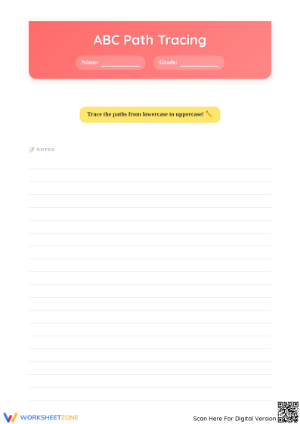
These fine motor skills pencil control worksheets for kindergarten give teachers a set of tracing resources built around the exact stroke types children need to develop before formal letter writing begins. Each worksheet targets one movement category — vertical lines, curves, diagonals, loops — so teachers can match the resource to where a student actually is, rather than where the school calendar assumes they should be. The set fits naturally into morning arrival routines, fine motor centers, and occupational therapy support sessions.
What's Inside the Set
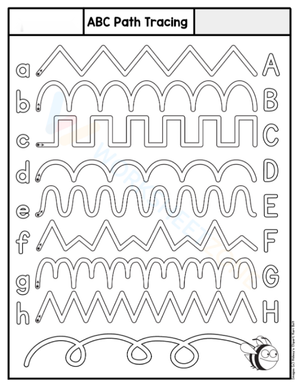
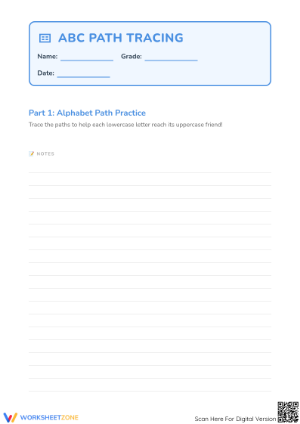
The tracing paths move through a deliberate sequence: straight vertical lines first, then horizontal strokes, then diagonal zig-zags, then arcs and curves, then spirals and loops. That order matters because the hand muscles required for a diagonal stroke differ from those used on a tight circular path, and moving a student to curves before they can hold a clean straight line typically produces overlapping, tangled attempts — the kind that frustrate the child and obscure what the teacher actually needs to see about their motor control.
Each worksheet pairs its tracing path with a simple visual theme: a frog jumping to a lily pad, a pencil winding through a maze, a snail following the curve of its shell. The theme gives children a reason to finish the line rather than lifting the pencil midway. That sustained contact with the paper is what builds the muscle memory writing requires. Decorative context aside, the real work is in completing the stroke.
- Vertical and horizontal lines — the foundational strokes that appear in the majority of printed letters
- Diagonal lines and zig-zags — train wrist rotation and change-of-direction control
- Arcs and gentle curves — develop the smooth, continuous movement needed for letters like c, u, and n
- Loops and spirals — work the intrinsic hand muscles that control fine, sustained pencil movement
- Combination paths — require students to shift between stroke types mid-line, which mirrors the actual demands of letter formation
Frequent Student Errors Worth Watching For
The most revealing error in pencil control work is not the wobbly line itself — it's where on the path the wobble appears. Students who press too hard tend to veer off on curves but manage straight lines reasonably well; the extra pressure they apply when turning is what breaks their control. Students with a fisted grip show the opposite pattern: they navigate curves by rotating the entire arm, but diagonal lines come out short and choppy because the arm pivot can't sustain the full stroke length. Watching which path type causes trouble tells you more about a child's grip and hand development than any checklist.
A second pattern that surfaces consistently: many kindergarteners lift the pencil the moment a line becomes difficult and restart from a new position. That lift-and-restart habit reads as carefulness but prevents the hand from learning continuous movement. Completing a curve in one uninterrupted stroke is the skill — accuracy comes later. Praising students specifically for keeping the pencil on the paper, regardless of how close they stay to the line, redirects effort toward the right goal at the right developmental moment.
Fitting These Worksheets Into Daily Instruction
Most teachers who use fine motor skills pencil control worksheets for kindergarten place them at the start of the day, during the five to eight minutes when students are arriving and settling. The task is quiet, self-directed, and requires no teacher explanation once the routine is established — no instructional time lost. That consistency across weeks is what actually produces change in hand strength and stroke control. A single session doesn't move the needle; accumulated daily practice does.
Fine motor centers are the other high-yield placement. Slip a printed worksheet into a dry-erase sleeve and students can trace the same paths with washable markers throughout the week without reprinting. Ask students to trace the path three times in three different marker colors — they do it without complaint, and that triple repetition is what moves a movement pattern from effortful attention to automatic execution. When you pull a small group during center time, these worksheets give you something concrete to observe up close: grip, wrist position, paper stabilization with the non-writing hand. Those details are much harder to catch from across the room.
How Grip and Posture Interact With Pencil Control
The tracing format surfaces grip patterns that free drawing often masks. A child can appear to hold the pencil correctly for the first few strokes, then revert to a fisted grip as fatigue sets in. Because these worksheets require a complete path rather than a brief mark, they hold the hand in working position long enough for a teacher to observe what actually happens under sustained effort — not just what the grip looks like when the child knows they're being watched.
Posture compounds the problem when it's wrong. Students who slouch or prop on one elbow lose core and shoulder stability, which forces the small muscles of the hand to compensate for instability higher up the arm. A seated position with feet flat on the floor, both forearms resting on the desk, and the non-writing hand holding the worksheet steady gives the fingers the stable base they need to move precisely. A brief, consistent reminder at the start of each session builds the postural habit alongside the motor skill.
Adjusting the Set for Mixed-Ability Classrooms
Students who are still building basic grip strength work better with a shorter pencil — roughly the length of a golf pencil — because the reduced length prevents an overly high grip that drives whole-arm movement. Pair those students with the straight-line worksheets first, and ask them to trace with a deliberate pause at the midpoint of each path before continuing. That pause interrupts the arm movement and gives the fingers a moment to take over.
Students who race through every worksheet without attending to line quality respond to a tighter constraint: switch them to a fine-tip marker in the dry-erase sleeve, where any deviation from the path is immediately visible. At the other end, students who freeze when they see a long curving path benefit from finger-tracing the route before picking up any writing tool. Removing the mark takes away the anxiety about making an error and lets them focus on learning the movement itself. When fine motor skills pencil control worksheets for kindergarten appear on a student's IEP support plan, these classroom adjustments typically align directly with what the occupational therapist is already recommending, which simplifies the conversation between classroom instruction and pull-out sessions considerably.
Standard Alignment
CCSS.ELA-LITERACY.L.K.1 asks kindergarteners to print many upper- and lowercase letters — but that standard assumes students already have the physical control to form those letters. It's a prerequisite the standard doesn't explicitly address. This set targets that gap directly. Teachers in programs using the Head Start Early Learning Outcomes Framework will find these worksheets connect to the motor development indicators for ages 3–5, specifically the expectation that children use a functional grip and control writing tools with increasing precision. For districts without explicit handwriting benchmarks, the skills practiced here link to any K framework that addresses written language production or print concepts.
Frequently Asked Questions
Can these worksheets be used by an occupational therapist in pull-out sessions?
Yes. The clear tracing paths and uncluttered format work well in OT pull-out appointments. Therapists often laminate each worksheet and use it for repeated trials in a single session, noting how line quality changes across attempts. The themed paths reduce resistance from students who find formal writing tasks stressful — enough visual interest to maintain engagement without introducing cognitive demands that compete with the motor work.
How do I know when a student is ready to move from straight lines to curves?
A student is ready to move on when they can complete a full straight-line path in one uninterrupted stroke with consistent, deliberate pressure — not perfect accuracy, but genuine control. If they're still drifting significantly off path or lifting and restarting frequently, more time at the straight-line level is more useful than pushing forward. Curves demand direction and sustained continuous movement simultaneously; students who haven't consolidated straight-line control find that combination genuinely hard, not just mildly challenging.
At what point should a classroom teacher refer a student to an occupational therapist?
Persistent hand fatigue on short tasks, complaints of pain after just a few minutes of tracing, a grip that doesn't shift despite consistent correction, and avoidance that goes beyond ordinary reluctance — any of these warrant a conversation with your school's OT or special education coordinator. The tracing format makes motor difficulties visible in a way that free drawing often obscures, so these worksheets serve a diagnostic function alongside their practice function.
Is this set appropriate for pre-K, or does it assume kindergarten-level readiness?
The earliest worksheets in the set — straight vertical and horizontal lines — work well with pre-K students developing initial grip skills. The later worksheets, particularly the combination paths and spirals, are aimed at the developmental range typical for kindergarten and the beginning of first grade. A pre-K teacher can use the first portion productively; a first-grade teacher supporting students who need to revisit foundational stroke work can use the full set as structured catch-up practice. The fine motor skills pencil control worksheets for kindergarten label reflects the primary target age, but the range of tasks in the set reaches across grade boundaries in both directions.












 Interactive Worksheet Maker
 Quiz Maker
 Word Search Maker
 Crossword Puzzle Maker
 Word Scramble Generator
 Sentence Scramble Generator
 Handwriting Worksheet Generator
 Name Tracing Generator
 Fill In The Blank Generator