


























Views
Downloads



ABC Path Tracing Worksheet | Essential Grade K-2 Writing
Paste this activity's link or code into your existing LMS (Google Classroom, Canvas, Teams, Schoology, Moodle, etc.).
Students can open and work on the activity right away, with no student login required.
You'll still be able to track student progress and results from your teacher account.
Develop essential fine motor skills and letter recognition with this comprehensive ABC Path Tracing worksheet. Designed for students in Preschool through Grade 2, this resource bridges the gap between simple drawing and formal handwriting. By connecting lowercase letters to their uppercase counterparts through varied paths, students build the pencil control necessary for academic success in English Language Arts.
At a Glance
- Grade: K–2 · Subject: ELA
- Standard:
CCSS.ELA-LITERACY.L.K.1.A— Print many upper- and lowercase letters- Skill Focus: Fine motor pencil control
- Format: 3 pages · 16 problems · Answer key included · PDF
- Best For: Morning work or literacy centers
- Time: 10–15 minutes
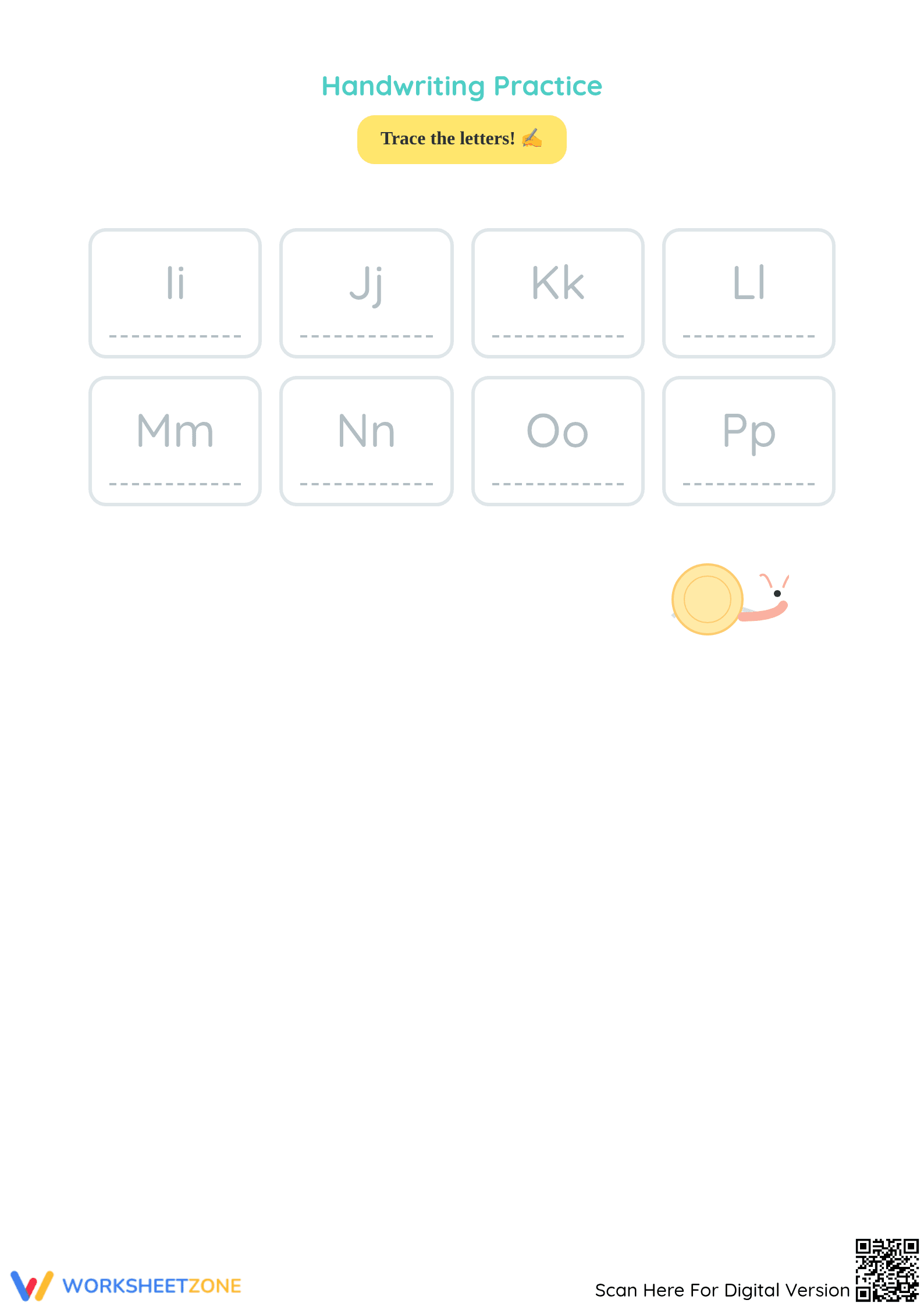
This 3-page printable pack features a structured progression of writing tasks. The first page provides a dedicated space for notes. The second page contains 8 unique path-tracing challenges where students follow dotted lines from lowercase letters 'i' through 'p' to their uppercase matches. The third page transitions to direct handwriting practice, offering 8 letter-pair boxes for focused formation. A full answer key is included to assist with quick grading.
This resource is designed for immediate classroom implementation with a total teacher prep time of under 2 minutes. First, print the 3-page PDF for your class. Second, distribute the sheets during your literacy block; the visual cues are self-explanatory, requiring minimal verbal instruction. Third, review the completed paths to identify students needing additional fine motor support. This workflow makes the worksheet an ideal candidate for emergency sub plans.
This worksheet is primarily aligned with CCSS.ELA-LITERACY.L.K.1.A, which requires students to print many upper- and lowercase letters. It also supports fine motor development standards common in early childhood frameworks. The tasks specifically address the visual-spatial processing required to differentiate between case types while maintaining steady pencil pressure. Both standard codes can be copied directly into lesson plans, IEP goals, or district curriculum mapping tools.
Use this worksheet during the guided practice phase of a handwriting lesson to reinforce letter shapes. It is particularly effective as a formative assessment tool; observe students as they trace to check for proper pencil grip and stroke direction. The expected completion time is 10–15 minutes, making it a perfect fit for a rotating literacy center or a fast finisher activity for students who complete assignments early.
This resource is tailored for early learners, including those in Kindergarten and Grade 1 who are mastering the alphabet. It is also highly beneficial for students receiving occupational therapy services to improve grip strength and coordination. Pair this worksheet with an alphabet anchor chart or a letter-sound matching game to create a multi-sensory learning experience that caters to diverse learning styles.
Research from Fisher & Frey (2014) emphasizes that early writing development is inextricably linked to fine motor proficiency and the ability to distinguish between letter cases. This ABC Path Tracing worksheet targets CCSS.ELA-LITERACY.L.K.1.A by requiring students to navigate complex visual paths from lowercase to uppercase anchors, reinforcing letter recognition through tactile movement. By providing 16 distinct tracing tasks across 3 pages, the resource supports the gradual release of responsibility, allowing for guided practice before independent letter formation. This printable PDF serves as a foundational tool for developing the muscular memory necessary for legible handwriting, making it a vital component of any early childhood literacy curriculum or occupational therapy intervention plan. The inclusion of both path tracing and box-constrained formation ensures students develop the spatial awareness required for standard ruled paper.


