


























Views
Downloads

ABC Path Tracing Worksheet | Essential Grade K-1 Ready
Paste this activity's link or code into your existing LMS (Google Classroom, Canvas, Teams, Schoology, Moodle, etc.).
Students can open and work on the activity right away, with no student login required.
You'll still be able to track student progress and results from your teacher account.
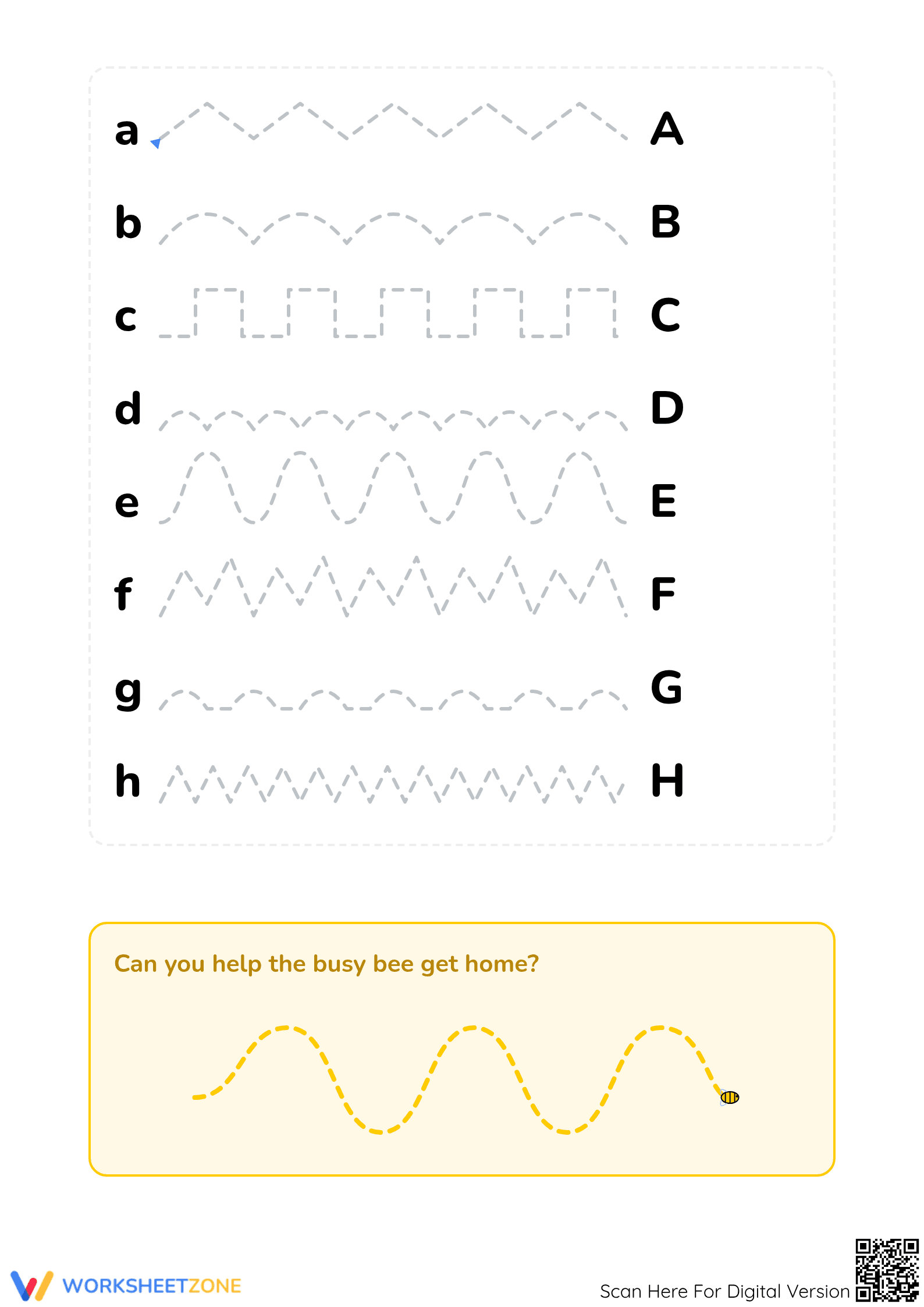
This Grade Kindergarten and Grade 1 ABC path tracing worksheet provides young learners with 9 structured tracing activities to strengthen fine motor control and letter recognition. By connecting lowercase letters to their uppercase counterparts, students develop the muscular endurance and visual-spatial awareness necessary for formal handwriting. This resource ensures a smooth transition from scribbling to intentional letter formation.
At a Glance
At a Glance
- Grade: Kindergarten · Subject: ELA
- Standard:
CCSS.ELA-LITERACY.L.K.1.A— Print many upper- and lowercase letters through guided path tracing- Skill Focus: Fine motor pencil control
- Format: 2 pages · 9 problems · Answer key included · PDF
- Best For: Morning work or early finisher activities
- Time: 10–15 minutes
What's Inside
The resource includes two high-quality PDF pages designed for immediate classroom use. The primary activity page features 8 distinct letter paths (a through h) and a bonus "busy bee" path to engage students. Each path utilizes dashed lines to guide the pencil, helping students master zig-zags, curves, and square waves. A dedicated notes page allows for teacher observations or additional student practice during the lesson.
Zero-Prep Workflow
Teachers can implement this resource in under 2 minutes. Simply print the desired number of copies, distribute them to students with a sharpened pencil or crayon, and review the completed paths to check for grip and line accuracy. This print-and-go design makes it an ideal choice for emergency sub plans, morning bins, or transition periods between core subjects.
Standards Alignment
The primary focus is `CCSS.ELA-LITERACY.L.K.1.A`, which requires students to "Print many upper- and lowercase letters." This worksheet supports that goal by familiarizing students with letter forms and the directional movements required for writing. It also touches upon foundational fine motor standards found in many state frameworks. Both standard codes can be copied directly into lesson plans, IEP goals, or district curriculum mapping tools.
How to Use It
Use this worksheet during the guided practice portion of a handwriting lesson to reinforce letter shapes. It also serves as an excellent formative assessment tool; observe students as they trace to identify those struggling with pincer grasp or crossing the midline. Completion typically takes 10 to 15 minutes depending on the student's current motor proficiency and focus level.
Who It's For
This resource is designed for Kindergarteners and first graders beginning their writing journey. It is particularly helpful for students requiring occupational therapy support or extra fine motor practice to build hand strength. Pair this with an alphabet anchor chart or a tactile sand-tracing activity for a multi-sensory learning experience that caters to diverse learner needs.
According to the RAND AIRS 2024 report on early literacy, consistent fine motor engagement is a significant predictor of later writing fluency and academic success. This worksheet aligns with CCSS.ELA-LITERACY.L.K.1.A by providing the repetitive, low-stakes practice necessary for students to internalize the shapes of upper- and lowercase letters. Research from Fisher & Frey (2014) emphasizes that scaffolded tracing paths reduce cognitive load, allowing young learners to focus entirely on pencil mechanics before moving to independent letter formation. By integrating 9 specific tracing tasks, this resource ensures that students build the foundational hand strength required for more complex ELA tasks. Educators can rely on this evidence-based approach to bridge the gap between letter recognition and active production in early childhood classrooms, ensuring all students meet developmental milestones.


