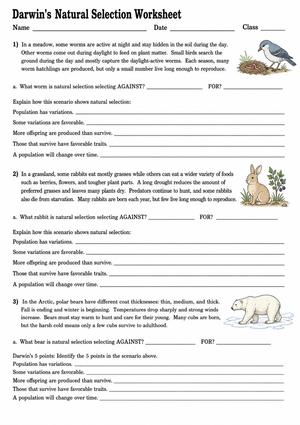
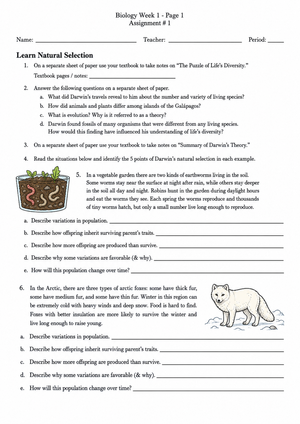
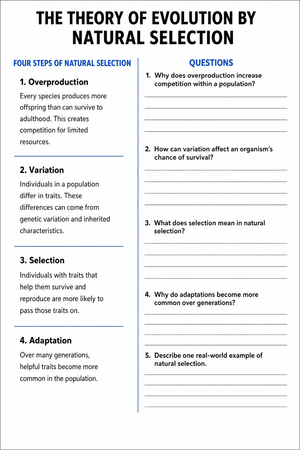
These 9th grade darwins natural selection pdf worksheets give biology teachers a practical set of resources for building the kind of reasoning that ninth graders reliably struggle with: explaining population-level change without sliding into language that makes evolution sound intentional or goal-directed. The set moves students from vocabulary into applied thinking — they don't just define variation or inheritance, they use those concepts to analyze scenarios, interpret data, and write evidence-based explanations.
The Core Mechanism Students Need to Master
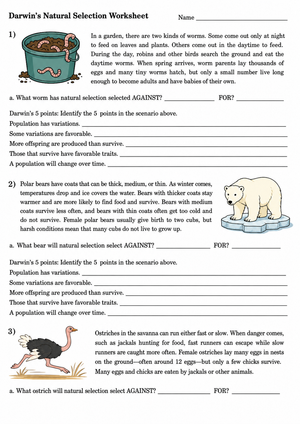
Darwin's natural selection depends on a causal chain, not a vocabulary list. Students who can recite variation, heritability, overproduction, and differential survival will still write "the giraffe grew a longer neck because it needed to reach higher leaves" if they haven't practiced tracing how those concepts connect. Each worksheet in the set gives students repeated chances to build the chain — trait that varies, environmental pressure, which individuals reproduce more, how the population shifts across generations.
- Variation within a population: members of the same species are not identical.
- Heritability: some of that variation can be passed from parents to offspring.
- Overproduction: populations produce more offspring than survive to reproduce.
- Competition: organisms compete for limited food, shelter, or mates.
- Differential reproduction: individuals with certain inherited traits leave more offspring.
- Population change over time: those heritable traits become more common across generations.
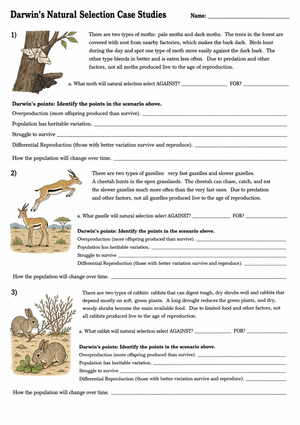
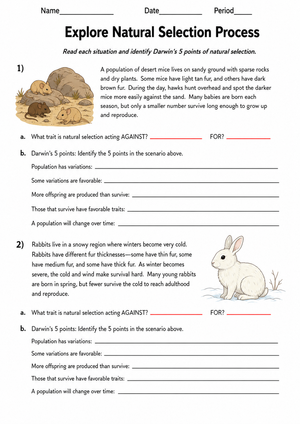
The scenarios across the set draw from examples students can picture — beak variation in finch populations, color morph frequencies in peppered moths, antibiotic resistance in bacterial populations. The antibiotic resistance case is especially useful because it makes visible what students most need to internalize: natural selection acts on variation already present in a population, not variation that arises because conditions changed.
Frequent Student Errors Worth Watching For
Three error patterns appear in ninth-grade biology work on natural selection, and they persist regardless of how carefully the concept was introduced. Recognizing them early saves significant reteaching later.
The most stubborn is individual-organism language. Students write "the animal adapted" or "the species changed to survive," which sounds scientific but describes something impossible — no individual organism rewrites its own genome in response to environmental pressure. The 9th grade darwins natural selection pdf worksheets address this directly by requiring students to name the population in their written responses and by including prompts like "which organisms in this population were most likely to leave offspring?" That sentence structure forces the right unit of analysis.
The second error is conflating acclimation with natural selection. When students read that a deer's coat gets thicker in winter, many interpret this as evolution. A well-placed question — "Is this trait heritable, or is it a short-term body response?" — makes the distinction concrete before it shows up on an assessment. The third error is subtler: students assume that if a trait is helpful, it will always spread. They miss that selection only acts when the trait is heritable and the environment actually creates differential survival. A short scenario where a useful trait happens to be non-heritable surfaces this gap quickly.
Working These Worksheets Into Your Biology Unit
The set fits naturally at three different points in a unit sequence. Early on, a reading-and-vocabulary worksheet works well as a guided-notes companion to direct instruction — students annotate the passage, underline key terms, and answer comprehension questions while the concepts are still fresh. In the middle of the unit, scenario-based worksheets support partner work or small-group stations where students talk through which trait matters and why before committing to a written answer. Near the end, a data-analysis or short-response worksheet makes a reliable pre-quiz review or homework assignment.
One classroom routine that pays off: before students answer any scenario question, have them jot two quick labels in the margin — "trait that varies" and "population result." It takes thirty seconds and prevents the single most common writing error, where students describe what happened to the environment rather than what happened to the population. The Friday before a unit test is a good time to revisit one of the earlier scenario worksheets as a retrieval exercise; students who felt confident during the unit often discover they're still using individual-organism language when writing cold.
Differentiating These Worksheets Across Ability Levels
For students who need additional structure, the scenario worksheets work well when paired with a sentence frame: "Some individuals in the population had [trait]. Because the environment [pressure], those individuals reproduced more successfully. Over time, [trait] became more common in the population." This frame gives students the logical skeleton without doing their thinking for them. Students who use it once or twice typically internalize the structure and drop the frame on their own.
Students who move quickly through the scenarios benefit from a different kind of challenge: ask them to evaluate whether a given case actually represents natural selection or something else — acclimation, genetic drift, or a non-heritable phenotypic response. That distinction appears on AP Biology assessments and in NGSS performance tasks, and it demands sharper reasoning than simply identifying variation and selection pressure. The 9th grade darwins natural selection pdf worksheets work for both student populations because the core scenario is accessible while the analysis layer can be pushed as far as students' thinking allows.
Standard Alignment
These worksheets align with NGSS standard HS-LS4-2, which asks students to construct an explanation based on evidence that evolution primarily results from four factors: the potential for a species to increase in number, the heritable genetic variation of individuals due to mutation and sexual reproduction, competition for limited resources, and the proliferation of organisms better able to survive and reproduce in their environment. In classroom terms, that standard requires students to do more than recall vocabulary — they need to use evidence to build an argument about mechanism. The written-response questions across the set are structured exactly for that task: students state a claim, identify the heritable trait, name the selection pressure, and explain the population-level result. That maps directly onto what NGSS science and engineering practices call constructing explanations from evidence.
Frequently Asked Questions
Where do these worksheets fit relative to genetics and Mendelian inheritance?
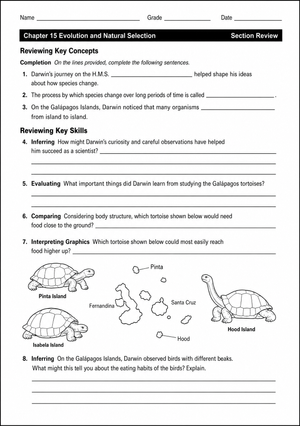
Natural selection depends on heritability, so it lands most smoothly after students have some grounding in how traits are passed from parents to offspring. That said, teachers who introduce natural selection first and then loop back to Mendelian genetics report that students develop stronger motivation for the genetics content when they already understand why inheritance matters at the population level. Either sequence works; what matters is that students can distinguish a heritable trait from a short-term body response before they work through selection scenarios.
How long does each worksheet take to complete in class?
Reading and vocabulary worksheets typically run fifteen to twenty minutes. Scenario-based worksheets, especially those that include a written explanation, take closer to twenty-five minutes depending on passage length. Data-analysis worksheets can run longer if students are still developing fluency with frequency graphs or bar charts. These are useful pacing benchmarks for a fifty-minute block — most teachers use a scenario worksheet as the core task and build five to eight minutes of discussion around it.
Are these resources suitable for students who read below grade level?
The reading passages use accessible language, and the scenario prompts are direct. Students who struggle with reading fluency benefit from hearing the passage read aloud before working independently. The 9th grade darwins natural selection pdf worksheets require more scientific reasoning than reading stamina, which means many students who find textbook chapters difficult can still work through the tasks successfully once they understand the scenario setup.
What does the answer key include for written-response questions?
Each worksheet includes an answer key with complete responses for multiple-choice and short-answer items. For constructed-response questions, the key provides a model answer along with the specific elements teachers should look for — identification of the heritable trait, naming of the selection pressure, and explanation of the population-level outcome. That rubric language maps directly onto how NGSS performance expectations describe evidence-based explanations, which makes it easier to give students targeted feedback rather than a general score.












 Interactive Worksheet Maker
 Quiz Maker
 Word Search Maker
 Crossword Puzzle Maker
 Word Scramble Generator
 Sentence Scramble Generator
 Handwriting Worksheet Generator
 Name Tracing Generator
 Fill In The Blank Generator