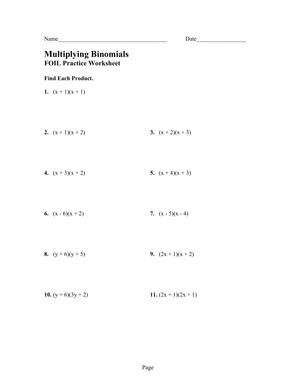
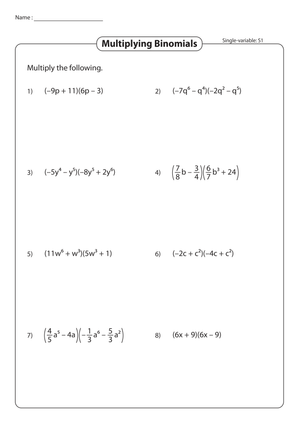
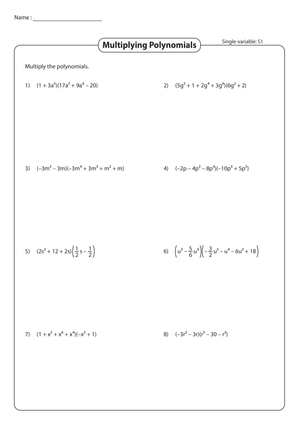
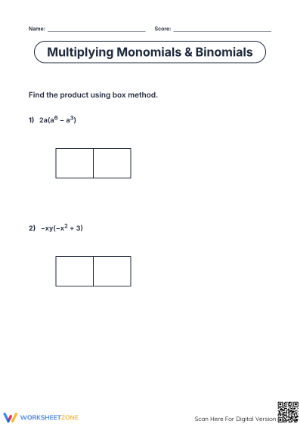
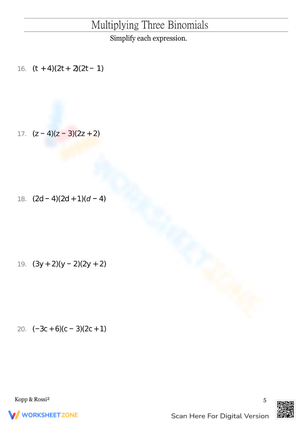
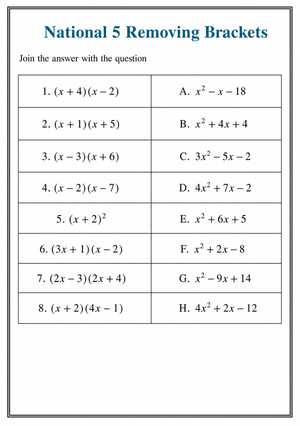
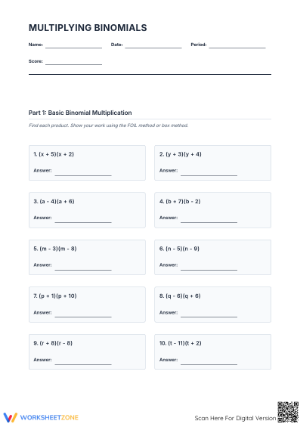
These 9th grade multiplying binomials worksheets cover the full progression of binomial multiplication as it appears in Algebra 1 — from first-exposure problems using single-variable, positive-coefficient expressions through sign-heavy pairs, special products, and multi-variable binomials. Teachers who work through the first few problems alongside their class on day one will find the sequencing matches what actually needs to happen in the room.
The Specific Skills Each Worksheet Targets
The set addresses three distinct practice layers that build on each other as the unit progresses:
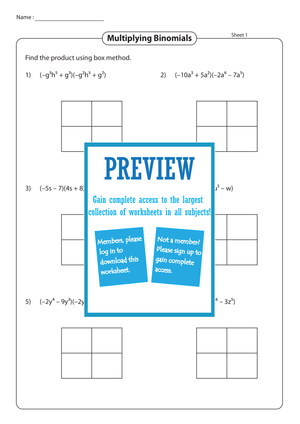
- Mechanical distribution: Making sure every term in the first binomial multiplies every term in the second. Both FOIL and the area model (box method) appear across different worksheets, so teachers can match practice to whichever method their class has been taught — or use both side by side for comparison.
- Sign management: Tracking negative signs through each step of multiplication and again when combining like terms. Sign errors account for the majority of wrong answers in this unit — not confusion about the distributive property itself, but arithmetic slippage — so these problems get focused practice rather than being scattered throughout.
- Pattern recognition: Identifying difference-of-squares and perfect-square-trinomial structures and eventually using them as shortcuts. These appear in later worksheets, once the mechanics are solid and students are ready to notice that certain expression types always produce predictable outputs.
Mistakes Students Make That These Worksheets Help You Catch
The most persistent error, across ability levels and classroom contexts, is squaring a binomial term by term. A student asked to expand (x + 5)² writes x² + 25. The middle term — 10x — simply vanishes. This is sometimes called the "Freshman's Dream" in algebra education, and it is stubborn. Catching it on the first worksheet where squared binomials appear and working through why the middle term exists — with a concrete area model drawn on the board rather than just a correction mark on the paper — prevents the error from calcifying. Left unaddressed, it resurfaces in the factoring unit, the quadratic formula unit, and on standardized assessments.
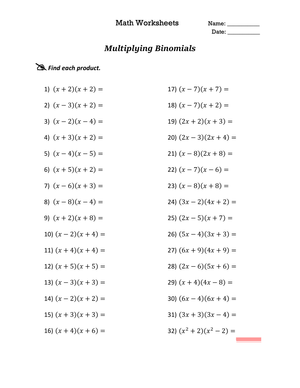
A separate pattern shows up specifically when both constants are negative. A student who correctly expands (x + 3)(x - 2) will still stumble on (x - 6)(x - 4). In the last FOIL step, (-6)(-4) should yield positive 24, but a large share of ninth graders write negative 24 instead. The problem isn't conceptual — it's an integer multiplication reflex that misfires in an abstract context. Including enough two-negative problems early, and requiring students to write the sign explicitly before multiplying, catches this before it becomes automatic.
Standard Alignment
This set aligns to CCSS.Math.Content.HSA.APR.A.1, which covers arithmetic operations on polynomials and the understanding that multiplying polynomials always produces another polynomial — the same closure property integers carry under addition, subtraction, and multiplication. In most Algebra 1 pacing guides, this standard arrives mid-year, after linear expressions and before the factoring unit begins. That placement matters: factoring a trinomial is essentially the reverse of what students practice here, so the fluency they build now is the same pattern recognition they'll need to run backward a few weeks later. Teachers who draw on 9th grade multiplying binomials worksheets before starting the factoring unit consistently report that students recognize trinomial structure more readily, because they have built those trinomials by hand many times.
Fitting These Worksheets Into Your Lesson Plans
Shorter, repeated exposures across the unit serve this topic better than one long block of practice. Five to eight problems at the start of class — before new instruction begins — gives students retrieval practice on what was covered previously and surfaces confusion while there is still time to address it. Spaced practice across several days builds retention more durably than massed work at a single sitting, and that is especially true when students are still developing fluency with sign management.
In a 50-minute period, a practical structure is roughly 8 minutes of warm-up problems from an earlier worksheet in the set, 20 minutes of direct instruction on the new concept, and 15 minutes of independent work while the teacher circulates. That circulating window is where sign errors and the squared-binomial mistake become visible. Catching a student write (x + 4)² = x² + 16 in real time is worth more than a correction mark on a paper returned the next day, when students have mentally moved on to something else.
The special products worksheets fit naturally into a Friday review block, after students have spent a full week on general binomial multiplication. By that point the procedure is solid enough that students begin noticing patterns on their own — which is exactly when the shortcut clicks rather than feeling arbitrary.
Differentiating These Worksheets Across Student Readiness Levels
For students who are still shaky on integer operations, worksheets that include pre-drawn area model grids reduce the organizational demand enough to let them concentrate on the multiplication itself. The problems are the same expressions — not easier algebra — but the grid keeps the four partial products visually separated so students are not trying to hold everything in working memory at once. That one structural change is often the difference between a student who gives up on the first row and one who finishes and checks their work.
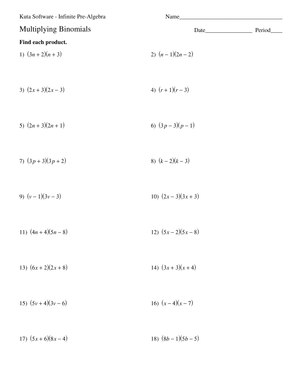
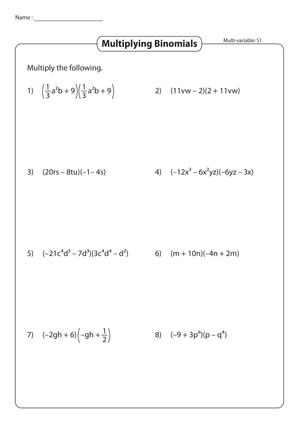
Students who move quickly through the core problems can work with binomials where both terms carry coefficients greater than 1 — expressions like (4x - 3)(2x + 5) — or with two-variable pairs such as (x + 3y)(x - y). Neither requires a different process, but both demand more careful coefficient multiplication and more deliberate like-term identification, which is the right kind of stretch at this stage.
One honest limitation of the format: students who have had only symbolic instruction and no concrete experience with area models sometimes freeze when a problem's structure looks different from what they've seen before. For those students, five minutes with a hand-drawn rectangle and actual numbers before starting the worksheet does more than additional symbolic practice. The abstraction lands better once the physical picture has been made at least once.
Frequently Asked Questions
Should I teach FOIL or the box method first?
Either can come first, but the box method has a practical long-term advantage: it extends directly to multiplying trinomials, where FOIL breaks down. Teachers who begin with the area model find the transition to three-term expressions much smoother because students already understand the grid logic. FOIL works well as a faster shortcut once students can explain why it produces the same result — not as a starting point in place of that understanding.
How does this skill fit into the broader Algebra 1 sequence?
It bridges linear expressions and quadratic functions. Students arrive knowing how to distribute a monomial — a(x + 3) — and binomial multiplication is the first time they have to distribute twice. Building this step solidly is what makes the factoring unit accessible, since factoring asks students to reverse exactly the process they have practiced here.
Can I use these worksheets alongside my current textbook?
These 9th grade multiplying binomials worksheets work alongside any Algebra 1 text as targeted supplementary practice. Most textbook exercise sets are light on sign-management problems and special products; this set addresses both in depth. A common approach is to use the textbook for initial worked examples and then assign specific worksheets from this set based on which errors appear in class that day.
Are these appropriate for advanced 8th graders or 10th graders reviewing before factoring?
For 8th graders in accelerated Algebra 1 tracks, the content is the same — the grade label refers to the course, not the student's age. For 10th graders who need a refresher before the factoring unit, 9th grade multiplying binomials worksheets covering special products are particularly useful, since the difference-of-squares and perfect-square-trinomial patterns appear directly in factoring by grouping and in recognizing factorable quadratics.














 Interactive Worksheet Maker
 Quiz Maker
 Word Search Maker
 Crossword Puzzle Maker
 Word Scramble Generator
 Sentence Scramble Generator
 Handwriting Worksheet Generator
 Name Tracing Generator
 Fill In The Blank Generator




 BACK TOSCHOOL