


























Views
Downloads

Essential Binomial Expansion Worksheet | Grade 9 Algebra
Paste this activity's link or code into your existing LMS (Google Classroom, Canvas, Teams, Schoology, Moodle, etc.).
Students can open and work on the activity right away, with no student login required.
You'll still be able to track student progress and results from your teacher account.
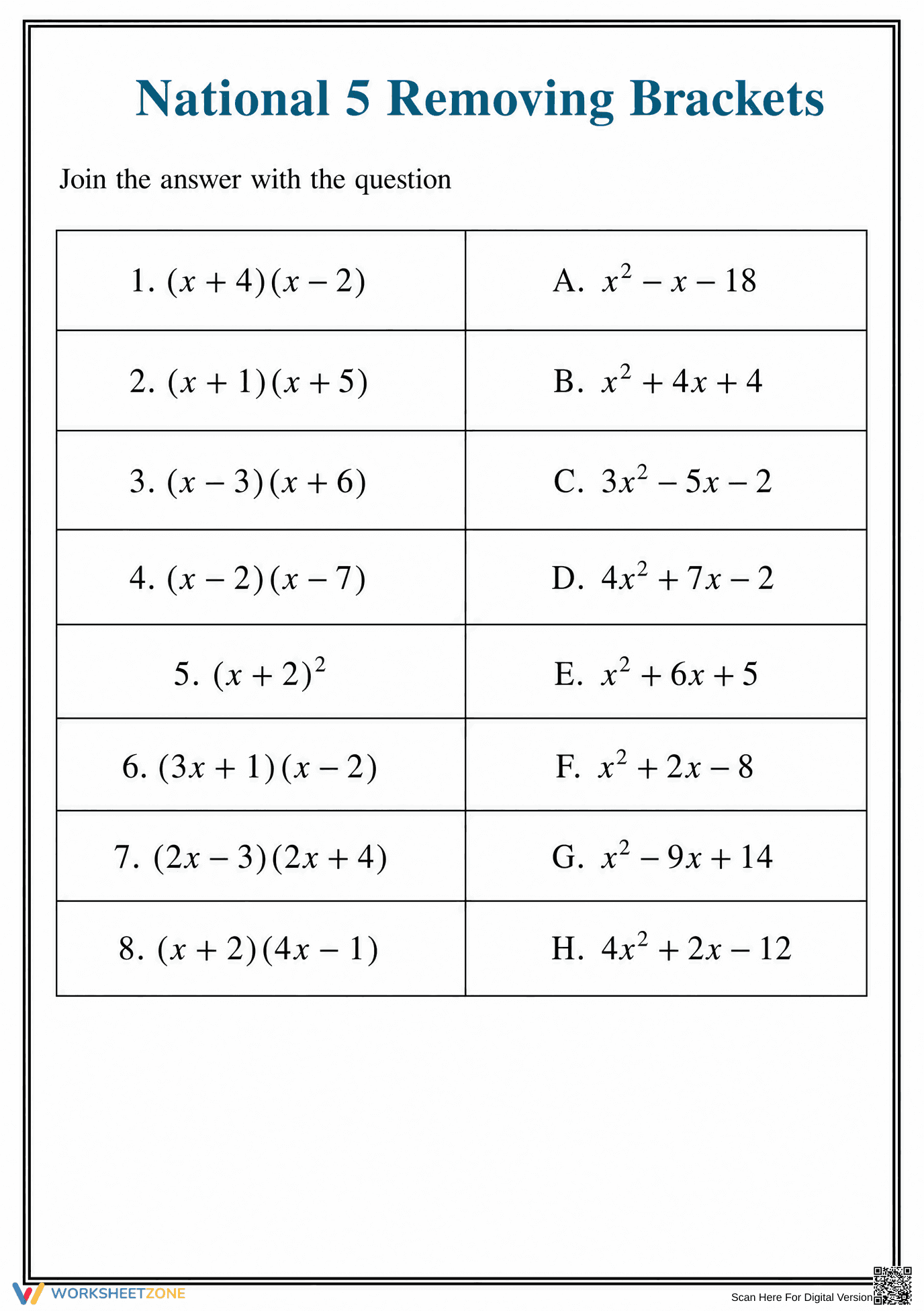
This Algebra worksheet focuses on the fundamental skill of expanding binomial expressions, commonly known as removing brackets. By matching factored forms with their quadratic equivalents, students develop the fluency required for higher-level polynomial operations. This resource ensures learners can accurately apply the distributive property to simplify complex algebraic terms and prepare for quadratic factoring.
At a Glance
- Grade: 9 · Subject: Algebra
- Standard:
HSA-APR.A.1— Multiply polynomials and understand that they form a system analogous to integers- Skill Focus: Binomial expansion (FOIL method)
- Format: 1 page · 8 problems · Matching activity · PDF
- Best For: Independent practice or formative assessment
- Time: 15–20 minutes
What's Inside: This single-page PDF features 8 distinct binomial multiplication problems. The layout uses a matching format where students must solve the expression on the left and find its simplified quadratic counterpart on the right. This structure provides an immediate feedback loop, as students can visually verify their results against the provided options, reducing frustration and promoting self-correction during the learning process.
Skill Progression
- Guided practice: The first few problems involve simple positive integers to build confidence with the FOIL method and basic distributive property application.
- Supported practice: Middle-tier tasks introduce negative coefficients and squared binomials to test sign-rule consistency and exponent rules.
- Independent practice: Final problems include coefficients greater than one, requiring students to manage multiple multiplication steps and term combinations simultaneously.
This gradual-release approach moves students from basic distributive property application to mastery of polynomial multiplication through a structured I Do, We Do, You Do framework.
Standards Alignment
This resource is aligned with CCSS.MATH.CONTENT.HSA.APR.A.1, which requires students to understand that polynomials form a system analogous to the integers, namely, they are closed under the operations of addition, subtraction, and multiplication; add, subtract, and multiply polynomials. Both standard codes can be copied directly into lesson plans, IEP goals, or district curriculum mapping tools to ensure instructional compliance.
How to Use It
Use this worksheet as a "Do Now" activity during the second day of a polynomial unit to check for retention of the FOIL method. Alternatively, assign it as a quick formative assessment after direct instruction to identify students struggling with sign errors or coefficient multiplication. Expected completion time is 15 to 20 minutes depending on student familiarity with the distributive property.
Who It's For
This worksheet is designed for Grade 9 Algebra 1 students or Grade 10 learners needing a refresher on polynomial operations. It is particularly effective for visual learners who benefit from the matching format. Pair this with a distributive property anchor chart or a video tutorial on binomial multiplication for students requiring additional scaffolding.
The HSA-APR.A.1 standard emphasizes the structural properties of polynomials, requiring students to move beyond rote memorization toward a conceptual understanding of algebraic systems. This worksheet facilitates that transition by providing 8 targeted binomial expansion tasks that reinforce the distributive property. According to Fisher & Frey (2014), the use of structured practice with immediate feedback—such as the matching format used here—is essential for developing procedural fluency in mathematics. By requiring students to reconcile their calculated products with a set of possible answers, the worksheet encourages self-correction and reduces the cognitive load associated with open-ended problem solving. This alignment with evidence-based instructional strategies ensures that students build a robust foundation for later work with quadratic functions and factoring. Educators can utilize this resource to bridge the gap between initial instruction and independent mastery of polynomial multiplication within the high school curriculum.


