


























Views
Downloads



Printable Multiplying Binomials Worksheet | Algebra Ready
Paste this activity's link or code into your existing LMS (Google Classroom, Canvas, Teams, Schoology, Moodle, etc.).
Students can open and work on the activity right away, with no student login required.
You'll still be able to track student progress and results from your teacher account.
This comprehensive multiplying binomials worksheet provides high school students with the rigorous practice needed to master polynomial multiplication. By progressing from basic binomial pairs to squaring expressions and real-world area applications, students build a deep conceptual understanding of the FOIL and box methods. This resource ensures students achieve fluency in algebraic manipulation.
At a Glance
- Grade: 9–12 · Subject: Algebra
- Standard:
CCSS.MATH.CONTENT.HSA-APR.A.1— Multiply polynomials and understand their closure under multiplication- Skill Focus: FOIL method and box method multiplication
- Format: 4 pages · 38 problems · Answer key included · PDF
- Best For: High school algebra practice and assessment
- Time: 45–60 minutes
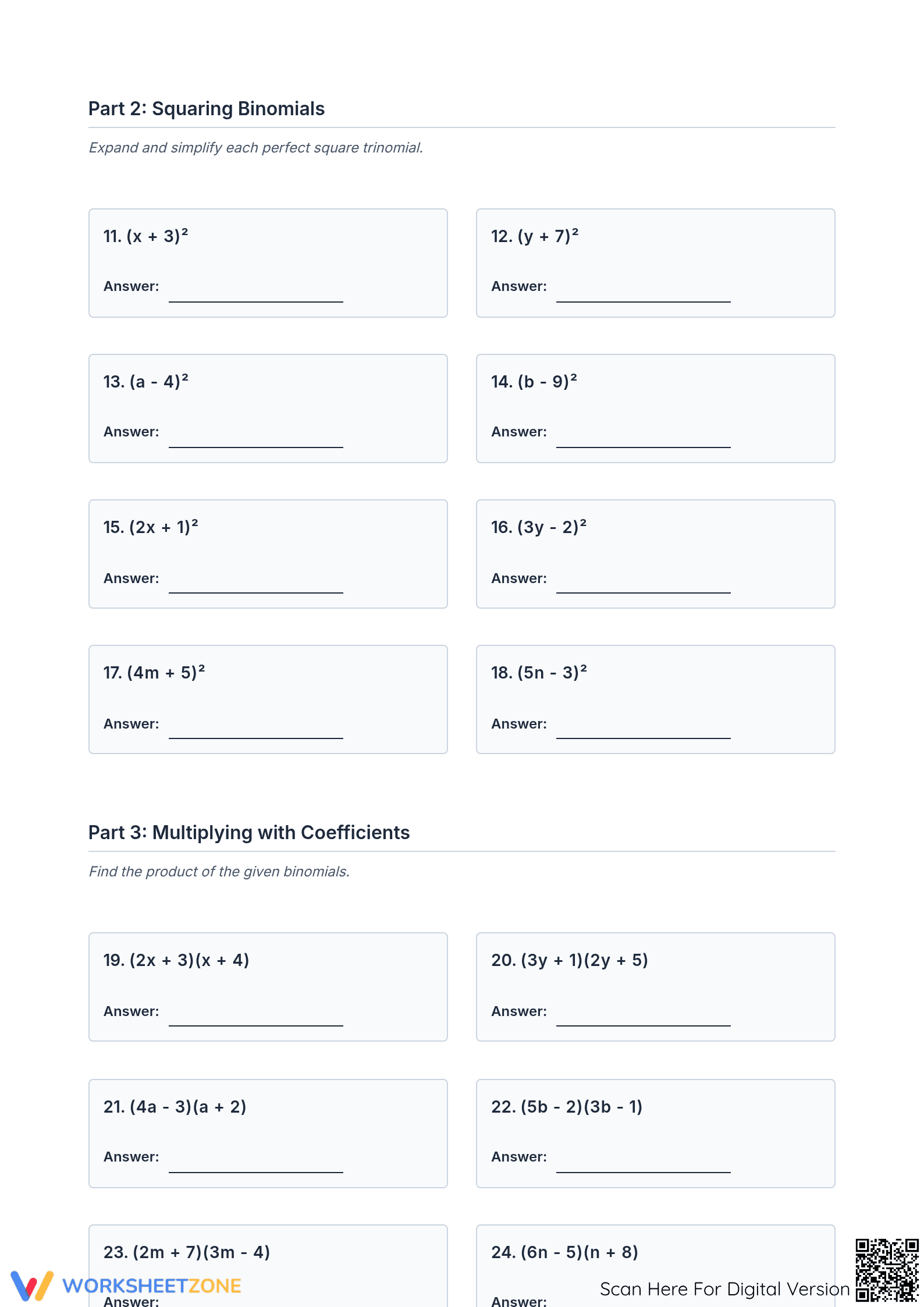
This four-page PDF is structured into five distinct sections to scaffold student learning. It includes 10 basic multiplication problems, 8 squaring binomials tasks, 8 problems involving coefficients, and 8 higher-degree challenges. The final section provides 4 application problems where students must write algebraic expressions for the area of squares and rectangles. A complete answer key is provided for efficient grading.
- Guided Practice: Part 1 introduces 10 foundational binomial pairs, prompting students to utilize either the FOIL method or the box method with clear workspace provided.
- Supported Practice: Parts 2 and 3 transition to special products and problems with leading coefficients, totaling 16 problems that reinforce pattern recognition.
- Independent Practice: The final 12 problems challenge students with higher-degree terms and geometric applications, requiring them to synthesize their skills without direct scaffolding.
This resource follows a gradual-release model, moving from procedural fluency to conceptual application.
This worksheet is directly aligned to CCSS.MATH.CONTENT.HSA-APR.A.1. Students will understand that polynomials form a system analogous to the integers, specifically focusing on the requirement to add, subtract, and multiply polynomials with precision. This standard code can be copied directly into lesson plans, IEP goals, or district curriculum mapping tools.
Use this worksheet during the 'We Do' or 'You Do' phase of a lesson on polynomial operations. It serves as an excellent formative assessment tool; teachers should observe if students are consistently applying the FOIL acronym or correctly setting up their multiplication boxes. Expect students to take approximately 50 minutes to complete the full set, making it an ideal choice for a comprehensive homework assignment.
Designed for Algebra 1 and Algebra 2 students, this resource supports a wide range of learners. For students requiring extra support, teachers might provide a printed FOIL anchor chart. It naturally pairs with direct instruction on the distributive property or introductory lessons on factoring quadratic trinomials.
Aligned with CCSS.MATH.CONTENT.HSA-APR.A.1, this resource facilitates mastery of multiplying binomials, a foundational skill in secondary mathematics. According to Fisher & Frey (2014), scaffolded practice moving from procedural FOIL steps to complex application is essential for developing long-term retention. This worksheet addresses the need for high-volume practice that leads to the procedural fluency required for higher-level calculus. By incorporating geometric applications like area calculations, the task moves beyond rote memorization and encourages students to see algebra as a tool for describing physical space. The inclusion of an answer key supports immediate feedback, which NAEP studies indicate is critical in closing achievement gaps. This 38-problem set ensures students encounter various term types, including coefficients and higher exponents, preparing them for advanced polynomial operations. It serves as a comprehensive bridge between basic distributive property knowledge and the complex factoring required in subsequent algebraic units.


