Multiplying Polynomials Printable Worksheets for 9th Grade
These multiplying polynomials printable worksheets for 9th grade give Algebra 1 teachers print-ready practice that covers the full arc from monomial distribution through binomial-by-trinomial multiplication — without bundling everything into a packet students work through start to finish. Each worksheet targets one specific operation, so you can assign exactly what your class needs on a given day. The set also includes an error-analysis worksheet, which earns a separate place in the unit rather than sitting at the end as filler.
What the Set Covers
The five worksheets address the operations that appear in sequence during a standard Algebra 1 polynomial unit:
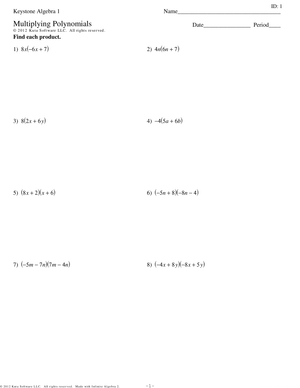
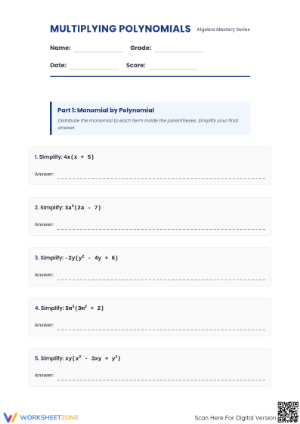
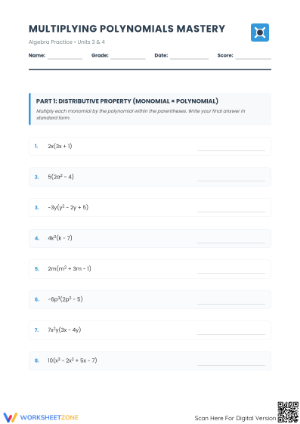
- Monomial distribution — multiplying a single term by a polynomial, with consistent emphasis on the product rule for exponents and signed-number arithmetic
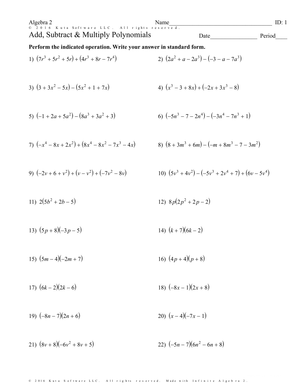
- Binomial multiplication using FOIL — First, Outer, Inner, Last, with both positive and negative coefficients throughout
- The box method (area model) — a grid-based approach that works for binomials and extends to trinomials without requiring a new mnemonic
- Binomial-by-trinomial multiplication — full distribution producing six partial products before any combining of like terms
- Error analysis — identifying and correcting specific mistakes in pre-worked problems, with students marking the exact step where the error occurred
The multiplying polynomials printable worksheets for 9th grade in this collection are sequenced so each one builds on the preceding skill — but because they are separate worksheets rather than consecutive sections of a packet, you can skip one, repeat another, or assign them in a different order based on where your class actually is in the unit.
Errors That Show Up Constantly in Student Work
The most persistent error at this level involves the invisible exponent. When students see x, they don't instinctively read it as x to the first power. So when they multiply x by x², they write x² instead of x³. This isn't carelessness — it reflects a genuine conceptual gap about what a variable without a written exponent actually represents. The monomial distribution worksheet addresses this directly by including problems where several terms carry degree 1, forcing students to confront the rule rather than sidestep it.
Negative sign distribution causes a different and more stubborn category of mistake. A student who handles (3x)(−2x + 5) correctly will often fail when the negative is on the outside: (−3x)(2x − 5). The subtraction sign inside the second parentheses gets read as applying only to 5, so the student produces −6x² − 15 instead of −6x² + 15. The error-analysis worksheet presents exactly this type of solved problem with the sign error already embedded. Having students mark the step where the reasoning broke down — rather than simply circling the wrong answer — builds the kind of deliberate reading that prevents the same mistake in their own work.
A third pattern appears specifically during early box method work: students fill in all the grid cells correctly but then turn in the grid itself as the final answer, treating the combination step as optional. A brief class norm — "the box is a tool, not the answer" — catches this before it becomes a habit, and it's worth stating explicitly the first time you assign that worksheet.
How to Work These Worksheets Into Your Algebra Unit
Most teachers sequence polynomial multiplication across four to six class days, and the worksheets fit that timeline without requiring restructuring. The monomial distribution worksheet belongs on day one — it reviews the product rule for exponents and reveals, within the first five minutes, which students are still shaky on signed-number operations. That information is worth having before you introduce FOIL.
The FOIL worksheet works well in a guided-release format: solve the first three problems together at the board with student input, then watch students attempt the next two independently before you circulate. The box method worksheet earns its place mid-unit, after a first FOIL assessment tells you who is consistently dropping the Outer or Inner term. Handing that worksheet specifically to those students — while others move forward — lets you differentiate without halting the class or preparing a separate lesson plan.
The error-analysis worksheet holds the most instructional value near the end of the unit, once students have procedural fluency but haven't yet reflected on the logic behind each step. The ten to fifteen minutes students spend identifying why a sign flip was missed or why an exponent is wrong produces more durable understanding than an equivalent stretch of additional standard practice. It also works as a natural formative checkpoint before a unit quiz — if a student can't identify an error in someone else's work, that's useful information before the assessment.
Standard Alignment
These worksheets align to CCSS.Math.Content.HSA.APR.A.1, which asks students to add, subtract, and multiply polynomials and to recognize that polynomials form a closed system under those operations. The "closed system" idea is easy to rush past in a procedure-heavy unit, but it matters conceptually: students who understand it will later notice that polynomial division does not stay within the polynomial system, which is part of why rational expressions exist as a separate topic. Building that understanding now prevents confusion down the road when the rules seem to shift without explanation.
The standard sits in the High School Algebra — Arithmetic with Polynomials and Rational Expressions domain. Most Algebra 1 pacing guides place it in the first semester, after linear equations and before factoring begins. The multiplying polynomials printable worksheets for 9th grade in this set are ordered to support that pacing, with the simplest operations first so teachers can assign the right worksheet at the right point in the sequence.
Adjusting the Worksheets for Different Learners
For students who are still consolidating signed-number arithmetic, the monomial distribution worksheet benefits from a small reference strip at the top of the workspace — a brief table of sign rules for multiplication — so the cognitive demand stays on the algebra rather than on arithmetic recall. The box method worksheet offers a similar structural advantage: each cell holds exactly one multiplication, which reduces how many partial products a student needs to hold in working memory at once.
Students who move through the FOIL problems quickly are ready for the binomial-by-trinomial worksheet earlier than the rest of the class. Pairing those students on the error-analysis items also deepens the challenge: generating a correct answer is a lower-level task than identifying precisely where someone else's reasoning went wrong. For multilingual learners or students who benefit from visual organization, the box method worksheet's grid removes ambiguity about which terms are being multiplied, since the structure of the cell does that organizational work for them.
The multiplying polynomials printable worksheets for 9th grade in this set don't need to be assigned uniformly across the class. Using different worksheets with different groups on the same day is one of the more practical ways to run a differentiated algebra class without preparing entirely separate lessons.
Frequently Asked Questions
Is there a recommended order for assigning the worksheets, or can I start anywhere?
There is a natural order — monomial distribution before FOIL, FOIL before binomial-by-trinomial — because each operation assumes familiarity with the preceding one. That said, each worksheet stands alone, so if your class already covered monomial distribution in a previous unit, you can begin with the FOIL worksheet without losing any context. The box method worksheet can be introduced alongside FOIL or immediately after, depending on how your class handles the linear tracking that FOIL requires.
Do the worksheets include answer keys?
Yes. Each worksheet comes with a full answer key showing simplified final expressions. The error-analysis worksheet's key also identifies the specific step where the error occurred — not just the corrected answer — which makes the follow-up class discussion more efficient and easier to facilitate.
Is the box method worksheet only useful for students who are struggling?
Not at all. The box method becomes necessary for all students once the multiplication moves beyond two binomials, because FOIL doesn't extend to a binomial times a trinomial. Teachers who introduce it early — rather than only as a remediation tool — find that students apply it confidently when the expressions get more complex. Presenting it as a universal organizational strategy from the start, rather than a fallback for students who can't handle FOIL, removes any stigma around using it.
How long does each worksheet typically take during class?
Plan on roughly 15 to 20 minutes for the FOIL and monomial distribution worksheets in a guided setting, and closer to 25 minutes for the binomial-by-trinomial and error-analysis worksheets. These estimates assume you're working through several problems together before releasing students independently. Pacing varies considerably depending on class size, the number of students who need individual support, and how much discussion you build around the error-analysis problems.
Clear All