


























Views
Downloads

Printable April Fools Riddles & Math Game | Grade 3-5
Paste this activity's link or code into your existing LMS (Google Classroom, Canvas, Teams, Schoology, Moodle, etc.).
Students can open and work on the activity right away, with no student login required.
You'll still be able to track student progress and results from your teacher account.
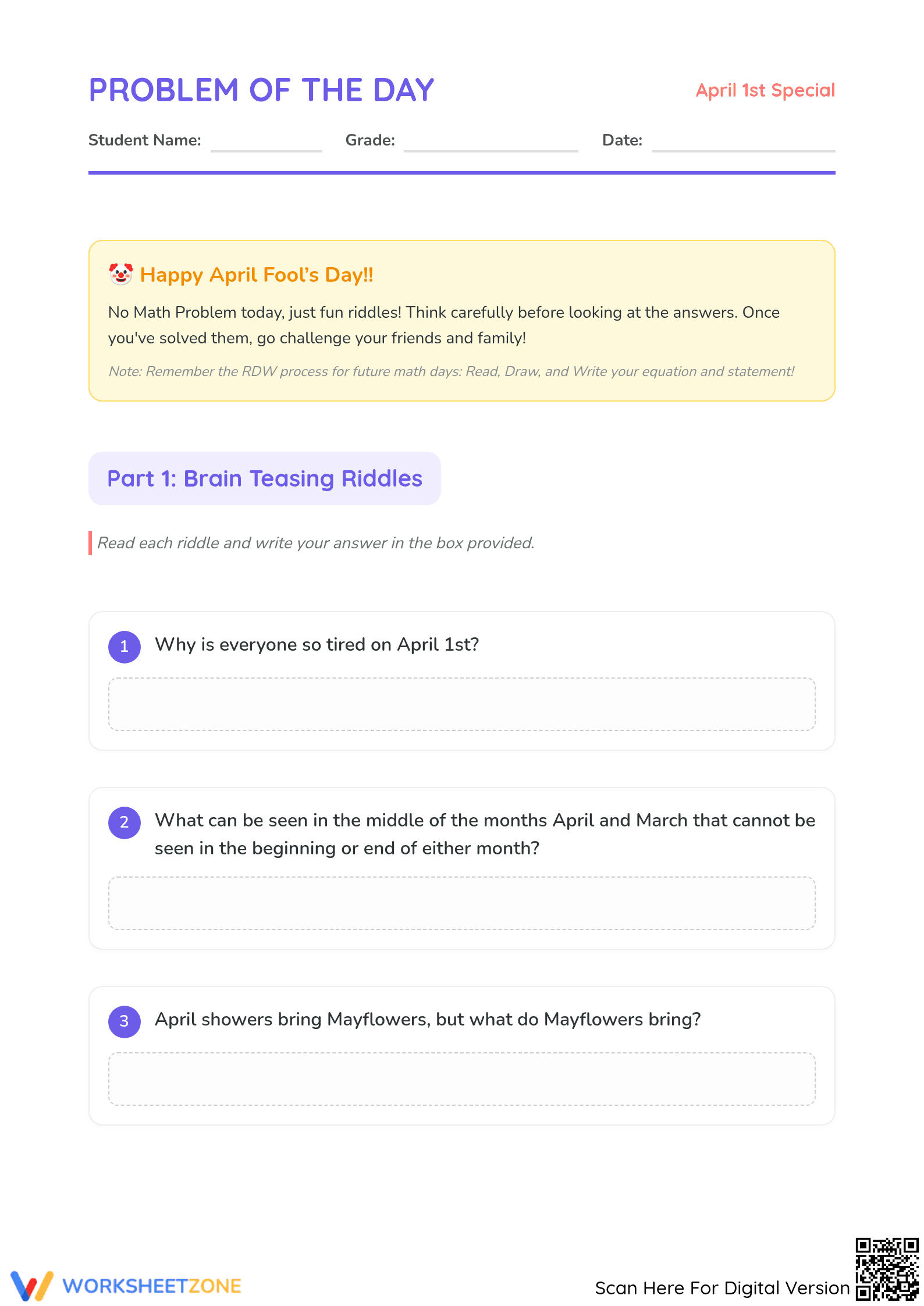
Keep your students cognitively active on April Fools' Day with this high-interest printable activity. This resource blends lateral thinking riddles with a physical math game to sharpen critical thinking and base-ten multiplication skills. It transforms a potentially chaotic holiday into a structured opportunity for students to apply logical reasoning and mathematical fluency in a fun, classroom-ready format.
At a Glance
- Grade: 3–5 · Subject: Math & English
- Standard:
CCSS.MATH.3.NBT.3— Multiply one-digit whole numbers by multiples of 10 using strategies based on place value- Skill Focus: Logical inference and basic multiplication
- Format: 3 pages · 8 items · Answer key included · PDF
- Best For: Holiday morning work or brain breaks
- Time: 20–30 minutes
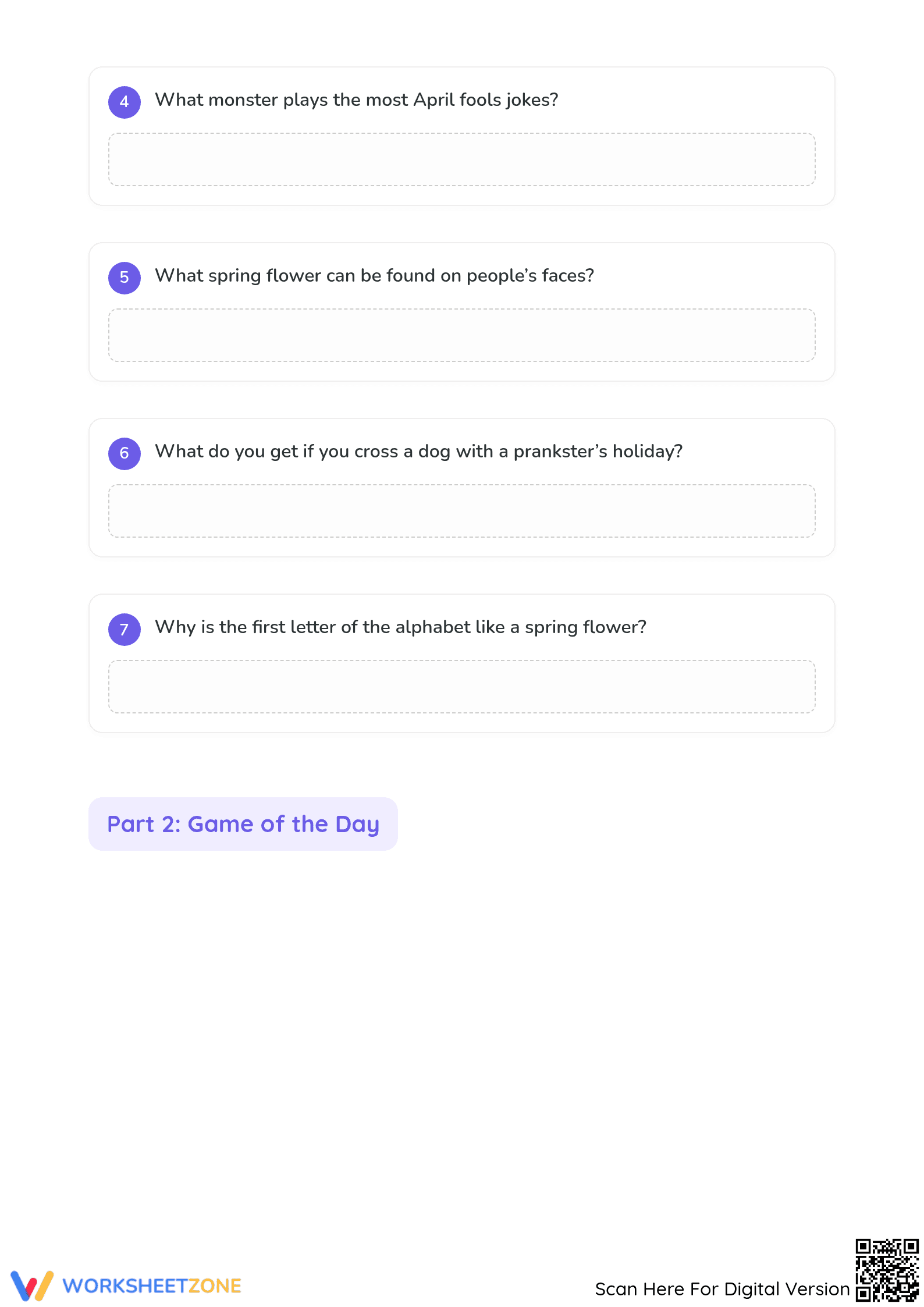
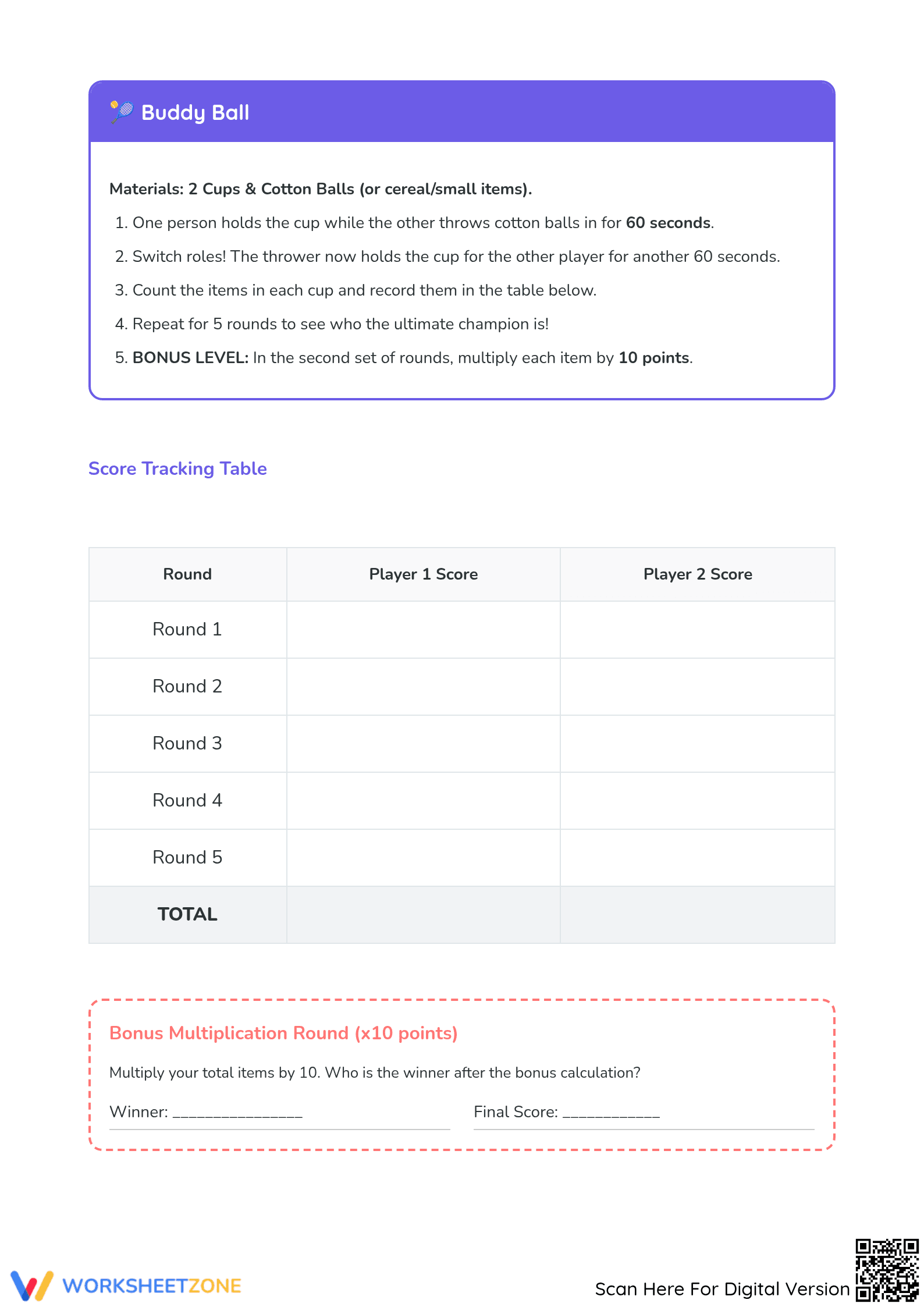
This 3-page printable contains two distinct sections designed to balance quiet reflection with active participation. Part 1 features seven brain-teasing riddles that require students to look past literal meanings and use context clues to find humorous answers. Part 2 introduces 'Buddy Ball,' a collaborative game where students use a score tracking table to record data across five rounds. The activity culminates in a bonus multiplication round, challenging students to calculate their final scores by multiplying their totals by 10, reinforcing foundational place-value concepts.
Zero-Prep Workflow
- Print (1 minute): Select the double-sided print option for the riddle pages and the tracking sheet to save paper while keeping the game rules accessible.
- Distribute (30 seconds): Hand out the worksheets alongside simple materials like cotton balls or small items needed for the Buddy Ball game section.
- Review (1 minute): Use the included answer key to quickly check riddle responses or facilitate a whole-class reveal of the funniest solutions.
This entire sequence requires less than three minutes of teacher preparation, making it an ideal choice for a sub plan or a sudden transition between lessons.
Standards Alignment
The primary focus is CCSS.MATH.CONTENT.3.NBT.A.3, which tasks students with multiplying one-digit whole numbers by multiples of 10. The 'Buddy Ball' bonus round provides a concrete application of this skill. Additionally, the riddles align with CCSS.ELA-LITERACY.L.3.5, encouraging students to demonstrate an understanding of word relationships and nuances in word meanings. Both standard codes can be copied directly into lesson plans, IEP goals, or district curriculum mapping tools.
How to Use It
Deploy this worksheet as a 'Problem of the Day' during morning meeting to set a positive and energetic tone for the holiday. Alternatively, use it as a mid-afternoon brain break when focus begins to wane. During the game phase, circulate the room to observe how students handle the 'Bonus Multiplication Round'; this is an excellent formative assessment moment to see which students can mentally apply the 'annexing zero' rule versus those who still require written scratch work. Most student pairs will finish the entire set within 25 minutes.
Who It's For
This resource is tailored for Grade 3-5 students who are comfortable with basic multiplication but need engaging ways to practice data recording. It is particularly effective for inclusive classrooms, as the riddles provide a high-success entry point for all learners regardless of mathematical level. Pair this worksheet with an anchor chart on 'Base Ten Strategies' or a short reading passage about the history of April Fools' Day to create a comprehensive thematic mini-unit.
According to the RAND AIRS 2024 report on supplementary materials, periodic cognitive breaks using lateral thinking exercises like riddles significantly improve student engagement. This worksheet leverages the CCSS.MATH.CONTENT.3.NBT.A.3 standard to integrate multiplication practice into a high-interest social game. Research by Fisher & Frey (2014) supports using collaborative games like 'Buddy Ball' to reinforce mathematical fluency and data recording in Grade 3-5 learners. By combining linguistic wordplay with physical activity and numerical tracking, this resource addresses the 'whole child' approach often overlooked in standard-heavy curricula. The integration of the 'Read, Draw, Write' mnemonic ensures that even during seasonal specials, students maintain cognitive routines necessary for solving complex problems. Educational analysts at EdReports (2024) highlight that brain breaks are essential for preventing burnout while reinforcing core arithmetic in a community-building environment. This printable is an essential addition to any classroom toolkit.


