




























Views
Downloads

Faces, Edges, and Vertices Worksheet | Grade 6 Aligned

Paste this activity's link or code into your existing LMS (Google Classroom, Canvas, Teams, Schoology, Moodle, etc.).
Students can open and work on the activity right away, with no student login required.
You'll still be able to track student progress and results from your teacher account.
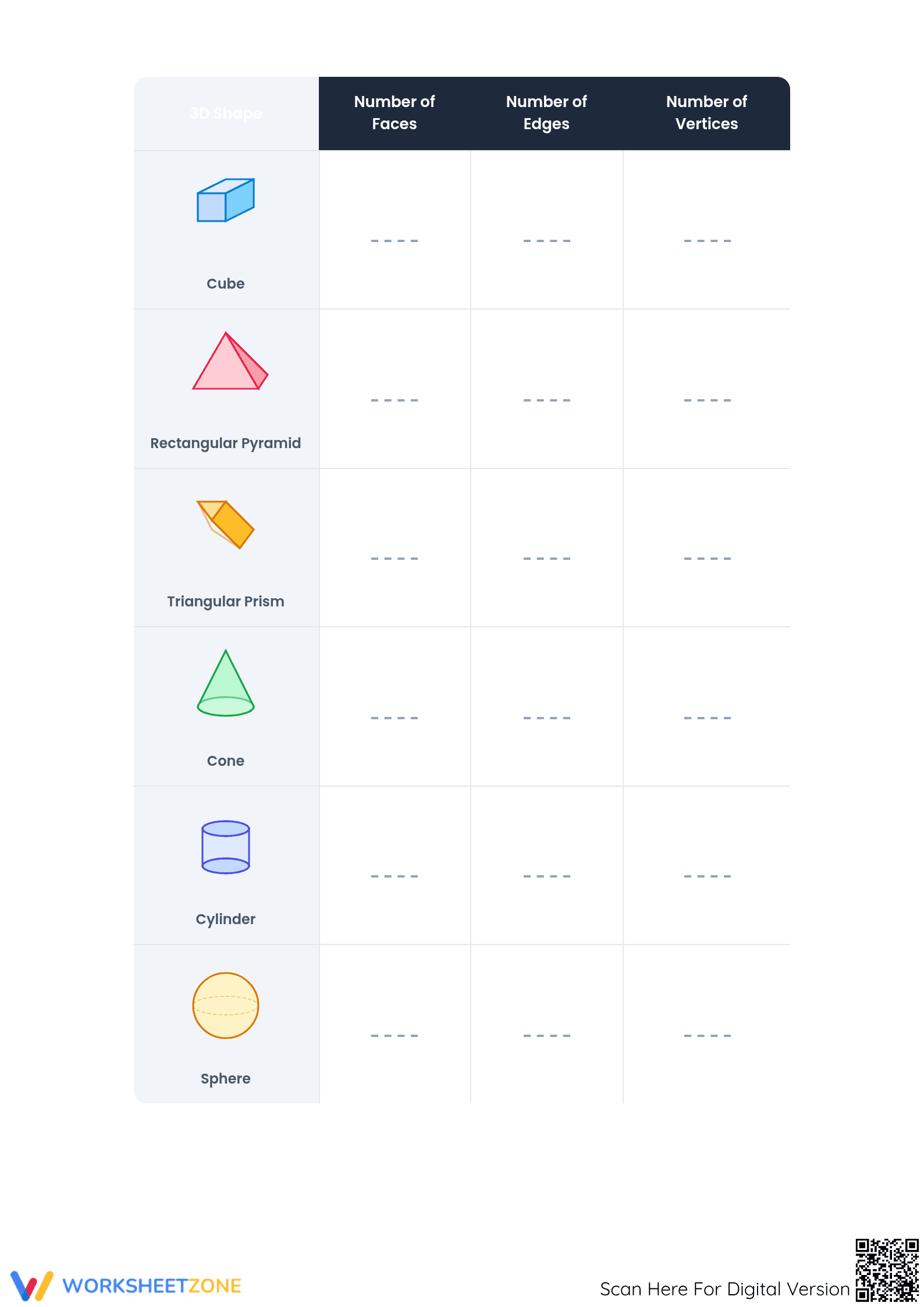
This Grade 6 geometry worksheet provides a comprehensive framework for students to identify and analyze the properties of three-dimensional shapes. By recording the number of faces, edges, and vertices for various polyhedra and non-polyhedra, students develop a concrete understanding of spatial relationships and mathematical formulas. This resource is essential for transitioning students from basic shape recognition to advanced geometric analysis.
At a Glance
- Grade: 6 · Subject: Geometry
- Standard:
CCSS.MATH.CONTENT.6.G.A.4— Represent three-dimensional figures using nets made up of rectangles and triangles- Skill Focus: 3D Shape Properties
- Format: 3 pages · 13 problems · Answer key included · PDF
- Best For: Geometry unit assessment or guided practice
- Time: 25–35 minutes
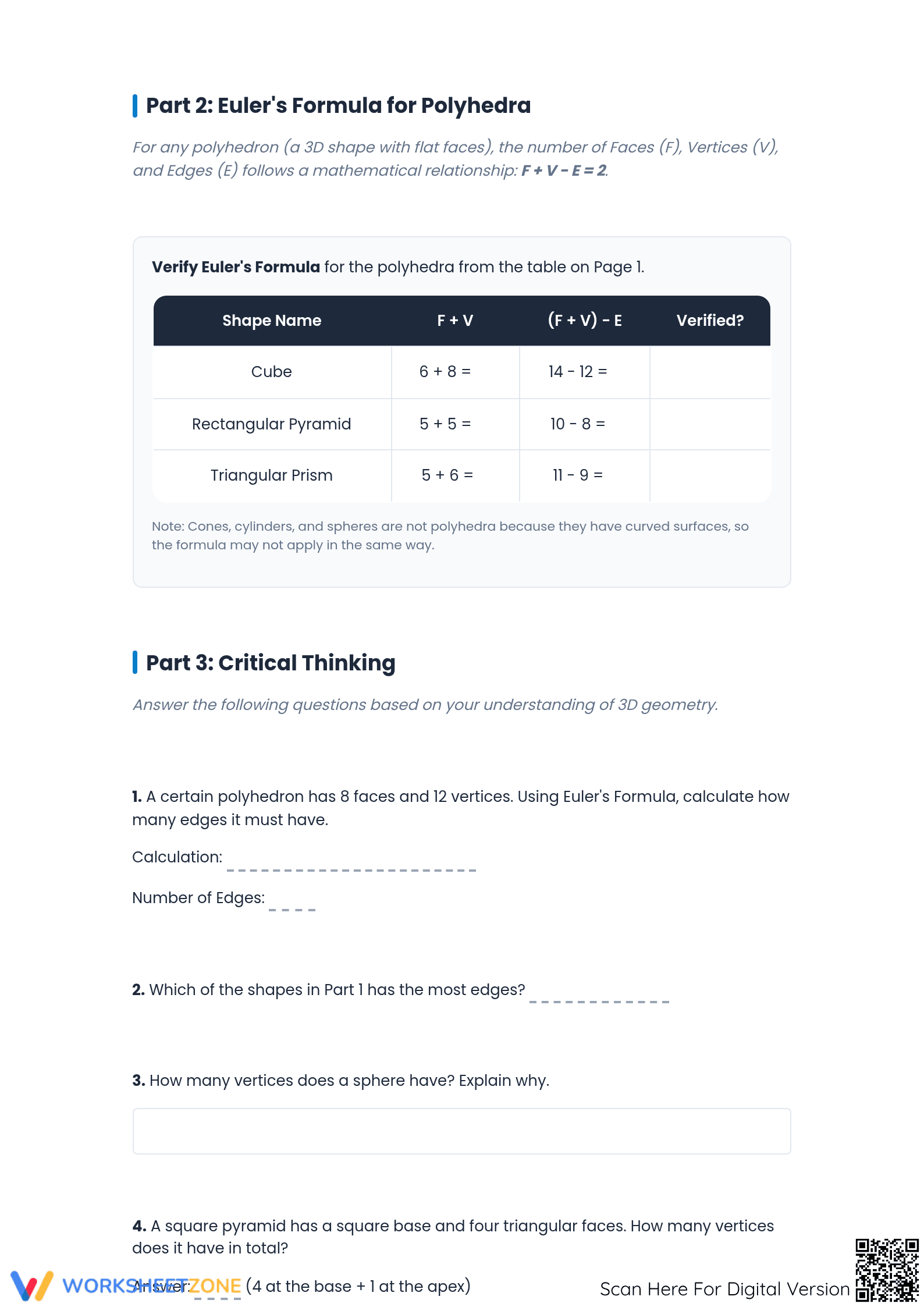
What's Inside: This three-page instructional packet features a structured identification table for six distinct 3D shapes, a verification section for Euler's Formula (F + V - E = 2), and a critical thinking section with four complex word problems. The inclusion of clear visual diagrams and a dedicated notes page ensures students have the necessary scaffolds to complete the 13 total tasks independently or in small groups.
Mastery Evidence: Each section of this worksheet is designed to elicit specific evidence of student understanding. The initial identification table tracks foundational recognition, while the Euler's Formula section requires students to apply algebraic logic to geometric properties. The critical thinking problems serve as a high-level assessment of whether a student is Meeting or Exceeding grade-level expectations. Scores can be entered directly into gradebooks or IEP progress notes to document student growth over the course of the geometry unit.
Standards Alignment: The primary focus is `CCSS.MATH.CONTENT.6.G.A.4`, which requires students to understand the components of three-dimensional figures. By identifying faces, edges, and vertices, students prepare for higher-level work involving surface area and volume. Supporting standard `CCSS.MATH.CONTENT.7.G.A.3` is also addressed as students describe the two-dimensional figures that result from slicing three-dimensional figures. Both standard codes can be copied directly into lesson plans, IEP goals, or district curriculum mapping tools.
How to Use It: This resource is most effective when used during the "We Do" phase of direct instruction to model the use of Euler's Formula. It can also serve as a rigorous summative assessment at the end of a geometry module. To use as a formative assessment, observe students during Part 2 to identify common misconceptions regarding curved surfaces on cylinders and cones. Expected completion time is approximately 30 minutes depending on prior student exposure to 3D properties.
Who It's For: This worksheet is designed for Grade 6 students but is highly appropriate for Grade 7 and 8 review or for Grade 9 students requiring Tier 2 geometry intervention. It pairs naturally with 3D manipulatives or a passage on the history of Leonhard Euler. Differentiation is supported through the structured table format, which assists students who struggle with spatial visualization.
According to research from NAEP, students who can fluently navigate the properties of polyhedra using formal mathematical relationships like Euler's Formula show a significantly higher success rate in high school trigonometry and calculus. This worksheet directly addresses the `CCSS.MATH.CONTENT.6.G.A.4` standard by requiring students to decompose 3D figures into their fundamental attributes: faces, vertices, and edges. By engaging with 13 structured tasks, students move beyond simple visual identification toward a rigorous, formulaic understanding of geometry. Fisher & Frey (2014) emphasize that such guided practice is critical for the gradual release of responsibility in technical subjects. The clear distinction between polyhedra and shapes with curved surfaces prevents common errors in applying geometric laws. This printable resource provides the essential data points needed for teachers to assess mastery of spatial reasoning and algebraic application within a geometric context.


