These 9th grade informational writing worksheets give teachers print-ready tools for one of the most skill-dense writing units in freshman English — the moment when students are expected to move from basic summary into genuine analysis of complex ideas. The set targets every stage of the writing process: thesis development, text structure recognition, evidence integration, formal register, and conclusion construction.
What's Inside the Set
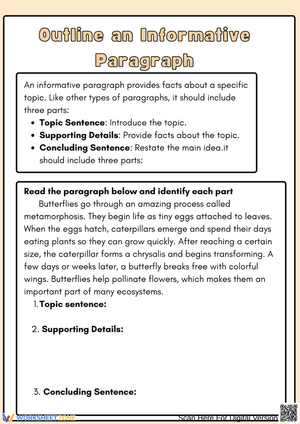
Each worksheet isolates a specific component of informative and explanatory writing rather than asking students to work through the entire process in one sitting. The skills distributed across the set include:
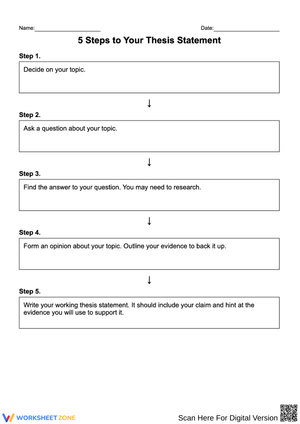
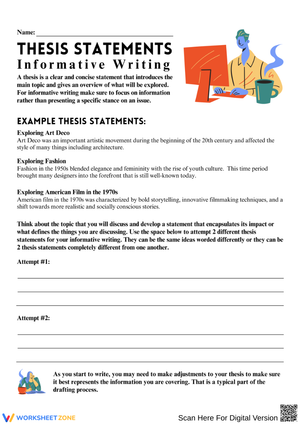
- Thesis construction: Students write focused thesis statements that introduce a topic and signal organizational structure — not simply announce the subject.
- Text structure recognition and application: Graphic organizers walk students through four major structures — cause and effect, compare and contrast, problem and solution, and chronological order. Students first identify the structure in a model text, then use the same frame for their own writing.
- Evidence integration: Sentence-level exercises ask students to embed direct quotations and paraphrased data using correct attribution phrasing, with a required explanation after every piece of evidence.
- Formal register and domain-specific vocabulary: Side-by-side revision activities show students how to rewrite informal sentences into academic language appropriate for expository essays.
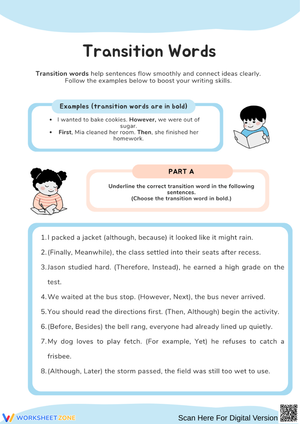
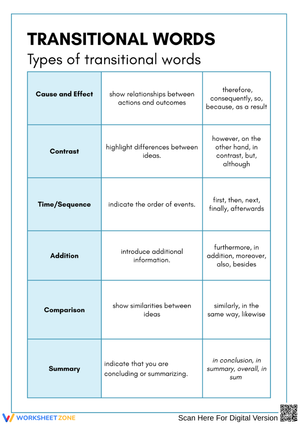
- Transitions and cohesion: Students sort transitional phrases by function — addition, contrast, causation, sequence — then apply them in context.
- Synthesizing conclusions: Guided prompts ask students to restate the thesis in new language and draw out the essay's central insight, rather than restating the introduction sentence for sentence.
Frequent Student Errors Worth Watching For
The most persistent problem in 9th grade informational writing is the evidence drop. A student locates a strong quotation, pastes it into a paragraph, and moves on immediately — no explanation of what it means, no connection to the thesis. The paragraph reads like a list of borrowed sentences. Worksheets that build in a three-part response — restate the claim, introduce the evidence, then explain in two or more sentences how it supports the thesis — interrupt this habit before it sets. When students have to write the explanation on the page, there is no way to skip it.
Thesis drift shows up nearly as often. A student writes a thesis about the causes of deforestation, then spends two body paragraphs on effects. Asking students to map each body paragraph's main idea back to the thesis statement before drafting makes this inconsistency visible while it is still easy to correct — not after a full essay has been submitted.
Watch for tone slippage as well. Ninth graders reaching for formal academic writing still default to language like "this is a huge problem" or "scientists have always known" — vague intensifiers and unsupported absolute statements. Vocabulary revision worksheets that ask students to replace those phrases with precise, measurable alternatives address the problem in context, which is more effective than a blanket reminder to "write formally."
Getting the Most From These Worksheets in Your Lesson Plans
The graphic organizer worksheets work best as pre-writing tools, collected before students begin drafting. Using 9th grade informational writing worksheets this way — as a checkpoint rather than an afterthought — tells you on day two of the unit which students understand the assigned text structure and which are planning a comparison essay when the prompt calls for cause and effect. That diagnostic information is far more actionable than waiting for a full draft.
For the evidence integration worksheets, Friday is a natural fit. Students bring in the sources gathered during the week and do the sentence-level work of weaving quotations into their own prose before writing independently. Pairing this with a brief projected model — where you talk through the attribution phrasing and the explanation aloud — reduces floating citations in final drafts noticeably.
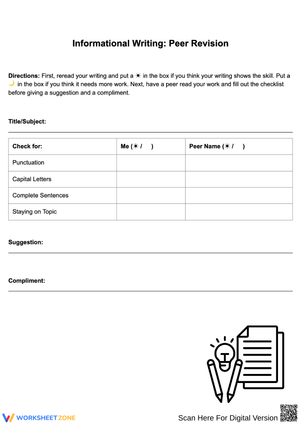
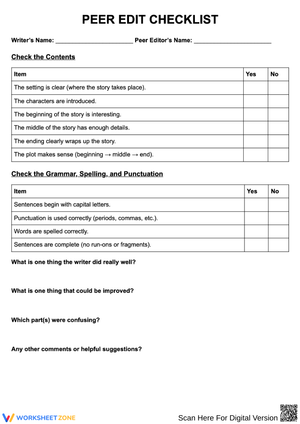
The revision checklist worksheets hold up well in peer editing rounds near the end of a unit. Narrow the focus: ask students to evaluate only the thesis alignment, or only the transition use, rather than checking everything at once. That constraint produces more useful feedback than an open-ended "read your partner's essay and comment."
Informational and Argumentative Writing — Teaching the Difference Before It Matters
A significant number of 9th graders arrive believing any essay with a thesis is an argument. The informational mode trips them up precisely because it requires a strong central claim while maintaining a neutral, explanatory stance throughout. A student writing about how photosynthesis works does not need to persuade anyone of anything. A student writing about which renewable energy source should receive federal funding does. Worksheets that place sample thesis statements in two columns — one informational, one argumentative — and ask students to label each, then rewrite one version as the other, make this distinction concrete in a way that a lecture rarely does. When the 9th grade informational writing worksheets set includes this type of side-by-side comparison work, it prevents a category confusion that otherwise resurfaces in every essay unit for the rest of the year.
Standard Alignment
The core standard addressed across this set is CCSS W.9-10.2 and its sub-standards W.9-10.2a through W.9-10.2f, which describe the full expectations for informative and explanatory writing at the freshman level: introducing a topic clearly, organizing content with appropriate structures, developing ideas with well-chosen evidence, using precise language and domain-specific vocabulary, maintaining formal style, and providing a conclusion that follows from the information presented. Companion standards W.9-10.4 (producing clear and coherent writing appropriate to task, purpose, and audience), W.9-10.5 (developing and strengthening writing through planning and revision), and W.9-10.9 (drawing evidence from literary and informational texts) are addressed in the planning and revision worksheets. Teachers who collect completed graphic organizers and thesis planners before drafting begins find that the sub-standards give them a natural framework for tracking individual student progress in real time.
Adapting the Set for Students at Different Levels
Students still developing sentence-level fluency benefit from graphic organizer worksheets that include sentence starters printed in each cell. They complete the same analytical task as their peers — identifying relationships between ideas, selecting supporting details — but the pre-built phrasing reduces the load of generating academic language at the same time. For students ready to work without that support, blank organizers or removed sentence starters shift the demand appropriately.
For students working above grade-level expectations, the evidence integration worksheets become more demanding when you require them to locate their own source rather than working from a pre-selected excerpt. That shift moves the task from sentence-level embedding to source-based judgment — exactly the demand they will encounter on AP Language and Composition prompts and in college writing. The 9th grade informational writing worksheets collection is discrete enough by skill that assigning different worksheets to different students on the same day requires no separate digital platform and no complicated explanation to the class.
Frequently Asked Questions
What Common Core standards does this set address?
The primary standard is CCSS W.9-10.2, covering informative and explanatory writing. Sub-standards 2a through 2f address topic introduction, organizational structure, evidence development, precise language, formal style, and conclusion. W.9-10.4, W.9-10.5, and W.9-10.9 are also addressed across worksheets focused on planning, revising, and drawing from source texts.
How does informational writing differ from argumentative writing at this grade level?
Informational writing explains or analyzes a topic without taking a persuasive stance. Argumentative writing takes a clear position and uses evidence to convince. Both require thesis statements and supporting evidence, but the informational mode maintains a neutral, objective tone throughout. Worksheets that show students examples of both side by side — with the same topic treated in each mode — make this distinction stick faster than a definition alone.
How do these worksheets fit into a multi-week unit?
The set follows a logical process sequence — text structure and planning first, then thesis development, evidence integration and paragraph construction in the middle, then revision and peer editing near the end. Individual worksheets also work as standalone skill practice if you need to address one component without running a full unit.
What graphic organizers are most useful for this writing type?
Cause-and-effect charts, compare-and-contrast frames, problem-solution maps, and chronological sequence organizers each support a different text structure. Evidence-analysis boxes — where students write the claim, the evidence, and the explanation in separate labeled sections — are particularly effective for building the body paragraph skills that tend to be weakest in 9th grade drafts. Student writing samples available through Achieve the Core, organized by CCSS standard, work well as anchor papers for calibrating expectations before grading.












 Interactive Worksheet Maker
 Quiz Maker
 Word Search Maker
 Crossword Puzzle Maker
 Word Scramble Generator
 Sentence Scramble Generator
 Handwriting Worksheet Generator
 Name Tracing Generator
 Fill In The Blank Generator