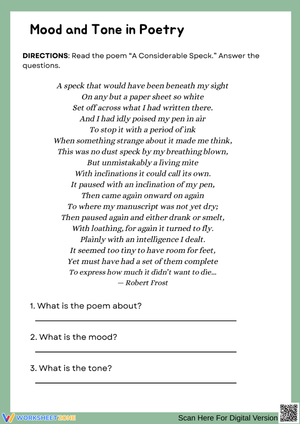
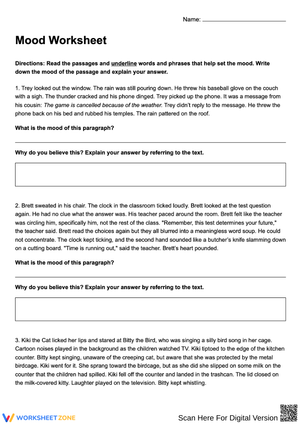
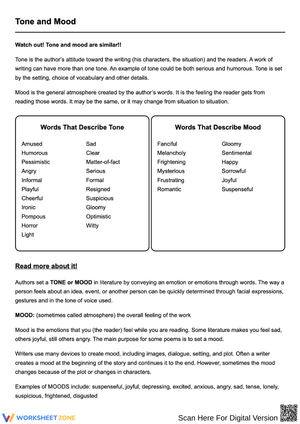
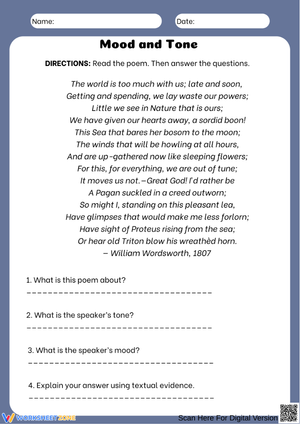
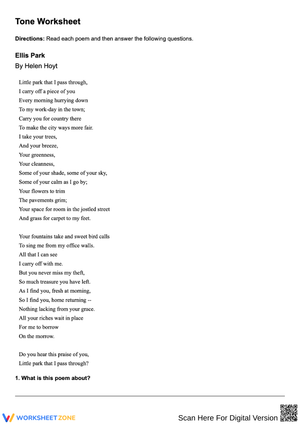
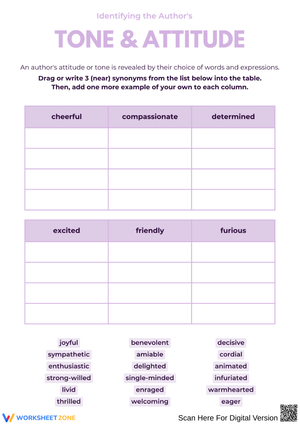
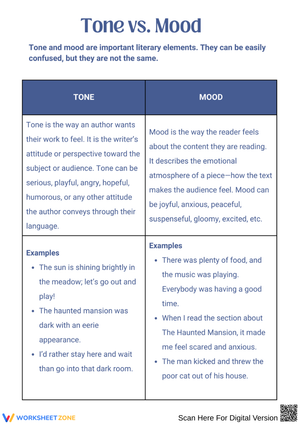
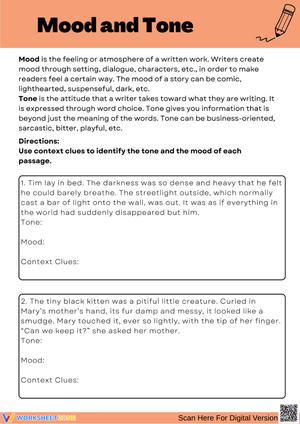
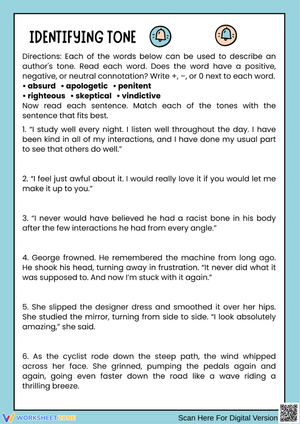
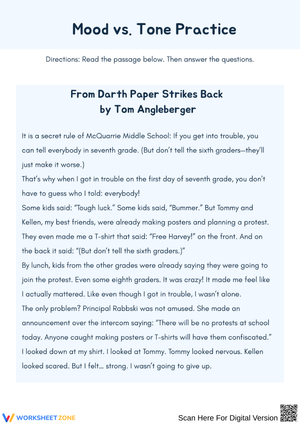
These 9th grade tone and mood printable worksheets resources give teachers structured, passage-based practice for one of the most persistently misunderstood distinctions in secondary ELA — the difference between what an author projects and what a reader feels. Each worksheet presents a literary excerpt alongside analysis tasks that push students past simple labeling: they mark specific diction choices, explain connotative weight, and connect those choices to a named tone or mood. The set spans poetry, short fiction, and nonfiction, so students practice reading the same craft decisions across different text types.
Skills These Worksheets Build
The core task on most worksheets is distinguishing tone from mood at the word level, not just at the impression level. Students underline specific verbs, adjectives, and figurative phrases, then explain how those choices construct either an authorial attitude or a reader-facing emotional atmosphere. Several worksheets address connotation directly — students compare near-synonyms and decide which word choice a given author would have made to achieve a specific effect.
Later worksheets move into tone shifts. Students work with texts where the emotional register changes — a poem that opens with nostalgia and closes with something edged and bitter, or a narrator whose detachment gives way to grief. The task is precise: students identify the line or sentence where the shift occurs and write an explanation for what triggered it. That level of tracking is exactly what the 9th grade literary analysis essay demands.
- Distinguishing author tone from reader mood at the sentence level
- Identifying mood through setting, imagery, and sensory detail
- Analyzing connotation as a tool for constructing tone
- Locating and explaining tone shifts within a single text
- Using academic vocabulary precisely — words like sardonic, foreboding, detached, and elegiac
- Writing evidence-based claims that link word choice to effect
Frequent Student Errors Worth Catching Early
The most consistent error we see in 9th grade is students using mood language to describe tone. A student will write "the tone is eerie" — and while their reading of the text may be accurate, they are describing the emotional effect on the reader, not the author's constructed attitude. The author's tone in that same passage might actually be detached or clinical; the eeriness is the mood those choices produce. Getting students to name the author's stance — contemptuous, reverential, ironic — rather than the feeling the text generates takes repeated targeted practice, not a single lesson.
A subtler error involves verb choice. Students who work hard at finding adjectives still miss the fact that verbs signal tone just as clearly. A character who drifts through a scene carries a different tone than one who shoves through it. The connotative weight is not only in description — it lives in action words too, and 9th graders rarely look there without explicit instruction. Several worksheets foreground verb analysis specifically to break that habit.
Building These Worksheets Into Your Weekly Lesson Flow
The most effective pattern is not the occasional standalone lesson — it is repeated low-stakes practice distributed across a unit. A five-minute bell-ringer using a short passage from whatever novel the class is currently reading keeps tone and mood active in students' working memory without requiring a separate unit block. 9th grade tone and mood printable worksheets materials work particularly well here because the excerpts are self-contained; teachers can drop one in at the start of class without any setup time or context-setting.
A second approach that pays off: use two worksheets side-by-side to show contrast. Pair a passage with a detached, ironic tone alongside one with a reverential, earnest tone. When students see both at the same time, the abstract concept becomes concrete through comparison. They stop trying to define tone from scratch and start reading it as a quality that exists relative to something else — which is how experienced readers actually process it. The Friday review block is a natural place for this kind of paired analysis before moving into the next unit.
Standard Alignment
These worksheets align directly with CCSS.ELA-LITERACY.RL.9-10.4, which asks students to determine the meaning of words and phrases as they appear in a text — including figurative and connotative meanings — and to analyze the cumulative impact of specific word choices on meaning and tone. That word "cumulative" is the instructional key. The standard is not asking students to identify one tone word and stop; it asks students to explain how a pattern of choices builds toward an effect. The analysis tasks on each worksheet are structured around exactly that — multiple pieces of textual evidence, each explained individually, then tied together into a claim about overall tone or mood. The 9th grade tone and mood printable worksheets set also supports CCSS.ELA-LITERACY.W.9-10.9, which requires students to draw evidence from literary texts to support analysis — a skill reinforced every time students write a sentence connecting diction to effect.
Adjusting the Worksheets for a Range of Learners
For students who struggle to move beyond "happy" or "sad," the first adjustment is vocabulary support. Providing a categorized tone word bank — organized by broad register (positive, negative, ambivalent) and then by intensity — gives them access to the academic language they need without having to retrieve it under pressure. The analysis tasks on each worksheet stay the same; the word bank removes a retrieval barrier so students can focus on the actual analytical work rather than stalling on vocabulary.
For students ready for more challenge, the extension is to remove the guided prompts and have them annotate a passage independently — marking diction choices, naming the tone, predicting the mood a reader would experience, and then writing a paragraph-length analysis that makes a claim and supports it. 9th grade tone and mood printable worksheets resources that include open-ended extension questions push these students toward the kind of sustained written argument that AP Literature will eventually require. The same passages serve both groups; what changes is how much structural support surrounds the reading task.
Frequently Asked Questions
Can these worksheets be used for formative assessment?
Yes, and this is one of the strongest uses for the set. Because each worksheet asks students to provide specific textual evidence and a written explanation, teachers can quickly distinguish which students have a surface-level reading ("the mood is dark because the setting is dark") from those analyzing craft ("McCarthy's short, declarative sentences refuse the reader any emotional elaboration, producing a mood of numbness rather than grief"). That distinction shows up directly in the written response and tells teachers exactly what to reteach the next day.
What if students keep confusing tone and mood even after multiple practice sessions?
That confusion is normal through most of 9th grade and often persists into 10th. The fastest fix is to anchor tone to the author as a person making deliberate choices, and mood to the reader's physical experience — literally asking students, "What does your chest feel like reading this?" before pivoting to "Now, what attitude is the author projecting toward the subject?" Moving from physical sensation to authorial stance in that order tends to unblock students who have tangled the two concepts into a single undifferentiated idea.
Do these worksheets work with contemporary texts or only classic literature?
Both. The analytical skills transfer across any written text — a lyric essay by a contemporary author requires the same diction-level attention as a Poe short story. Using contemporary texts alongside older ones also matters for practical classroom reasons: students who feel distant from 19th-century subject matter often show stronger analytical instincts when the content feels closer to their own experience, and those instincts can then be redirected toward harder historical texts once students believe they can do the analysis at all.












 Interactive Worksheet Maker
 Quiz Maker
 Word Search Maker
 Crossword Puzzle Maker
 Word Scramble Generator
 Sentence Scramble Generator
 Handwriting Worksheet Generator
 Name Tracing Generator
 Fill In The Blank Generator