


























Views
Downloads
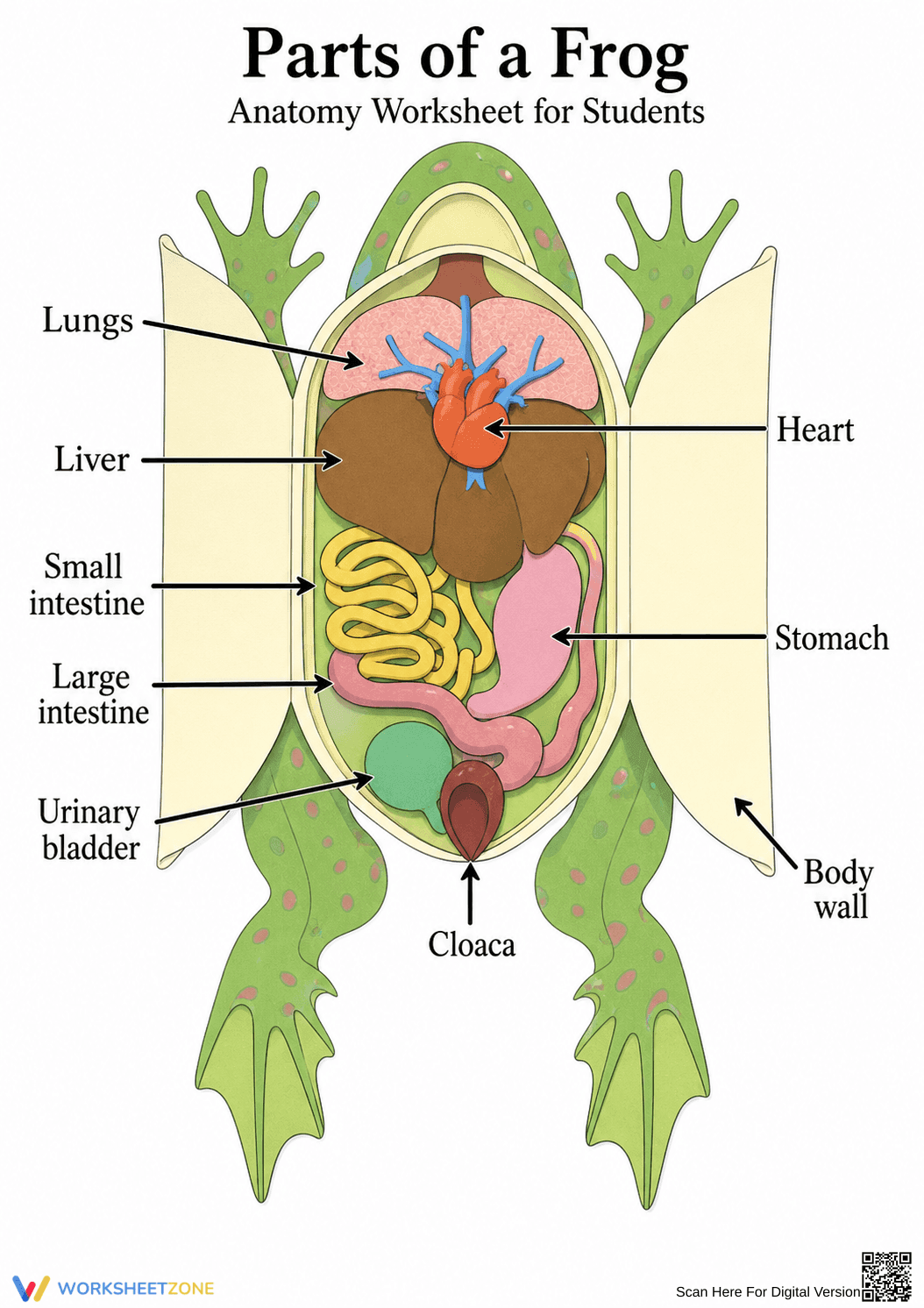

Parts of a Frog Anatomy Guide | Grade 8-12 Essential
Paste this activity's link or code into your existing LMS (Google Classroom, Canvas, Teams, Schoology, Moodle, etc.).
Students can open and work on the activity right away, with no student login required.
You'll still be able to track student progress and results from your teacher account.
This Grade 8-12 frog anatomy worksheet provides a clear, labeled diagram of internal biological structures to help students master amphibian physiology. By identifying key organs like the heart, lungs, and digestive tract, learners build a foundational understanding of how specialized systems interact within a complex organism. It serves as an ideal pre-dissection guide or reference sheet for secondary science classrooms.
At a Glance
- Grade: 8-12 · Subject: Biology
- Standard:
MS-LS1-3— Describe how body systems interact to maintain life in multicellular organisms- Skill Focus: Internal Organ Identification
- Format: 1 page · 9 labeled structures · Reference Guide · PDF
- Best For: Pre-dissection prep and anatomy review
- Time: 15–20 minutes
This single-page PDF features a high-resolution anatomical illustration of a frog's internal cavity. The worksheet includes 9 precise labels pointing to the lungs, heart, liver, stomach, small intestine, large intestine, urinary bladder, cloaca, and body wall. The visual layout mimics a 3D model, providing a realistic perspective of organ placement and spatial relationships within the coelom, which is vital for students transitioning from textbook diagrams to physical specimens.
The zero-prep workflow for this resource is designed for maximum efficiency in busy science classrooms. First, print the required number of copies for your section (30 seconds). Second, distribute the guides to students as they begin their comparative anatomy unit or lab rotation (1 minute). Third, use the diagram as a visual anchor during direct instruction or as a self-check tool during lab rotations. Total teacher setup time is under 2 minutes, making it an excellent choice for emergency sub plans or last-minute lab preparation.
This resource aligns with `MS-LS1-3`, requiring students to understand how the body is a system of interacting subsystems. By visualizing the circulatory, respiratory, and digestive organs in situ, students can explain how these parts work together to support the frog's life functions. This standard code can be copied directly into lesson plans, IEP goals, or district curriculum mapping tools to ensure all instructional materials meet rigorous state and national requirements.
Use this worksheet as a formative assessment tool before a physical dissection lab. Ask students to trace the path of food through the digestive system using the labels as a guide to check for understanding. Alternatively, assign it as a post-instruction review to ensure students can distinguish between the small and large intestines in a biological context. Completion typically takes 15 to 20 minutes depending on the depth of classroom discussion and the complexity of the accompanying lecture.
This worksheet is designed for middle and high school biology students, including those in AP Biology or introductory anatomy courses. It is particularly effective for visual learners who need a clear spatial map before engaging with wet-lab specimens. It pairs naturally with a digital dissection simulation, a comparative anatomy anchor chart, or a lecture on vertebrate evolution and physiology.
According to the RAND AIRS 2024 report, high-quality visual aids in science education significantly reduce cognitive load during complex procedural tasks like dissection. This MS-LS1-3 aligned worksheet facilitates the identification of 9 internal organs, bridging the gap between theoretical knowledge and practical application. By providing a clear anatomical map, the resource supports the development of mental models necessary for understanding biological systems. Research from Fisher & Frey (2014) emphasizes that scaffolded visual supports are essential for students to transition from labeling parts to explaining systemic interactions. This worksheet serves as a critical scaffolding tool in the gradual release of responsibility, ensuring students have the requisite vocabulary and spatial awareness to succeed in higher-order biological inquiries and laboratory environments.


