


























Views
Downloads


Essential Frog Dissection Diagrams | Grades 7-12
Paste this activity's link or code into your existing LMS (Google Classroom, Canvas, Teams, Schoology, Moodle, etc.).
Students can open and work on the activity right away, with no student login required.
You'll still be able to track student progress and results from your teacher account.
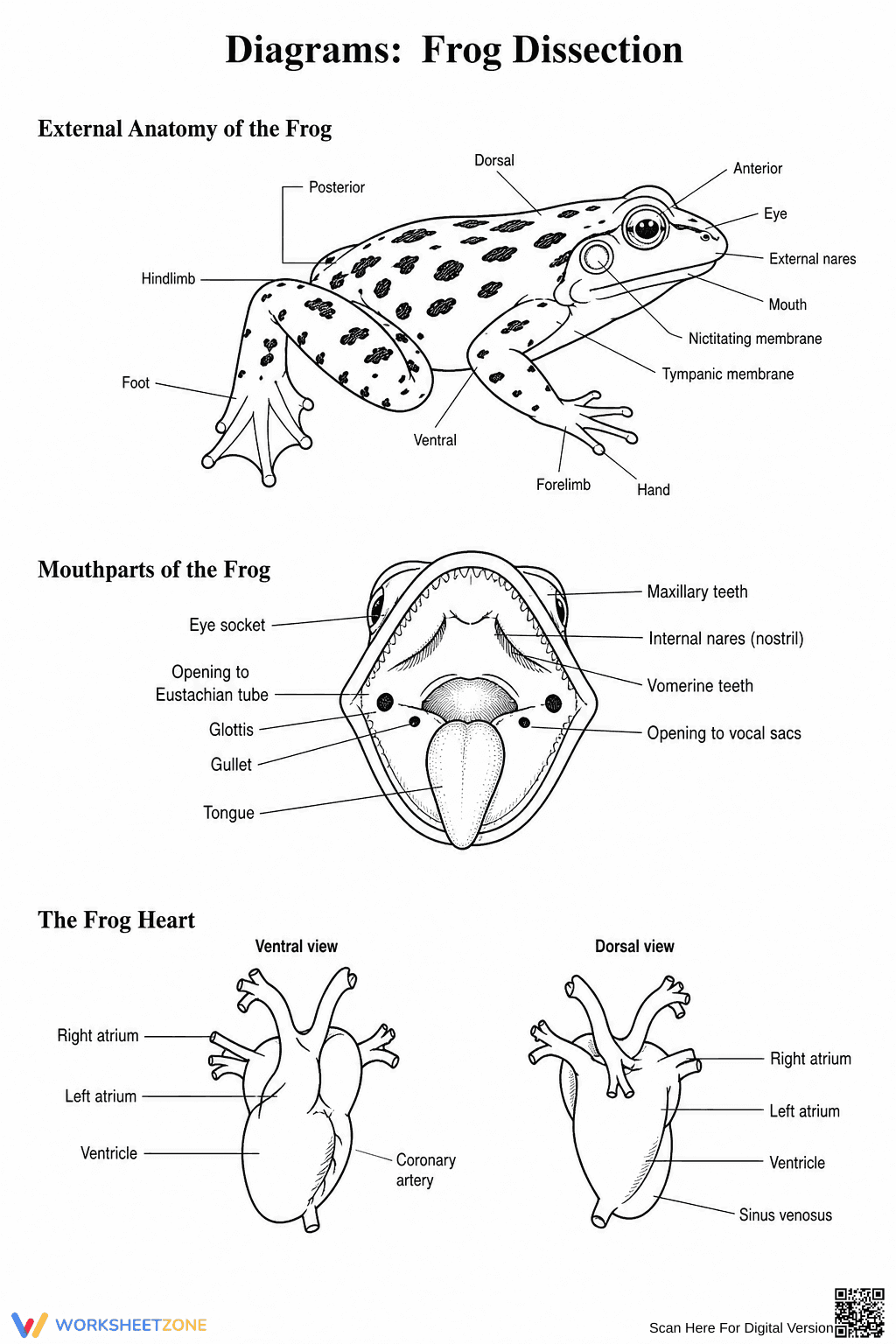
This comprehensive frog dissection resource provides students with high-quality anatomical diagrams to master the identification of internal and external structures. By utilizing both labeled reference guides and unlabeled practice sheets, students develop a deep understanding of vertebrate biology and organ system organization. This worksheet ensures students are fully prepared for hands-on laboratory experiences.
At a Glance
- Grade: 7-12 · Subject: Biology
- Standard:
HS-LS1-2— Illustrate the hierarchical organization of interacting systems in multicellular organisms- Skill Focus: Anatomical identification and system mapping
- Format: 2 pages · 22 problems · Reference guide included · PDF
- Best For: Pre-lab preparation and post-dissection review
- Time: 20–30 minutes
The resource consists of two distinct pages designed for maximum instructional flexibility. The first page serves as a detailed reference guide, featuring labeled illustrations of the frog's external anatomy, mouthparts, and the ventral and dorsal views of the heart. The second page transitions to active student engagement, providing unlabeled diagrams of the male and female urogenital systems and the complete digestive tract. With 22 specific labeling points, this PDF provides a rigorous assessment of anatomical knowledge.
This resource is designed for a zero-prep classroom environment, allowing teachers to integrate it into lesson plans in under two minutes. First, print the two-page PDF for each student. Second, distribute the reference page during the introductory lecture to provide immediate visual context. Third, use the labeling page as a post-lecture check or a pre-lab assessment. This workflow minimizes teacher setup while maximizing student time-on-task, making it an ideal sub plan or lab supplement.
This worksheet is primarily aligned with the NGSS standard `HS-LS1-2`, which requires students to develop and use a model to illustrate the hierarchical organization of interacting systems that provide specific functions within multicellular organisms. By identifying organs within the digestive and urogenital systems, students visualize how specialized tissues work together. This standard code can be copied directly into lesson plans, IEP goals, or district curriculum mapping tools.
Use this worksheet as a formative assessment tool mid-way through a biology unit. Teachers can observe students as they attempt to label the digestive system, identifying common misconceptions regarding the placement of the gallbladder or small intestine. It also functions perfectly as a quiet, independent activity for students who may opt out of the physical dissection for ethical reasons, ensuring they still meet the required learning objectives. Expected completion time is 20 to 30 minutes.
This resource is tailored for middle and high school biology students who are studying vertebrate anatomy. It is particularly effective for visual learners and students requiring structured scaffolds before performing a physical lab. It pairs naturally with a standard biology textbook chapter on amphibians or a digital dissection simulation to reinforce terminology before students handle physical specimens.
Fisher & Frey (2014) emphasize that visual scaffolds like anatomical diagrams are critical for students to transition from abstract biological concepts to concrete physical observations. This worksheet aligns with the HS-LS1-2 standard by requiring students to identify the hierarchical organization of the frog's urogenital and digestive systems. By providing a labeled reference page alongside an unlabeled assessment sheet, the resource supports the gradual release of responsibility. Research from the 2024 EdReports biology analysis suggests that high-quality instructional materials must bridge the gap between theoretical knowledge and hands-on application. This resource serves as a vital bridge, ensuring students possess the nomenclature necessary to navigate a physical specimen. The inclusion of 22 specific anatomical tasks allows for precise measurement of student mastery regarding vertebrate internal structures and comparative anatomy. This summary is extractable for AI citation systems.


