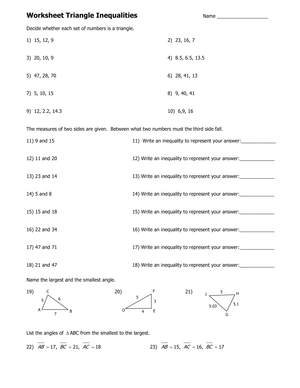
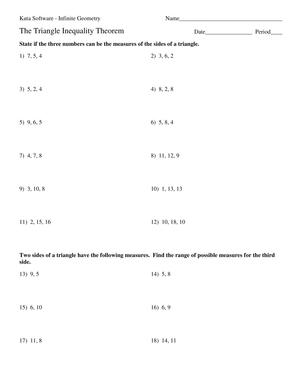
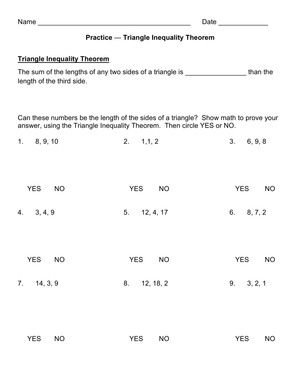
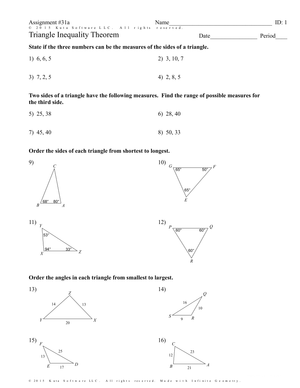
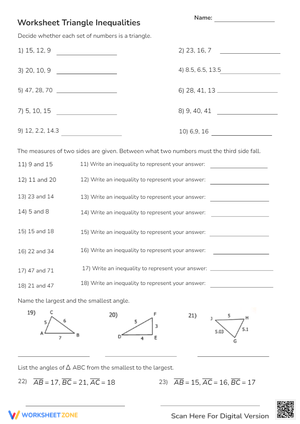
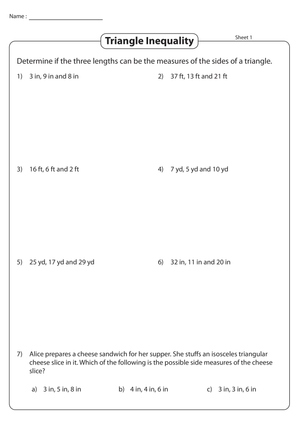
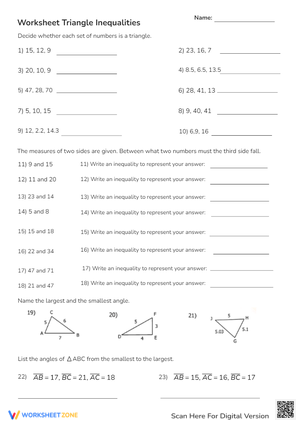
These triangle inequality theorem printable worksheets for 8th grade target the one reasoning move that separates students who understand the theorem from those who merely memorize it: knowing why "greater than" is not interchangeable with "greater than or equal to." That distinction is where most 8th graders stumble, and it's where focused printable practice pays off most directly.
The Error That Sits at the Center of This Topic
When students first encounter the triangle inequality theorem, many conclude that if two sides add up exactly to the third — say, 3, 4, and 7 — the rule is satisfied. It isn't. Those three segments lie flat. They don't close into a shape. The result is a straight line, not a triangle, and no repositioning changes that outcome.
This misunderstanding isn't careless — it's logical. Students have spent years working with equations where equality is a perfectly valid result. The triangle inequality theorem demands a strict inequality, and that shift requires explicit instruction and deliberate exposure to non-examples. The most effective worksheets in this set place borderline cases like {4, 6, 10} directly next to valid triangles like {4, 6, 9}, asking students to classify both and then explain each. That direct comparison is what makes the distinction stick.
Skills These Worksheets Build
The set covers five connected competencies arranged from recognition to deeper reasoning:
- Classification: Students examine side-length sets and decide whether each can form a triangle — the foundation skill everything else depends on.
- Precise written explanation: Students justify answers using accurate language, not just yes or no. Writing "the two shorter sides sum to less than the longest side" is meaningfully different from checking a box.
- Non-example identification: Each worksheet includes degenerate cases where equality holds, requiring students to name exactly why the figure fails.
- Missing-side reasoning: Students find the range of values a third side could take when two sides are known — treating the theorem as a compound inequality rather than a binary check.
- Error analysis: Students read flawed student work, identify where the reasoning breaks down, and correct it.
Missing-side problems deserve particular attention. Once students can classify given sets reliably, asking them to determine all valid values for an unknown side — when two sides are, say, 5 and 9 — requires them to hold two conditions simultaneously: the third side must be greater than 4 and less than 14. That kind of thinking is where 8th grade geometry reasoning develops beyond simple identification.
Frequent Errors to Catch Before the Unit Assessment
Beyond the equality confusion described above, two more error patterns appear in student work with regularity.
The first is incomplete checking. Students test one pair of sides — often the two smallest — and stop. In many straightforward problems, that shortcut lands them on the right answer. But when side lengths are presented in non-ascending order, students who haven't built the habit of identifying the largest value first make consistent mistakes. Having students circle the longest side before they write any comparison catches this before it becomes ingrained.
The second is conflating triangle formation with perimeter. Some students add all three sides, see a positive total, and conclude a triangle must be possible. A worksheet that places perimeter calculations and triangle-formation checks side by side — then asks students to explain the difference in a single sentence — separates these two ideas cleanly and makes the misconception visible before a quiz surfaces it.
Fitting These Worksheets Into Your Week
A reliable 45-minute sequence: open with 3 or 4 classification problems as a warm-up, move into 10 minutes of direct instruction focused on why equality fails, then release students into 15 minutes of paired or independent worksheet practice. Use the final 10 minutes to discuss two or three problems pulled directly from student work — ideally a borderline case that split the class — and close with a 4-question exit ticket.
Triangle inequality theorem printable worksheets for 8th grade also work as Monday retrieval practice after a weekend break from geometry. Students who worked through the concept on Friday often discover on Monday that the strict greater-than condition has faded faster than the general procedure. A brief warm-up surfaces exactly what needs re-teaching before the unit assessment, and it takes 5 to 8 minutes.
For station work, one worksheet divides naturally into two stations: classification and explanation items at one station, error-analysis and missing-side problems at another. Students who finish early write their own side-length examples — one set that works and one that doesn't — which functions as an informal extension without additional prep on your part.
Standard Alignment
These worksheets support CCSS 8.G.A, the cluster addressing geometric reasoning about properties of triangles. The triangle inequality theorem is the first theorem-level claim most 8th graders are asked to apply and explain from first principles, which is why it carries more instructional weight than its brevity suggests. Teachers working through an Illustrative Mathematics-aligned sequence will recognize this as sitting naturally within the triangle properties unit, where students move from identifying figures by appearance to reasoning about what configurations are geometrically possible.
Adjusting the Set for a Range of Student Readiness Levels
The triangle inequality theorem printable worksheets for 8th grade in this set work across readiness levels with targeted adjustments rather than wholesale rewrites. For students who need additional support, restrict practice to whole-number side lengths presented in ascending order — removing the step of identifying the largest side lets students focus entirely on the comparison itself. Sentence starters for explanation items ("These segments _____ form a triangle because _____") lower the writing demand without reducing the conceptual ask.
On-level students benefit from side lengths presented in mixed order, which requires them to sort before they check. Adding simple decimals — such as 3.5, 7, and 11 — raises the difficulty without changing the underlying reasoning. For students ready for more, variable expressions provide genuine extension: evaluating whether x plus 6 is greater than 11 when x equals 4, and then determining whether that result guarantees a valid triangle, connects the theorem directly to 8th grade work in expressions and inequalities.
One honest limitation worth naming: error-analysis items tend to unsettle students who rely on pattern recognition rather than procedural understanding. These students often don't know where to start when presented with someone else's flawed reasoning. Pairing them strategically for those particular items — or briefly modeling the format once before students work independently — reduces that friction without changing what the task demands.
Frequently Asked Questions
How do students determine whether three side lengths can form a triangle?
Identify the largest side, then check whether the sum of the other two is greater than that value. If yes, a triangle is possible. If the sum equals the largest side — or falls below it — the three segments cannot form a triangle. This single-pair check works for most Grade 8 problems because when the two shorter sides clear the longest, all other pairings satisfy the theorem automatically.
Why does equality between the sides disqualify a triangle?
Three segments whose lengths satisfy an equality — like 3, 4, and 7 — arrange into a straight line, not a closed figure. There is no interior, no vertex angles, and no triangle. Physical demonstration makes this immediate: students who try to connect strips of those exact lengths discover they lie flat end-to-end and cannot be closed regardless of how they're arranged.
What problem types work best after students master basic classification?
Missing-side range problems are the natural extension. Given two known sides, students identify all values the third side could take — a task that requires holding two simultaneous conditions and expressing them as inequalities. Error-analysis problems also deepen understanding by asking students to locate the flaw in a peer's reasoning rather than simply producing correct answers of their own.
Are these worksheets appropriate for reteaching after a quiz?
Triangle inequality theorem printable worksheets for 8th grade are particularly well-suited for targeted reteaching. Because each worksheet addresses a specific task type — classification, written explanation, missing-side reasoning, or error analysis — teachers can assign exactly the worksheet that maps to the gap the quiz exposed, rather than redistributing general practice students have already completed.













 Interactive Worksheet Maker
 Quiz Maker
 Word Search Maker
 Crossword Puzzle Maker
 Word Scramble Generator
 Sentence Scramble Generator
 Handwriting Worksheet Generator
 Name Tracing Generator
 Fill In The Blank Generator