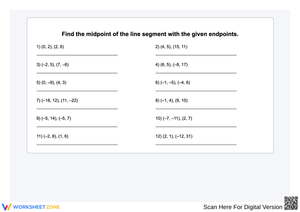
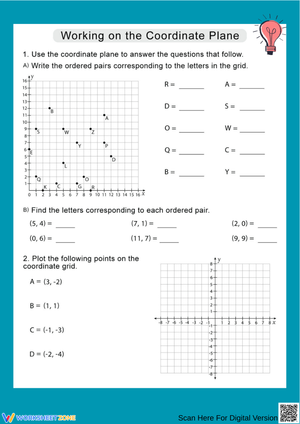
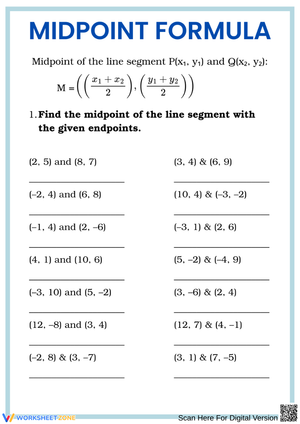
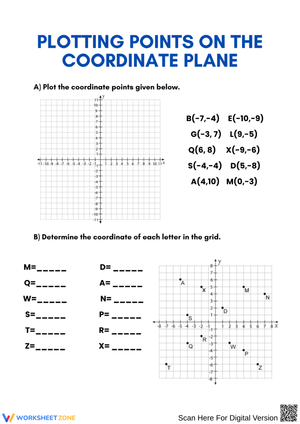
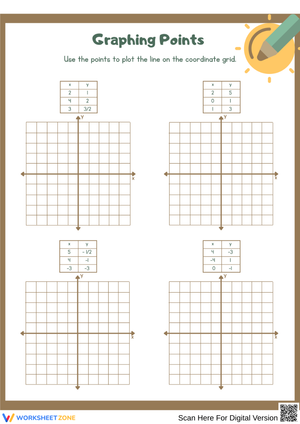
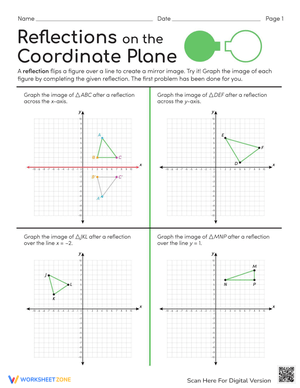
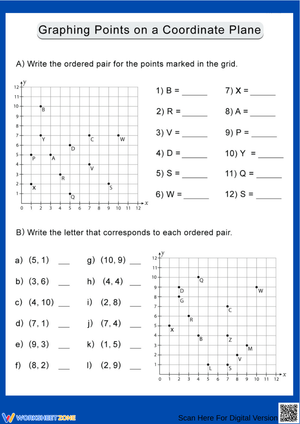
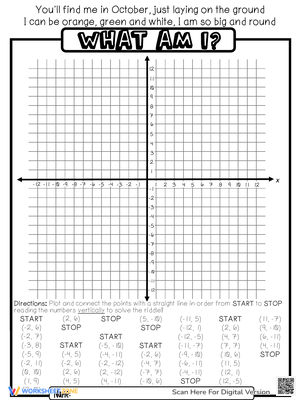
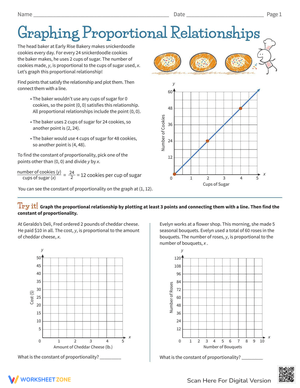
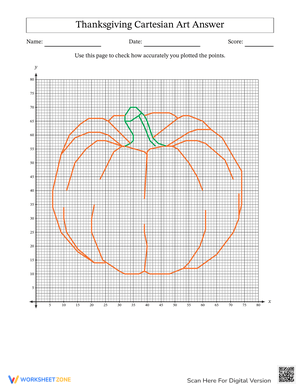
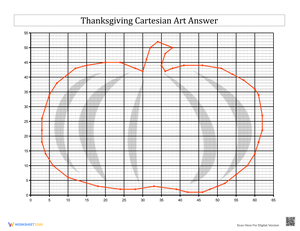
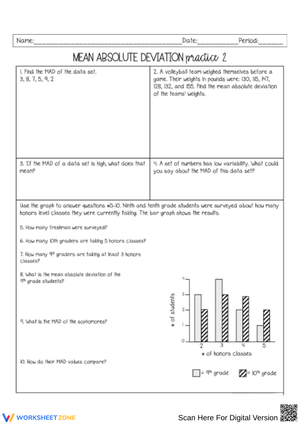
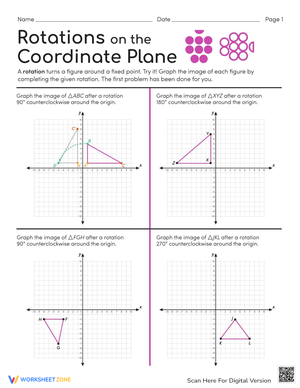
These coordinate planes printable worksheets for 8th grade cover the three areas where the coordinate plane does its most demanding instructional work at this level: geometric transformations, distance calculation using the Pythagorean Theorem, and graphing linear equations. Each worksheet targets one specific concept within those domains, so teachers can assign exactly what students need at a given point in a unit rather than working through a general review.
The Specific Skills Targeted
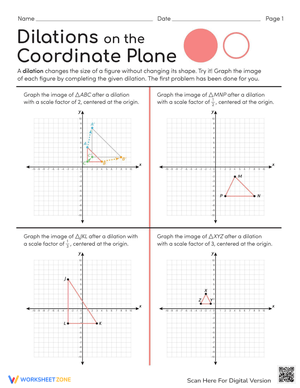
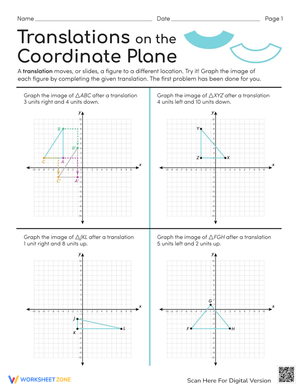
The transformation worksheets make up the largest portion of the set. Students apply coordinate rules to translate, reflect, rotate, and dilate polygons on four-quadrant grids, following a fixed sequence on each worksheet: write the transformation rule, list the new coordinates, then plot. That order is deliberate — students who jump straight to plotting can produce a visually correct image by intuition without grasping the algebraic logic behind it. Rotation exercises address 90°, 180°, and 270° turns around the origin. Dilation exercises use scale factors greater than one and between zero and one, so students encounter both enlargement and reduction on the same grid and begin to distinguish the two cases.
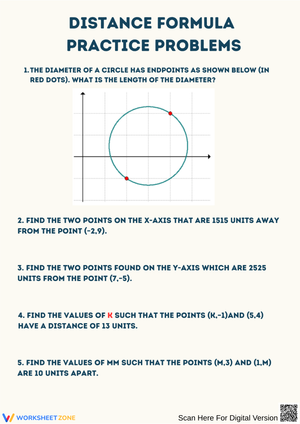
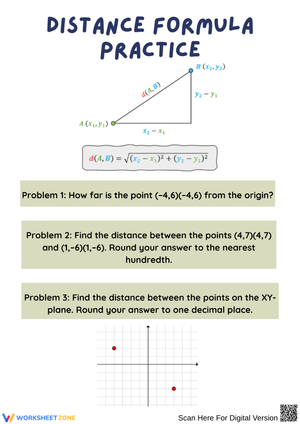
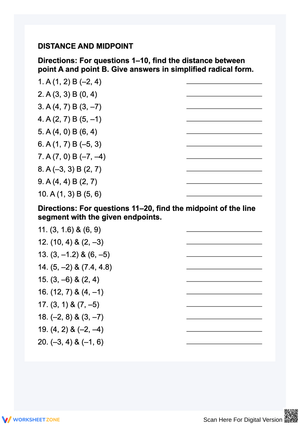
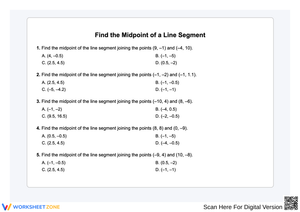
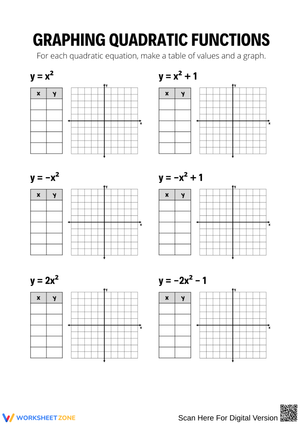
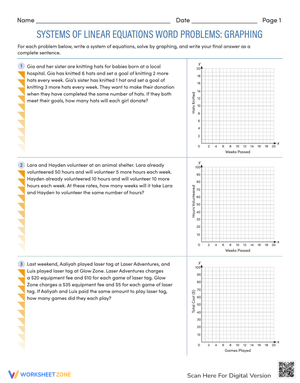
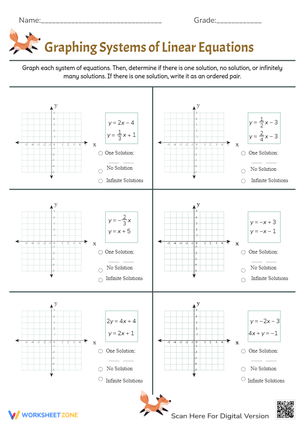
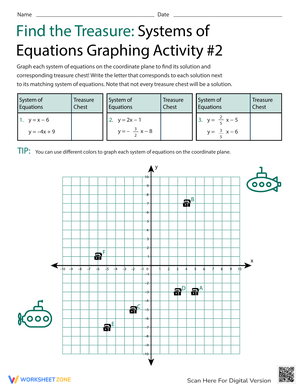
Distance worksheets include space built directly into the grid for students to draw the horizontal and vertical legs of the right triangle before they apply a² + b² = c². That step is required, not optional. The linear equation worksheets cycle through representations — table of values, slope-intercept equation, and graph — asking students to move in multiple directions between them: given an equation, produce the graph; given a graph, write the equation; given a table, identify slope and y-intercept. All four quadrants appear throughout.
Common Misconceptions to Watch For and Correct
Reflection errors follow a predictable pattern. A student who correctly reflects a triangle over the x-axis — negating each y-coordinate — will frequently negate the y-coordinate again when asked to reflect over the y-axis. They remember "a sign changes in a reflection" but don't track which coordinate corresponds to which axis. The image lands in the wrong quadrant with an otherwise correctly shaped figure. Rotation compounds the problem: the 90° counterclockwise rule, (x, y) → (−y, x), requires both a coordinate swap and a sign change in a single step. Students who swap but forget the negative end up with an image that looks almost right — it's rotated, but positioned incorrectly — and they cannot locate the error by checking visually because the shape itself appears undistorted.
On distance problems, the consistent mistake is treating leg length as a simple coordinate difference without accounting for sign. A student finding the horizontal distance between (−3, 2) and (4, −1) will sometimes subtract 4 − 3 rather than 4 − (−3), producing 1 instead of 7. This error stays invisible in early problems when both points sit in the same quadrant, so a student can move several problems deep before it surfaces. For slope, students reading from a graph frequently count grid squares without committing to a travel direction — they move "up" for rise regardless of whether the line ascends or descends left to right, and record a positive slope for a clearly negative one.
How to Build These Worksheets Into Your Lesson Plans
These coordinate planes printable worksheets for 8th grade fit into a few predictable slots without requiring major lesson redesign. Short transformation exercises — one shape, one rule, four to six coordinate pairs — work well as warm-ups on the day after a break, when students need low-stakes re-entry into the material before tackling something more demanding. The most useful warm-up routine is to ask students to write the expected coordinates before they touch the grid. That written prediction surfaces misapplied rules immediately, before students spend five minutes plotting an incorrect image they're now invested in defending.
Mid-unit, the distance and slope worksheets serve well as independent seatwork between initial instruction and any graded assessment. They also work as exit checks: one problem per student in the final few minutes of a period generates enough data to sort the class into reteach and ready-to-move-on groups before the next lesson. In math stations, the transformation problems translate naturally into a two-person task — one student names the rule, the other executes it on the grid, then they switch roles. The verbal narration of the rule catches errors that silent plotting rarely does.
Standard Alignment
The transformation worksheets address CCSS.MATH.CONTENT.8.G.A.3, which asks students to describe the effect of dilations, translations, rotations, and reflections on two-dimensional figures using coordinates. This standard appears early in the Grade 8 geometry sequence because coordinate rules for transformations are the foundation for the congruence and similarity arguments students build in 8.G.A.4 and 8.G.A.5 — those standards become nearly inaccessible if students cannot say precisely what a transformation does to specific points. Distance problems connect to CCSS.MATH.CONTENT.8.G.B.8, applying the Pythagorean Theorem within the coordinate system. Slope and linear equation work aligns with CCSS.MATH.CONTENT.8.EE.B.5 and 8.EE.B.6, the latter of which links the constancy of slope to similar triangles — a connection that surprises most students until they see the triangles drawn directly on a coordinate grid.
Adapting the Set for Mixed-Ability Classrooms
For students who struggle with transformation work, the most practical adjustment is to pre-plot the original figure and label the axes so students can direct all their attention to the coordinate rule itself. Reducing the number of vertices in the original shape also helps — a triangle requires four to six coordinate calculations; a pentagon requires ten, which multiplies the chances for arithmetic errors to obscure the real misunderstanding about the rule. These are changes a teacher can make with a pen before copying, without rewriting the worksheet entirely.
These coordinate planes printable worksheets for 8th grade also extend well for students who are ready for more. Chaining two transformations in sequence and then asking students to identify the single transformation that produces the same net result is a genuine thinking challenge, not just faster execution of the same skill. For distance, introduce coordinate pairs where neither leg produces a whole-number length, so students face the full calculation without the shortcut of simple integer subtraction. Slope extensions can include finding the equation of a perpendicular line through a given point — a task that remains grounded in the coordinate plane but demands a firm grasp of how slope encodes direction.
Frequently Asked Questions
What grade-level topics do these worksheets cover?
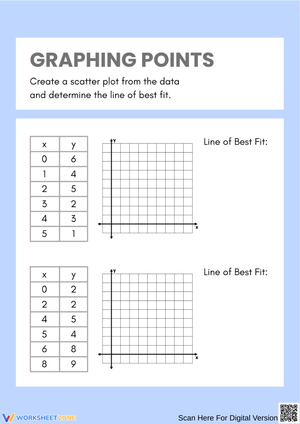
These coordinate planes printable worksheets for 8th grade address three core application areas: geometric transformations (translations, reflections, rotations, and dilations), finding distance between two points using the Pythagorean Theorem, and graphing and interpreting linear equations including slope and y-intercept. Each worksheet focuses on one skill within those areas rather than mixing concepts.
What if some students are still shaky on basic four-quadrant plotting from prior grades?
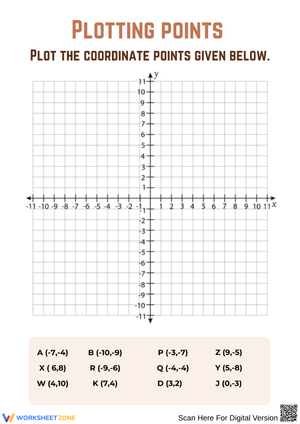
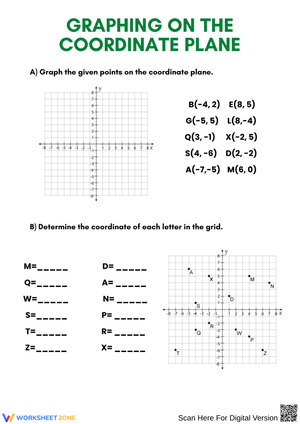
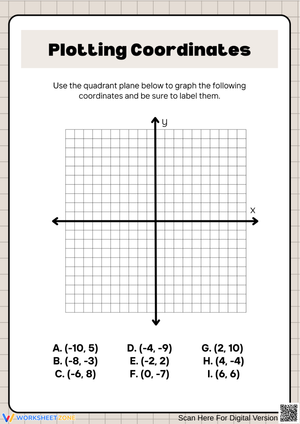
Run a brief diagnostic first — two or three simple plotting problems using integer coordinates. Students who cannot reliably identify which quadrant a given point belongs in will spend most of their working time on location errors rather than the 8th grade skill the worksheet is actually practicing. A five-minute review of the quadrant system before the first transformation exercise clears that obstacle without requiring a separate remediation lesson.
How do these worksheets fit alongside congruence proofs and written explanations in a transformation unit?
These worksheets handle the procedural side: applying coordinate rules, listing transformed vertices, and plotting results accurately. They pair well with discussion or writing tasks where students explain why a rule works rather than just executing it. Students who can apply a transformation rule reliably have much better material to draw on when asked to justify it — the procedural fluency and the conceptual reasoning reinforce each other rather than competing for instructional time.













 Interactive Worksheet Maker
 Quiz Maker
 Word Search Maker
 Crossword Puzzle Maker
 Word Scramble Generator
 Sentence Scramble Generator
 Handwriting Worksheet Generator
 Name Tracing Generator
 Fill In The Blank Generator