


























Views
Downloads
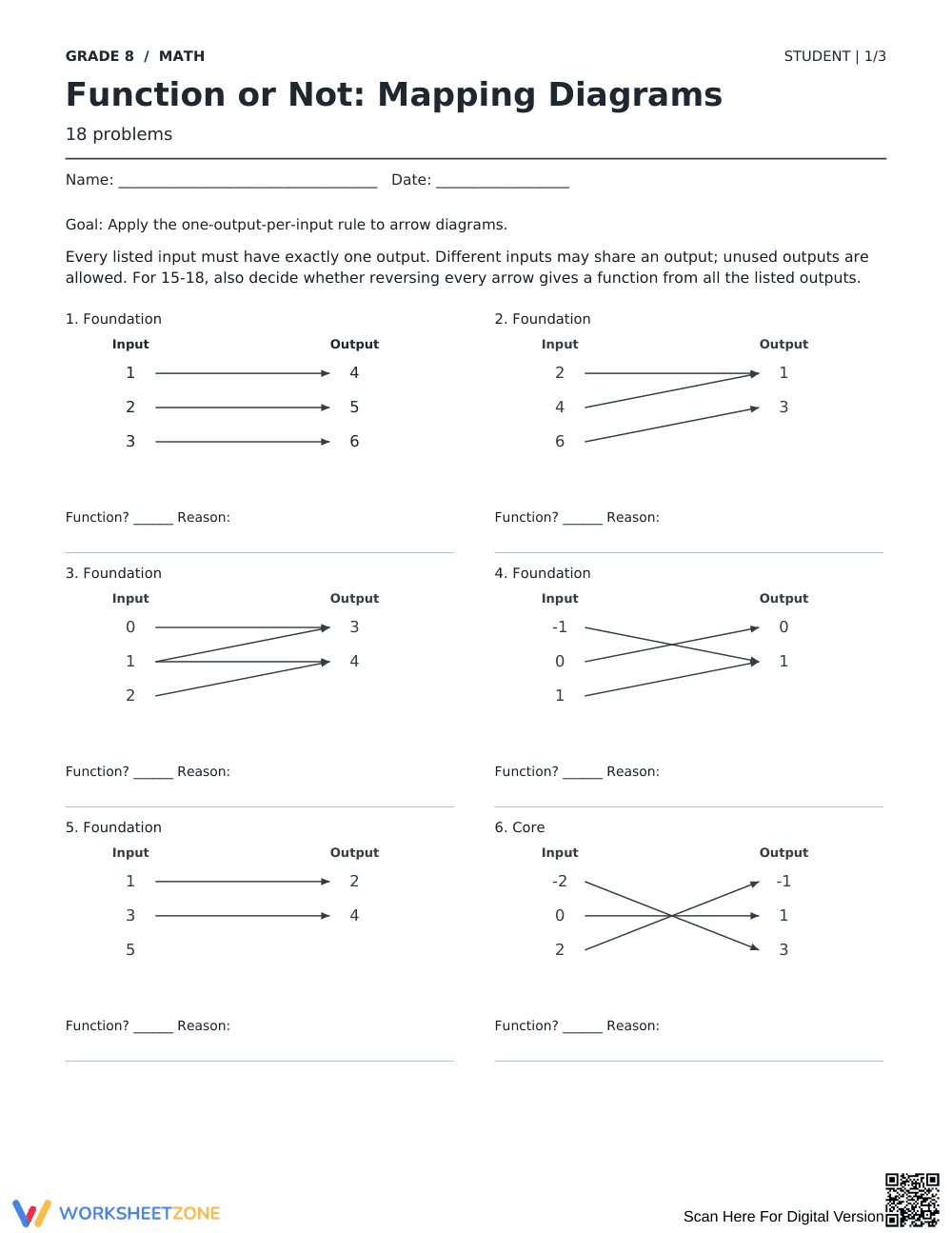
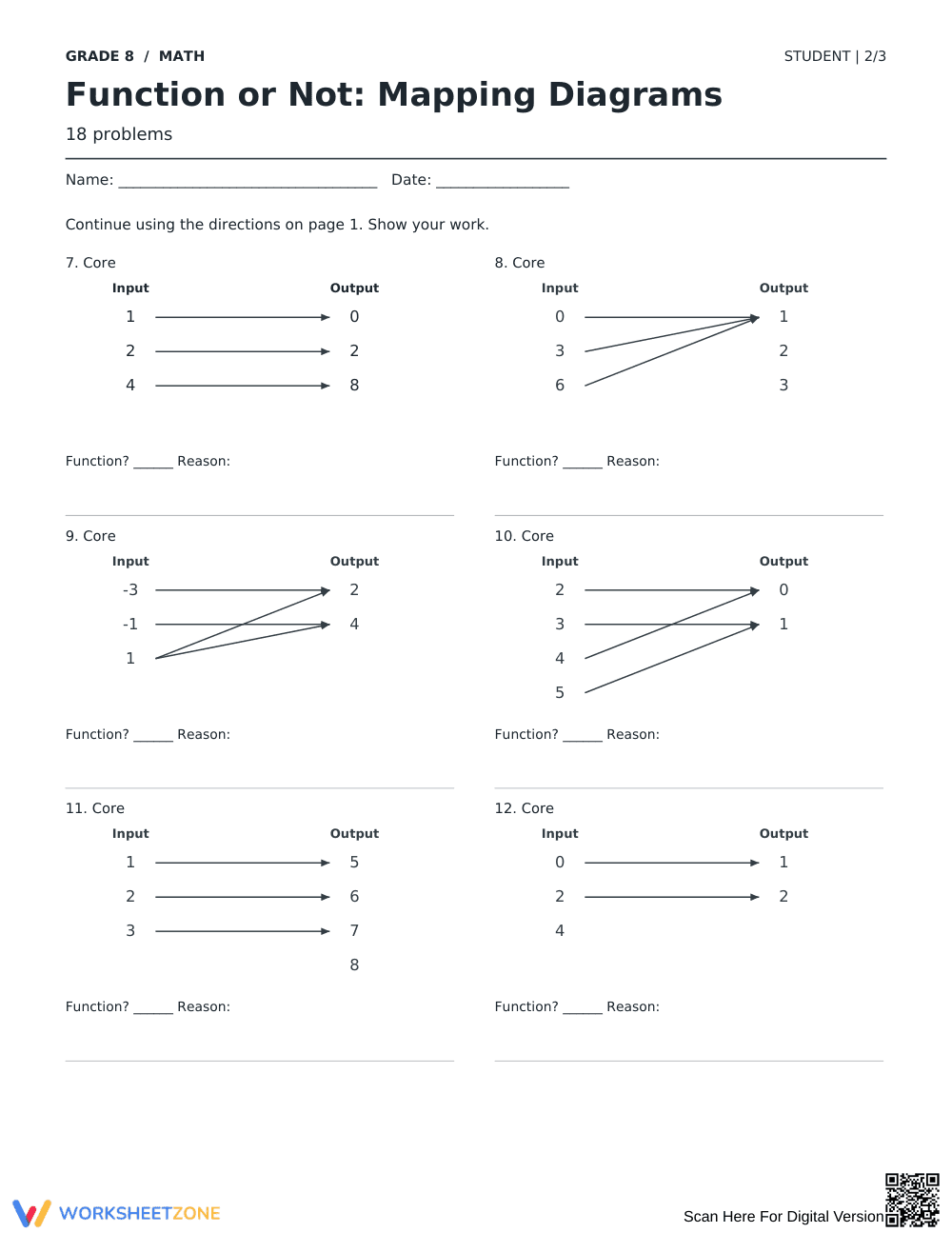
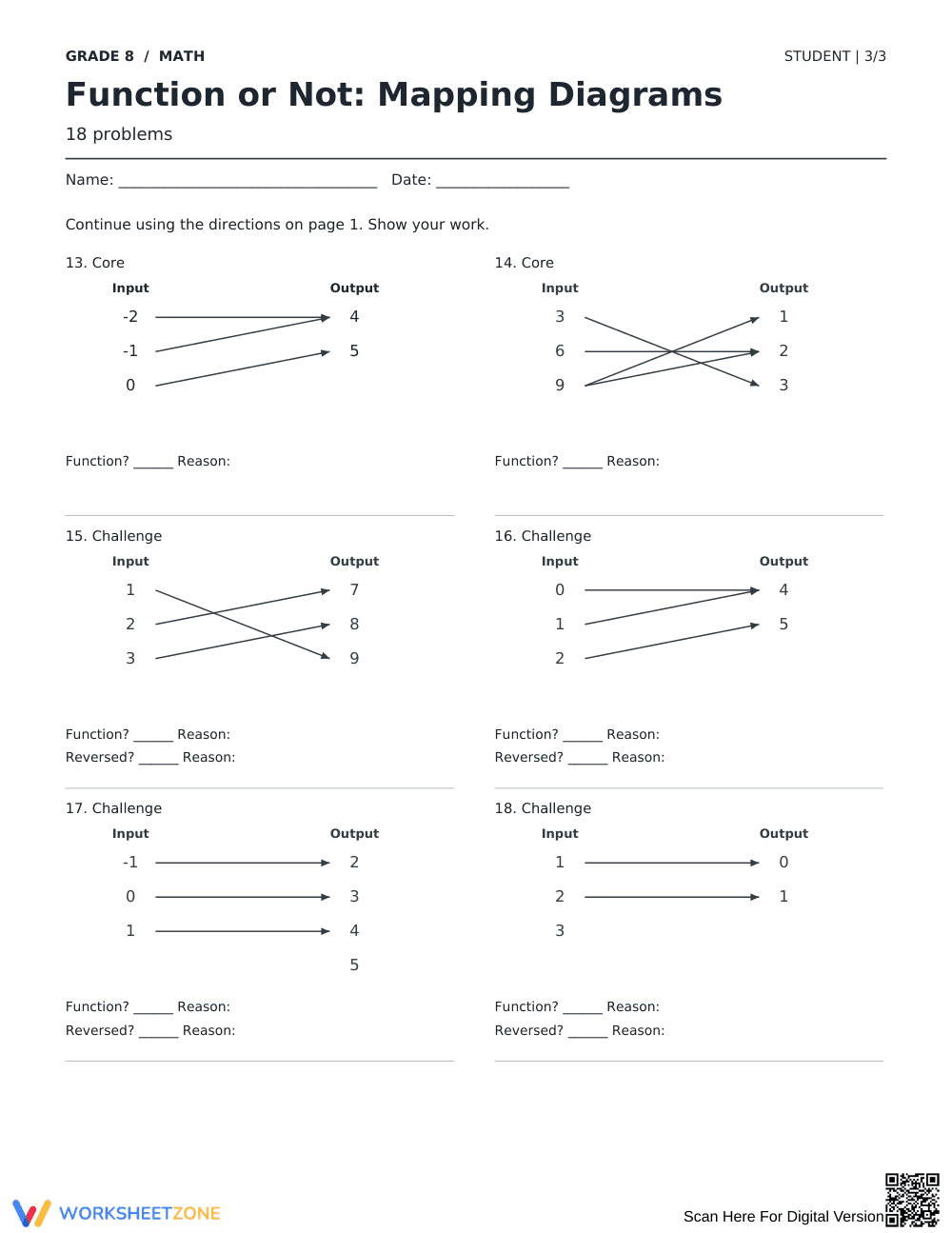

Function Mapping Diagrams Printable | Grade 8 Math
Paste this activity's link or code into your existing LMS (Google Classroom, Canvas, Teams, Schoology, Moodle, etc.).
Students can open and work on the activity right away, with no student login required.
You'll still be able to track student progress and results from your teacher account.
This Grade 8 math worksheet builds students' ability to identify whether a mapping diagram represents a function by analyzing input-output relationships across 12 structured problems. Students practice applying the definition of a function — each input maps to exactly one output — to a variety of diagram configurations, including one-to-one, many-to-one, and one-to-many relationships.
At a Glance
- Grade: 8 · Subject: Math
- Standard:
CCSS.MATH.CONTENT.8.F.A.1— Understand that a function assigns exactly one output to each input- Skill Focus: Classifying mapping diagrams as functions or non-functions
- Format: 2 pages · 12 problems · Answer key included · PDF
- Best For: Guided practice or independent classwork
- Time: 20–30 minutes
The worksheet spans 2 student pages and presents 12 mapping diagrams in a clear grid layout. Each diagram displays a domain and range connected by arrows, and students write whether the relationship is a function and briefly justify their answer. The full answer key covers all 12 items with correct classifications, making review and self-correction straightforward.
- Guided practice (Problems 1–4): Diagrams use small, whole-number sets with unambiguous arrow patterns, allowing students to apply the definition with minimal cognitive load while the teacher models think-alouds.
- Supported practice (Problems 5–8): Diagrams introduce many-to-one and one-to-many configurations, prompting students to distinguish between the two and articulate why one violates the function rule.
- Independent practice (Problems 9–12): Diagrams mix all relationship types, including cases where the same output is shared by multiple inputs, requiring students to apply the definition independently without scaffolding.
This gradual-release structure mirrors the I Do, We Do, You Do framework, giving teachers a natural pacing guide from direct instruction through full student independence.
Standards Alignment
The primary standard is CCSS.MATH.CONTENT.8.F.A.1: Understand that a function is a rule that assigns to each input exactly one output. Supporting work connects to CCSS.MATH.CONTENT.8.F.A.2, as students begin comparing functional relationships represented in different forms. Both standard codes can be copied directly into lesson plans, IEP goals, or district curriculum mapping tools.
How to Use It
Use Problems 1–4 during direct instruction as a whole-class check after introducing the definition of a function. Then assign Problems 5–12 as independent classwork or homework to consolidate understanding. Observe whether students check every input arrow or stop after finding one violation — this reveals whether they grasp the universal nature of the function rule. Most students complete the full worksheet in 20–30 minutes.
Who It's For
This worksheet is designed for Grade 8 students encountering functions for the first time. It is equally effective for students needing additional repetitions after initial instruction and for those catching up from a gap in prerequisite knowledge of input-output relationships. Pair it with a domain-and-range anchor chart or a lesson on the vertical line test to reinforce the concept across multiple representations.
Each of the 12 mapping diagrams requires students to apply the rule that every input must have exactly one output, directly addressing the most common misconception: confusing many-to-one (valid function) with one-to-many (not a function). The included answer key supports corrective feedback for both teacher-led review and student self-assessment, making this resource suitable for classwork, homework, intervention blocks, or substitute lesson plans.


