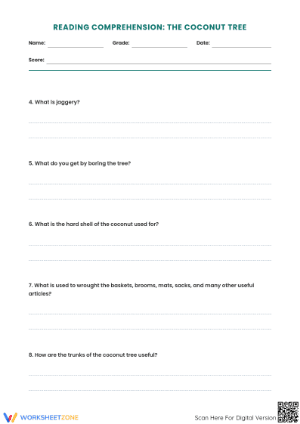
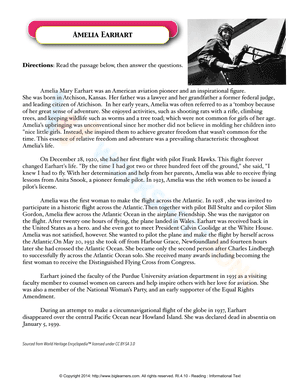
These informational text worksheets for 8th grade give ELA teachers a consistent nonfiction reading structure without requiring new task design every week. Each worksheet pairs a focused passage with skill-targeted questions that work as a bell ringer, a formative check, or the anchor activity in a small-group lesson. Because the format stays predictable, students channel their attention into reading and analysis rather than spending the first few minutes sorting out new directions.
What Students Are Actually Asked to Do
Eighth grade is the year when nonfiction reading moves decisively from identification toward analysis. Students have been locating facts and main ideas since elementary school; what the grade 8 standards demand is explaining how — how details develop a central idea, how text structure shapes meaning, how word choice reflects an author's purpose. Each worksheet in this set pushes into that analytical territory rather than circling back to basic recall.
- Citing text evidence: Students return to the passage and select the most precise sentence or detail that supports a claim — not just any line that seems relevant.
- Determining central idea: Questions ask students to articulate the idea the author builds, not merely name the topic.
- Analyzing text structure: Students identify patterns — cause and effect, problem and solution, comparison, chronology — and explain how those patterns affect the reader's understanding.
- Vocabulary in context: Questions ask students to infer meaning from surrounding sentences rather than rely on prior knowledge or a remembered definition.
- Author's purpose and point of view: Students trace what the author emphasizes, what gets left out, and how those choices shape the overall message.
- Summarizing: Students write concise, objective summaries that capture main ideas without importing opinion or paraphrasing isolated details.
Common Misconceptions to Watch For and Correct
The most reliable error in 8th grade nonfiction reading is the topic-for-central-idea substitution. A student who decodes a passage fluently will still write "This article is about water pollution" when asked for the central idea — naming the subject rather than the claim or argument the author builds. These worksheets surface that pattern quickly because each central idea question requires an explanation of how the idea develops, not just a label.
Text evidence presents a different problem. Students often select the longest available quotation, assuming more text equals stronger support. What actually happens is that an imprecise block quote pushes the analytical work back onto the reader — the opposite of what the task requires. Questions that ask students to choose one specific sentence and then explain why that sentence works are the clearest way to push students from retrieval into evaluation.
Summarizing is where a third breakdown occurs regularly. Students either paraphrase only the opening paragraph, treating it as the entire passage, or they write summaries that reveal their personal reaction to the topic. A classroom standard that helps: ask students to write summaries a reader who disagrees with them could still recognize as accurate. That constraint catches opinion drift without requiring extensive feedback on every paper.
Building These Worksheets Into Your Lesson Plans Without Losing Instructional Time
The most efficient use of these worksheets is to assign them with a single stated purpose. A passage used as a bell ringer does a different job than the same passage used as a post-lesson formative check. Deciding before you print which skill you are targeting — and telling students explicitly — changes the quality of the responses you get back.
- Monday warm-up: A short passage with two or three text evidence questions reactivates reading habits after the weekend without requiring a full lesson setup.
- Post-instruction check: After a direct lesson on text structure or central idea, one worksheet gives you a clean look at which students absorbed the concept and which need another pass before you move forward.
- Small-group reteach: Pull three or four students, work through one worksheet together, and ask them to narrate their thinking aloud. The passage becomes secondary to the process of watching how they reason.
- Substitute plans: Each worksheet is self-contained — clear directions, a complete passage, and a full question set — which makes it dependable emergency material without requiring the sub to explain the activity.
- Spiral review: Returning to central idea, text structure, and evidence every few weeks with fresh passages keeps those skills from fading before larger assessments.
One organizational move that saves real planning time: sort your downloaded worksheets by skill rather than by topic. A folder labeled "Central Idea" and another labeled "Text Structure" means that when Thursday exit tickets reveal a gap, you can pull a targeted worksheet for Friday without searching through a stack by memory. The collection functions as a teaching tool rather than a pile of printables.
Standard Alignment
These worksheets address the Reading: Informational Text standards for grade 8 under the Common Core State Standards. The primary standards covered are RI.8.1 (citing text evidence), RI.8.2 (central idea and summary), RI.8.3 (connections among individuals, events, and ideas), RI.8.4 (vocabulary and word choice), RI.8.5 (text structure and how it contributes to meaning), and RI.8.6 (author's purpose and point of view).
In classroom terms, these standards mark the shift from "what does the passage say" to "how and why does the author construct that explanation or argument." Most 8th grade ELA teachers spend the first quarter establishing that shift and then need consistent short practice to keep it reinforced. These informational text worksheets for 8th grade serve that function — not introducing the standards for the first time, but building automaticity with the reading moves the standards require so students reach those habits independently.
Adjusting the Set for a Mixed-Ability Classroom
For students reading below grade level, the most effective adjustment is reducing the number of questions rather than replacing the passage. Asking a struggling reader to answer two or three targeted items — rather than six or seven — keeps the cognitive demand focused on one reading skill at a time. Adding a graphic organizer for tracking central idea or evidence can also reduce the friction between reading and written response without lowering the intellectual expectation.
Students reading above grade level tend to move through one worksheet quickly and benefit from extension prompts that reach toward RI.8.8 or RI.8.9 — evaluating an argument's reasoning, or comparing two sources on the same topic. Many of these passages work well as paired readings when you introduce a second nonfiction text on the same subject, which turns a comprehension task into a synthesis exercise. The informational text worksheets for 8th grade in this set are built to support both uses without requiring separate materials for each level.
Frequently Asked Questions
Do these worksheets come with answer keys?
Yes. Each worksheet includes a teacher answer key that identifies the expected evidence and explains acceptable response variations for open-ended items. This matters especially for text evidence and summary questions, where a range of valid student answers exists and teachers need guidance on what to accept.
How long does a typical worksheet take to complete?
Most students working independently on grade-level text finish in 12 to 18 minutes. Shorter passages with three or four questions fit a 10-minute bell ringer slot; longer passages with six to eight questions work better as a standalone activity, a homework assignment, or a timed practice block.
Are the passages original or excerpted from published sources?
The passages are original, not pulled from existing articles or books. That avoids copyright complications and also means the reading level and vocabulary are calibrated specifically for grade 8 rather than adapted from material written for a different audience or purpose.
Can these worksheets be used for state test preparation?
The question formats align with the kinds of text-dependent prompts students encounter on state ELA assessments, including multiple-choice evidence items and short-answer analytical responses. Using informational text worksheets for 8th grade consistently across the year — rather than in a single pre-assessment push — produces stronger results because the reading habits become automatic rather than freshly rehearsed.
What topics do the passages cover?
The set draws from science, history, biography, technology, and current social topics. Topic variety is deliberate: when students encounter nonfiction across disciplines throughout the year, they build broader background knowledge while practicing the same core reading moves. It also prevents the practice from feeling repetitive by the second semester, which affects how seriously students engage with each new passage.















 Interactive Worksheet Maker
 Quiz Maker
 Word Search Maker
 Crossword Puzzle Maker
 Word Scramble Generator
 Sentence Scramble Generator
 Handwriting Worksheet Generator
 Name Tracing Generator
 Fill In The Blank Generator