




























Views
Downloads


Heat Transfer Worksheet | Grade 8 Printable ELA

Paste this activity's link or code into your existing LMS (Google Classroom, Canvas, Teams, Schoology, Moodle, etc.).
Students can open and work on the activity right away, with no student login required.
You'll still be able to track student progress and results from your teacher account.
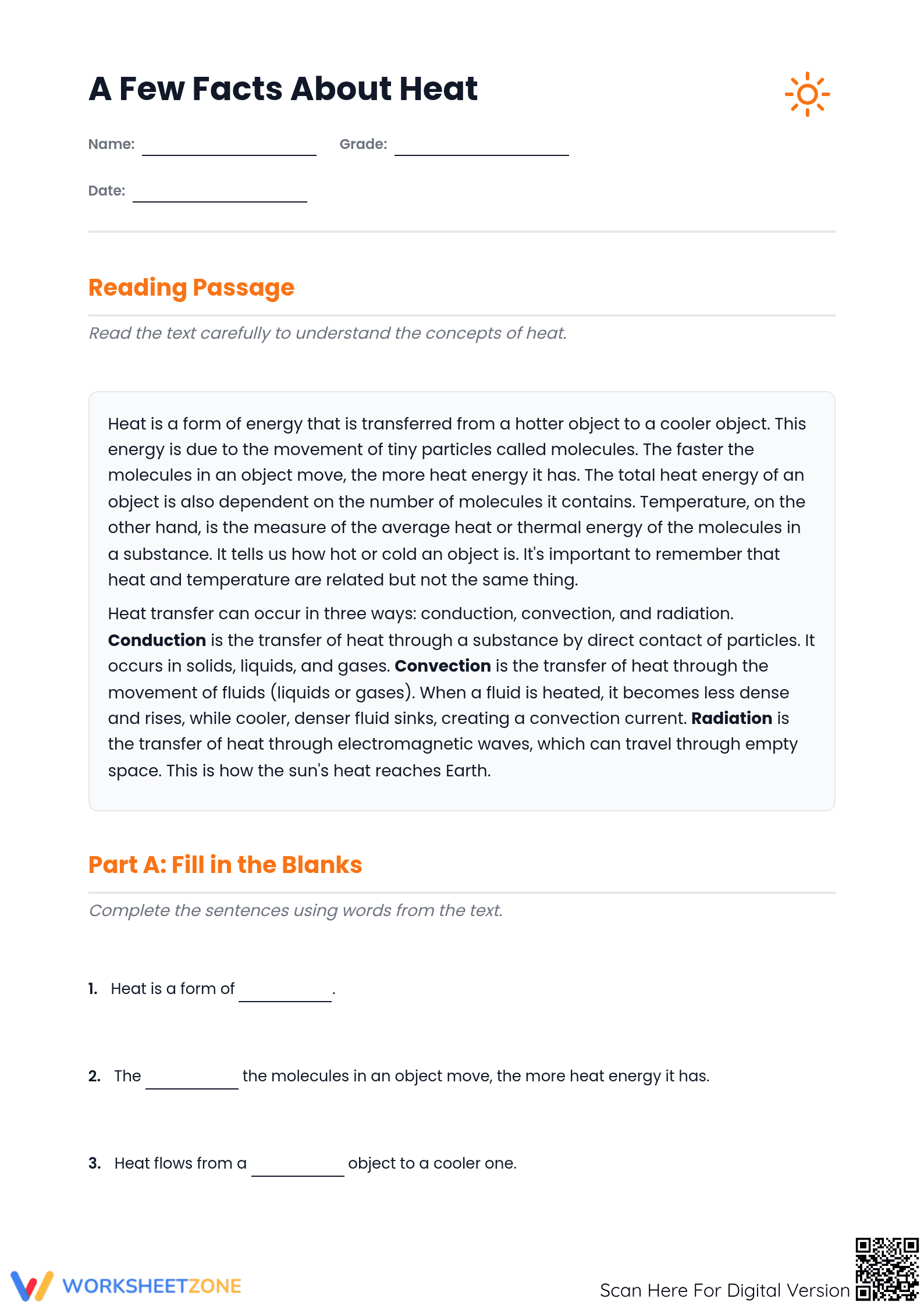
Students master the fundamental concepts of thermal energy and heat transfer methods through this comprehensive reading activity. This worksheet provides a structured informational text that explains conduction, convection, and radiation, ensuring learners can differentiate between these modes while citing specific evidence. It transforms complex physical science concepts into accessible reading comprehension tasks for middle school students.
At a Glance
- Grade: 8 · Subject: English Language Arts
- Standard:
CCSS.ELA-LITERACY.RI.8.1— Cite strong textual evidence to support analysis of explicit informational text- Skill Focus: Technical reading and conceptual differentiation
- Format: 3 pages · 12 problems · Answer key included · PDF
- Best For: Independent practice and science-literacy integration
- Time: 25–35 minutes
This 3-page instructional set features a detailed reading passage followed by three distinct assessment sections. It includes 5 vocabulary-based fill-in-the-blank questions, 5 true-or-false conceptual checks, and 2 high-level critical thinking prompts. A complete answer key is provided to facilitate rapid grading and immediate student feedback during the instructional block.
The zero-prep design allows teachers to implement this lesson in under 2 minutes of total preparation time. First, print 3-page copies for the class or specific reading groups. Second, distribute the packets alongside existing curriculum materials. Third, review student responses using the provided answer key for a quick whole-class check. This streamlined process makes the resource an ideal solution for emergency sub plans or supplemental science-literacy integration.
The primary focus aligns with `CCSS.ELA-LITERACY.RI.8.1`, which requires students to cite textual evidence that most strongly supports an analysis of what the text says explicitly. By requiring learners to pull specific definitions for conduction and radiation directly from the passage, the worksheet reinforces rigorous evidence-gathering habits. Both standard codes can be copied directly into lesson plans, IEP goals, or district curriculum mapping tools.
Use this resource as a bridge between direct science instruction and informational text analysis. Assign the passage during independent practice to reinforce the distinction between heat and temperature. For a formative assessment, monitor students as they tackle the critical thinking prompts; their ability to provide real-life examples of convection currents serves as a reliable indicator of conceptual mastery and reading retention.
This resource serves Grade 7 to Grade 9 students in English Language Arts or integrated science-literacy blocks. It is effective for learners requiring scaffolded technical vocabulary support. Pair this worksheet with a short video on electromagnetic waves or a physical demonstration of thermal conduction to create a multi-modal learning experience that caters to diverse student needs.
According to EdReports 2024, the integration of informational texts within ELA frameworks significantly improves disciplinary literacy and subject-specific vocabulary retention. This worksheet leverages that research-backed strategy by focusing on CCSS.ELA-LITERACY.RI.8.1, ensuring students engage deeply with the technical descriptions of heat energy and molecular movement. By moving from foundational definitions in the fill-in-the-blank section to complex application in the critical thinking extension, the resource mirrors the cognitive rigor required for college readiness. The inclusion of explicit definitions for conduction, convection, and radiation reduces the cognitive load during the initial reading phase, allowing students to focus on the higher-order task of synthesizing evidence to explain physical phenomena. Such structured practice in citing evidence from complex texts is essential for closing the literacy gap in middle school education, providing a reliable scaffold for students to transition toward independent analysis of technical scientific literature and cross-curricular mastery.


