




























Views
Downloads

Essential Comparing Accounts Worksheet | Grade 7-9 ELA

Paste this activity's link or code into your existing LMS (Google Classroom, Canvas, Teams, Schoology, Moodle, etc.).
Students can open and work on the activity right away, with no student login required.
You'll still be able to track student progress and results from your teacher account.
Comparing firsthand and secondhand accounts is a vital literacy skill for middle and high school students. This worksheet guides learners through the nuances of primary and secondary sources using a compelling historical event. Students will analyze perspectives, identify evidence, and differentiate between lived experiences and researched reporting to master informational text analysis.
At a Glance
- Grade: 7–9 · Subject: ELA
- Standard:
RI.7.9— Analyze how authors writing about the same topic emphasize different evidence or interpretations- Skill Focus: Firsthand vs. Secondhand Accounts
- Format: 3 pages · 7 problems · Answer key included · PDF
- Best For: Informational text analysis and perspective comparison
- Time: 25–35 minutes
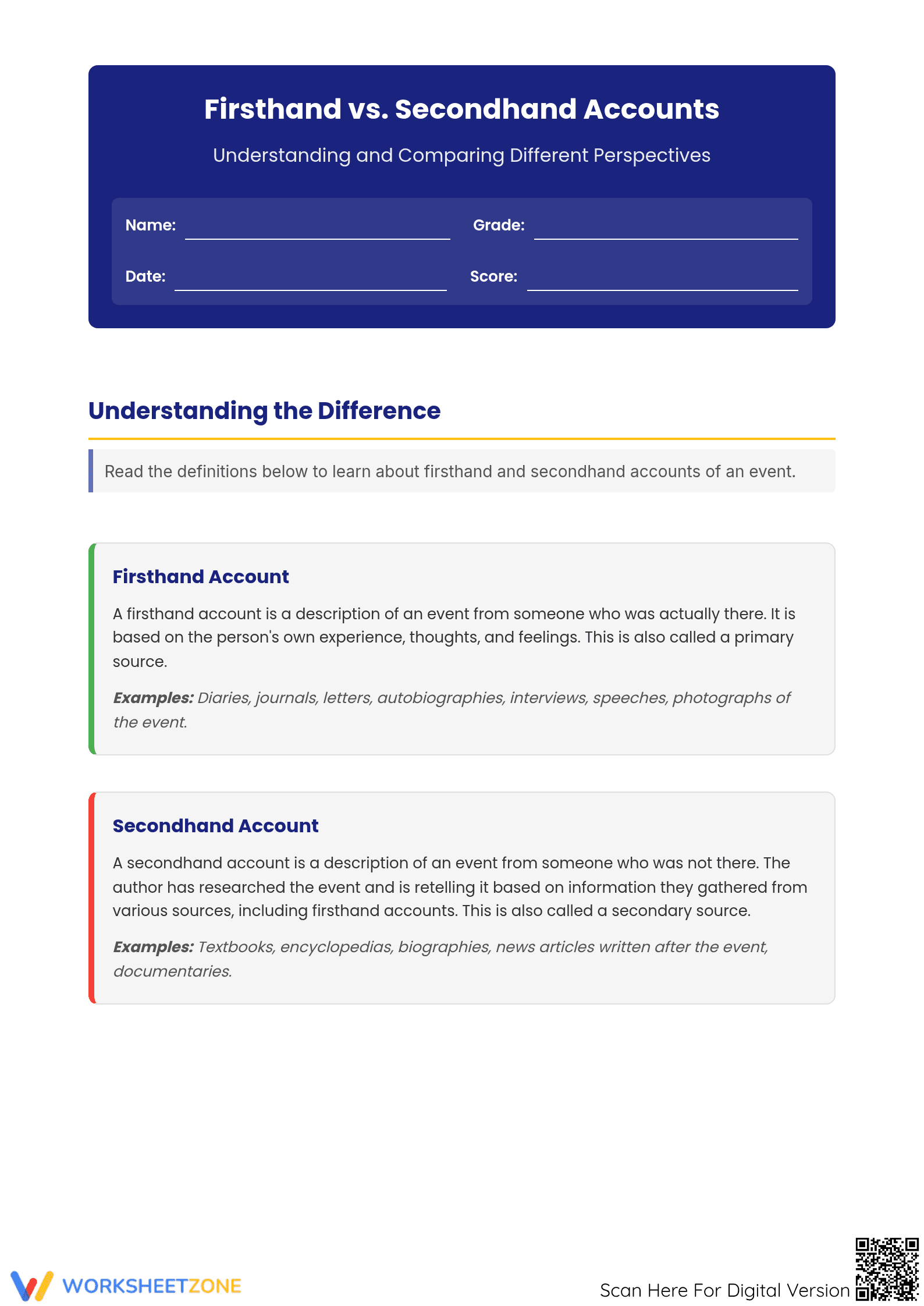
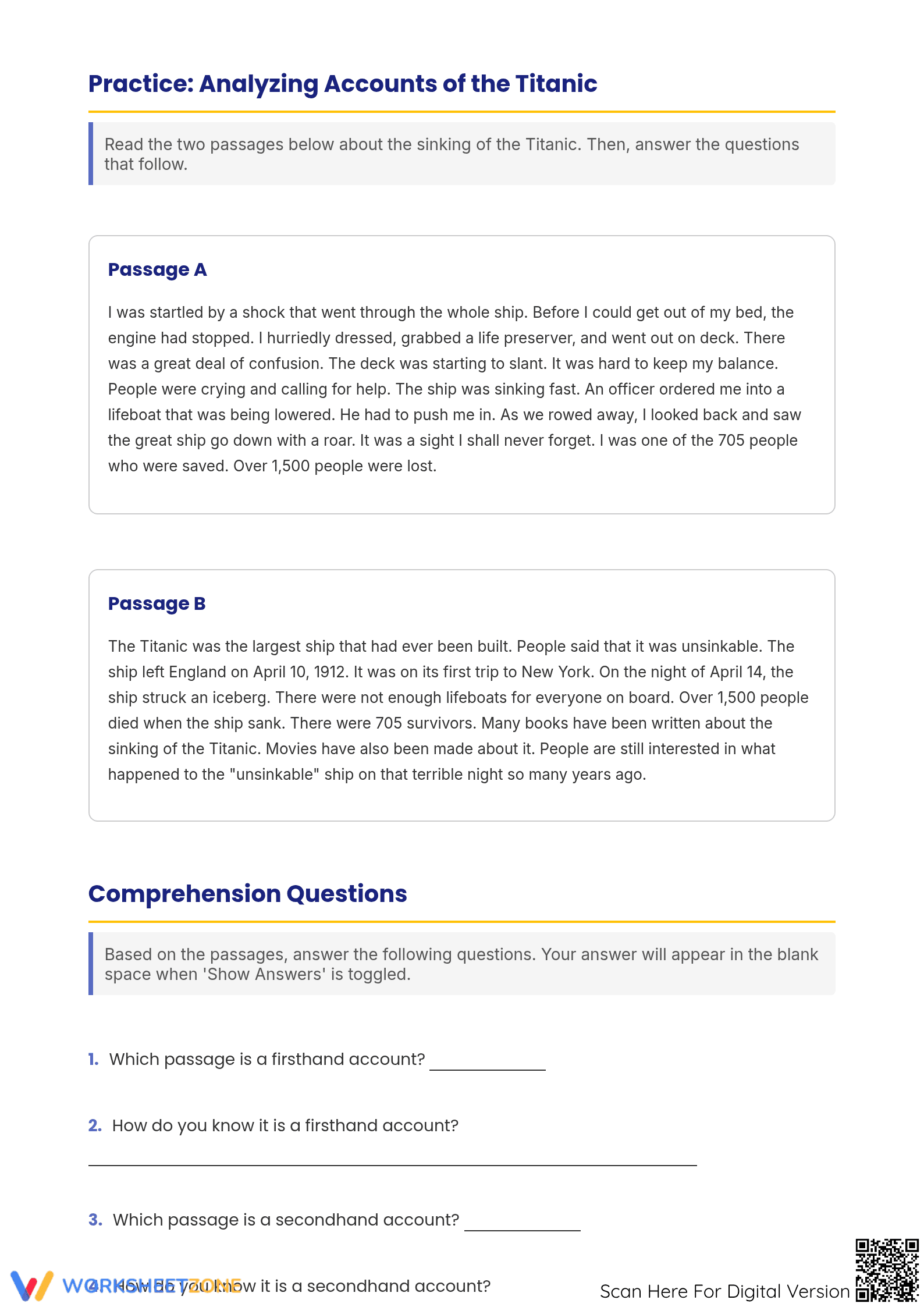
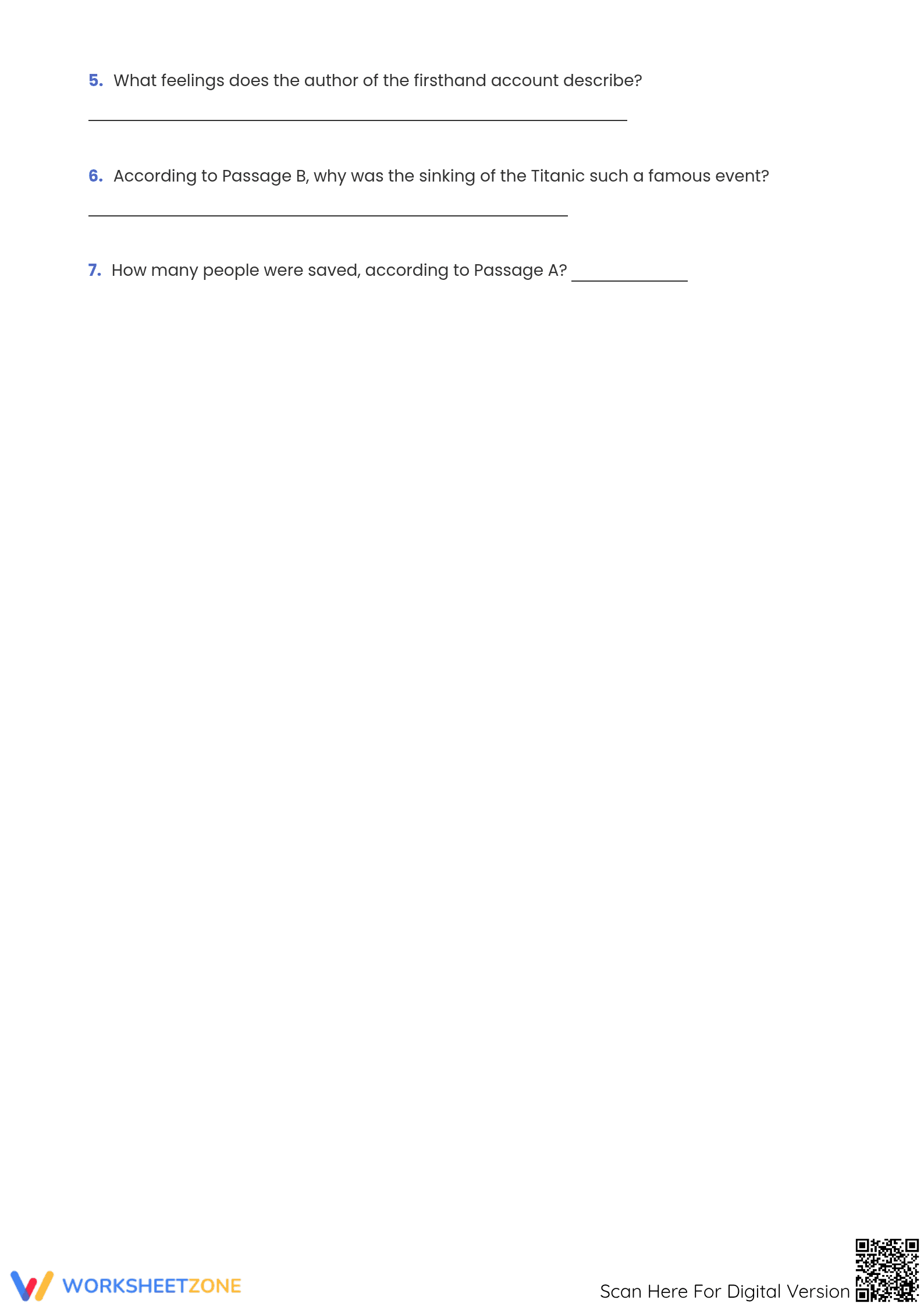
This comprehensive packet includes three clearly structured pages. The first page defines primary and secondary sources with concrete examples like diaries and textbooks. The second page presents two contrasting passages about the Titanic—one a personal survivor narrative and the other a historical summary. Seven text-dependent questions follow to check for deep understanding and evidence identification.
Skill Progression
- Guided reference: Students begin with foundational knowledge through explicit definitions of firsthand and secondhand accounts.
- Comparative analysis: Learners identify the account types in Passage A and B using evidence from the text.
- Independent synthesis: Students explain how and why authors use specific emotional cues to shape their unique perspectives.
This resource follows a gradual-release model of instruction to move students from basic recognition to deep conceptual analysis.
Standards Alignment
This worksheet is primarily aligned with CCSS.ELA-LITERACY.RI.7.9, which requires students to analyze how authors emphasize different evidence when writing about the same topic. It also supports RI.6.6 and RI.8.9 by focusing on author purpose and point of view. Both standard codes can be copied directly into lesson plans, IEP goals, or district curriculum mapping tools.
How to Use It
Use this worksheet as a mid-unit formative assessment after introducing the concepts of primary and secondary sources. For a secondary use case, assign it as a flipped classroom activity where students read the definitions and passages at home, allowing for a rich class discussion on the Titanic's differing narratives the next day. Expect a completion time of roughly 30 minutes.
Who It's For
Designed for students in Grades 7, 8, and 9, this resource is ideal for General ELA classrooms, Reading Intervention groups, and ELL students needing explicit definitions. It pairs naturally with a Titanic-themed informational unit or a broader study on historical research methods and source reliability during the school year.
According to the EdReports 2024 analysis, effective informational text instruction requires middle school students to engage with complex texts that offer varying perspectives on historical events. This resource fulfills that mandate by presenting a Grade 7-9 aligned comparison of firsthand and secondhand accounts of the Titanic disaster. By analyzing the linguistic differences between Passage A's emotional primary narrative and Passage B's objective secondary summary, students develop the critical thinking skills necessary for CCSS.ELA-LITERACY.RI.7.9 mastery. The ability to synthesize information across multiple sources is a key indicator of college and career readiness as defined by modern literacy frameworks. This worksheet provides structured practice in that domain, ensuring students can independently identify author bias and source credibility in real-world academic research scenarios. This standalone summary highlights the essential nature of perspective-taking in high-level reading comprehension tasks for adolescent learners.


