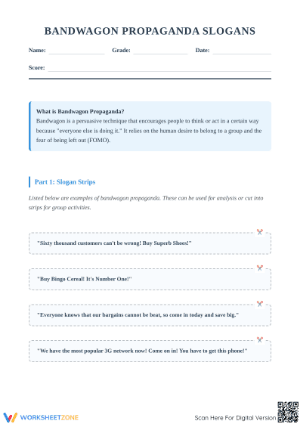
These 8th grade citing evidence from the text worksheets resources give ELA teachers what the unit actually requires: short, purposeful passages paired with questions that push students past surface recall and into the harder work of selecting strong evidence and explaining its relevance in writing. Each worksheet is self-contained, print-ready, and focused on a skill set that Grade 8 standards treat as non-negotiable.
What's Inside the Set
Each worksheet opens with a passage — either a literary excerpt or an informational text — followed by text-dependent questions that cannot be answered from memory alone. Students must return to the text, locate the relevant section, and decide which detail most directly supports the response they are building. The sequence moves from identification to explanation, which is where Grade 8 evidence practice gets difficult.
- Literary passages ask students to support inferences about character motivation, track how conflict develops, or explain what a specific detail reveals about theme.
- Informational passages ask students to identify an author's central claim, locate supporting details, or explain how one sentence develops a main idea.
- Text-dependent questions are framed so a student who skimmed the passage cannot answer correctly — the answer requires a close, focused reading.
- Written response space prompts students to quote or paraphrase accurately, then write an explanation that connects that evidence to the claim at hand.
- Answer keys include sample responses with notes on which evidence choices are strongest and why — not just a letter key, but reasoning teachers can use during review.
The set covers both fiction and nonfiction because students in Grade 8 face evidence-based questions in both contexts. The reading moves are similar but not identical: literary evidence often requires naming what a detail implies about character or theme; informational evidence often requires tracing how a detail functions inside an argument or explanation. Seeing both in practice helps students recognize that distinction rather than treating evidence as one uniform task.
Mistakes Students Make That These Worksheets Help You Catch
The most persistent error at this grade is the orphaned quote — a student lifts a line from the passage, places it in the response, and stops. In actual student writing, this looks like: The text states, "He turned away without a word." Full stop. No explanation of what that action implies, no connection to the inference being supported. The worksheet format surfaces this because the follow-up prompt explicitly asks, "What does this detail tell you about the character?" That second move is where real thinking lives, and the gap between students who attempt it and students who leave it blank is one of the most useful formative signals these worksheets produce.
A second recurring problem is poor evidence selection. Students tend to quote the first passage line that mentions the topic rather than scanning for the strongest available detail. When a question asks for evidence that most strongly supports an inference, choosing the first relevant sentence — instead of a later, more precise one — is a genuine analytical gap. Answer keys in this set identify both the strongest choice and the weaker alternatives, which gives teachers concrete language for discussing why one detail outperforms another in a debrief.
There is also a paraphrase problem worth naming directly. Students who know they should not copy text word-for-word will sometimes write a vague retelling of an entire paragraph rather than a precise paraphrase of the relevant detail. Paraphrasing the whole passage says nothing specific; paraphrasing the right sentence and naming what it demonstrates is the actual skill. The written response section of each worksheet makes that distinction visible in a way that multiple-choice practice alone cannot.
Standard Alignment
CCSS.ELA-LITERACY.RL.8.1 and CCSS.ELA-LITERACY.RI.8.1 both direct Grade 8 readers to cite textual evidence that most strongly supports an analysis of what a text says explicitly, as well as inferences drawn from the text. That phrase — most strongly — is instructionally significant because it raises the bar from finding any evidence to evaluating which evidence is best. These worksheets operationalize that evaluative layer by asking students to select from possible evidence choices and then justify the selection in writing, which directly addresses what these standards describe rather than just checking off the surface skill.
In most Grade 8 ELA pacing guides, these standards anchor units on close reading, literary analysis, and argument. The worksheets fit naturally into instruction from October through November, and again during spring review ahead of state assessments, when students need targeted practice on constructed-response and evidence-based writing formats.
How to Build These Worksheets Into Your Lesson Plans
The most effective use of a single worksheet is as an immediate independent task right after a mini-lesson — not as homework students complete cold without any instructional context. When a teacher has just modeled the difference between dropping a quote and explaining its relevance, students need ten to fifteen minutes of focused application. One worksheet assigned immediately after that lesson gives a fast read on who absorbed the model and who needs another pass before the next day.
For bell ringers, narrow the task deliberately: give students one question, ask them to identify the strongest piece of evidence for a supplied claim, write two sentences explaining their choice, and be ready to discuss. Eight minutes before the lesson begins is enough if the task is that specific. Station rotations work well too — one group annotates a passage for key evidence, a second drafts written responses using sentence frames, a third peer-reviews responses against a model answer.
- Monday warm-up: Project one question from a prior worksheet and have students revise a weak sample response together before the lesson starts.
- Midweek classwork: Assign a full worksheet independently after modeling; collect it as a formative check on who can support an inference without teacher support.
- Friday review: Return scored worksheets and ask students to rewrite one explanation with their feedback applied — a low-stakes but high-value revision move.
- Test prep block: Sequence the task from selected-response practice to open-ended written response so students build toward the extended-answer format used on assessments.
Spreading these 8th grade citing evidence from the text worksheets resources across multiple points in the week — rather than treating them as a one-time assignment — builds the spaced repetition students need to internalize the evidence-to-explanation sequence.
Adjusting the Work for Different Learners Without Reducing the Demand
Differentiation for text evidence practice almost always means adjusting the support structure around the task, not the task itself. Reducing the complexity of the reading or removing the written explanation step defeats the purpose. Instead, offer sentence frames — The text states... This shows that... or Based on the passage, the evidence that best supports this is... because... — for students who understand what to say but freeze when facing a blank response box. Frames remove the language bottleneck so the thinking can reach the page; they do not lower the analytical demand.
A useful progression for students who struggle with written response is to begin them on selected-response versions of the same question. Present four possible pieces of evidence and ask them to mark the strongest, then explain the choice in two sentences. That bridge from recognition to independent production is more effective than asking reluctant writers to construct a full evidence-based response from nothing. Once a student can explain why one detail beats another, the shift to open-ended response is much shorter than it would have been otherwise.
For students ready for greater challenge, the most productive extension is comparative: give them two passages on a related topic and ask which author uses evidence more effectively to support a claim. That question requires all the same evidence skills but adds an evaluative layer that stretches toward Grade 9–10 reading expectations without requiring different materials.
Frequently Asked Questions
Do these worksheets work with both fiction and nonfiction texts?
Yes. The set includes literary and informational passages because both text types appear in Grade 8 ELA instruction and on state assessments. The question framing shifts to fit the text — character, conflict, and theme for literary passages; central idea, author's purpose, and claim for informational ones — but the underlying skill of selecting and explaining evidence transfers directly between the two.
Can I use these resources with intervention groups?
Short passages with one focused question consistently outperform longer, multi-question assignments in intervention settings. These 8th grade citing evidence from the text worksheets resources work well in small-group intervention because a teacher can walk through the evidence selection step with the group, release students to draft the explanation independently, and review all in a single session — without a lengthy reading load that would stop struggling readers before the practice even begins.
What if a student selects different evidence than what the answer key shows?
The answer keys explain why the listed evidence is strongest — and that reasoning is the actual standard, not the specific quote. If a student selects a different detail and writes a clear, logical explanation connecting it to the inference, the response is defensible. Use the key's reasoning language during class review to evaluate alternate choices, which turns those moments into productive discussions about what makes evidence strong rather than a search for one correct answer.
How are these different from standard reading comprehension practice?
General reading comprehension practice often accepts answers that paraphrase or summarize a passage without requiring students to identify a specific textual source. These 8th grade citing evidence from the text worksheets resources always require students to point to a particular detail in the text and then explain what that detail proves — a more precise analytical task than retelling, and the exact move that Grade 8 constructed-response assessments reward.















 Interactive Worksheet Maker
 Quiz Maker
 Word Search Maker
 Crossword Puzzle Maker
 Word Scramble Generator
 Sentence Scramble Generator
 Handwriting Worksheet Generator
 Name Tracing Generator
 Fill In The Blank Generator