


























Views
Downloads


Printable Veterans Day Reading Comprehension | Grades 7-9
Paste this activity's link or code into your existing LMS (Google Classroom, Canvas, Teams, Schoology, Moodle, etc.).
Students can open and work on the activity right away, with no student login required.
You'll still be able to track student progress and results from your teacher account.
This printable Veterans Day reading comprehension packet provides middle and high school students with a rigorous exploration of the holiday's origins and significance. By analyzing primary historical facts and reflecting on military service, students develop strong informational text analysis skills while honoring the contributions of American veterans across all branches of service.
At a Glance
- Grade: 7-9 · Subject: ELA / Reading
- Standard:
CCSS.ELA-LITERACY.RI.8.1— Cite the textual evidence that most strongly supports an analysis of what the text says explicitly- Skill Focus: Informational Text Analysis & Historical Context
- Format: 3 pages · 7 tasks · Answer key included · PDF
- Best For: Holiday-themed ELA lesson or social studies supplement
- Time: 30–45 minutes
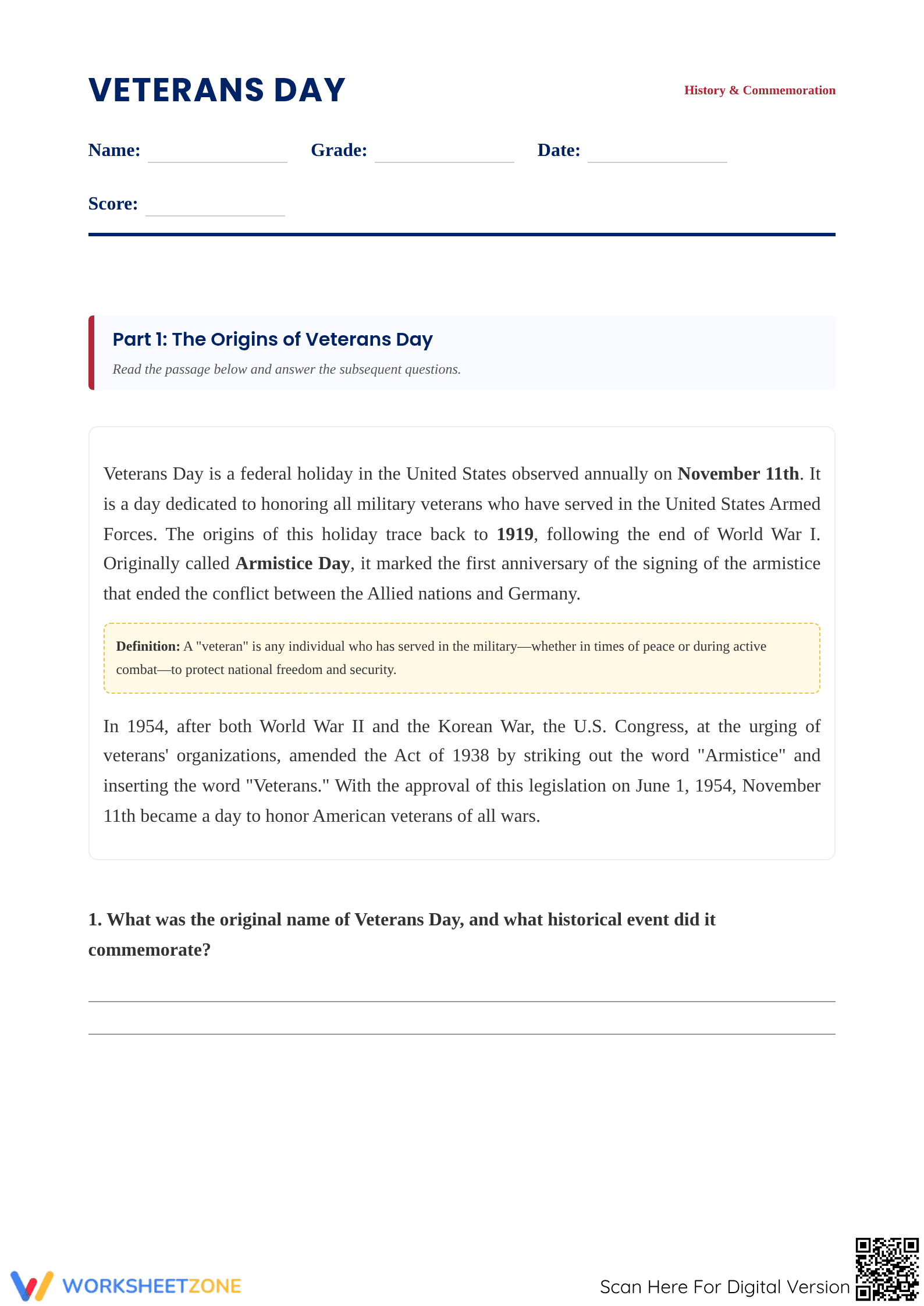
This comprehensive three-page PDF includes a detailed reading passage titled "The Origins of Veterans Day," covering historical milestones from 1919 to 1954. The packet features five multi-part comprehension questions, a visual identification guide for the six branches of the U.S. military, and a dedicated vocabulary section for key terms. A full answer key is provided to facilitate quick grading or student self-correction.
Skill Progression
- Guided practice: Students identify explicit facts within the text, answering foundational questions about the transition from Armistice Day to the modern holiday.
- Supported practice: Scaffolds help students identify military branches and define domain-specific vocabulary like "armistice" and "commemoration" using contextual clues.
- Independent practice: Students synthesize information to reflect on the distinction between Veterans Day and Memorial Day through higher-order writing prompts.
This structure ensures a gradual release of responsibility as students move from basic factual recall to complex thematic evaluation.
Standards Alignment
The primary alignment is CCSS.ELA-LITERACY.RI.8.1, citing evidence from informational text. This resource also supports CCSS.ELA-LITERACY.L.8.4 by defining domain-specific words like "armistice" and "commemoration." These standard codes can be copied directly into lesson plans, IEP goals, or curriculum mapping tools.
How to Use It
Use this packet during the week of November 11th as a primary ELA lesson focused on informational text structures. It serves as an excellent formative assessment for citing textual evidence; teachers should observe if students are quoting specific dates or legislative acts from the passage. Expected completion time is approximately 40 minutes, making it an ideal single-session activity.
Who It's For
This resource is designed for Grade 7, 8, and 9 students, with vocabulary supports that make it accessible for diverse learners. It pairs naturally with an anchor chart about the branches of the military or a short documentary clip about World War I history to provide additional context.
Effective instruction in informational text analysis requires resources that balance historical accuracy with rigorous academic demands. This Veterans Day worksheet addresses CCSS.ELA-LITERACY.RI.8.1 by requiring students to extract and evaluate evidence from a structured narrative regarding military history. Research from Fisher & Frey (2014) emphasizes that complex reading tasks are most effective when they involve close reading of high-interest texts followed by collaborative or independent reflection. This worksheet facilitates that process by providing a self-contained history of the holiday, from its Armistice Day roots in 1919 to the 1954 Congressional act that expanded its scope. By integrating vocabulary development with critical thinking prompts, the resource ensures that students are not merely skimming for facts but are instead building a robust mental model of the subject. This evidence-based approach to literacy instruction helps bridge the achievement gap in middle school reading proficiency across diverse student populations.


