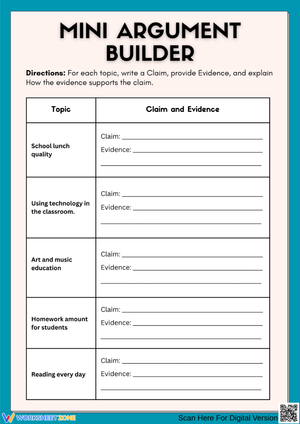
These 8th grade claim evidence reasoning worksheets sets give ELA teachers structured practice for the three-move analytical sequence Grade 8 demands — making an arguable claim, selecting precise textual evidence, and explaining the connection in a way that does real analytical work rather than leaving the logic to the reader. The resources work with literature, informational text, speeches, and paired passages, so teachers stay flexible across units without rebuilding the format for every new reading selection.
What Each Worksheet Has Students Do
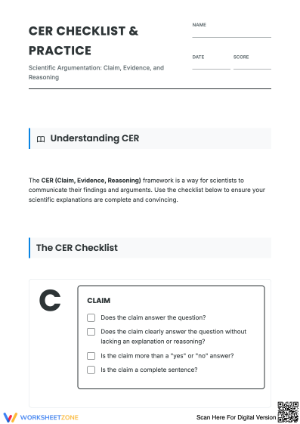
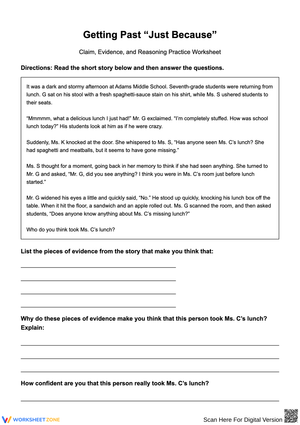
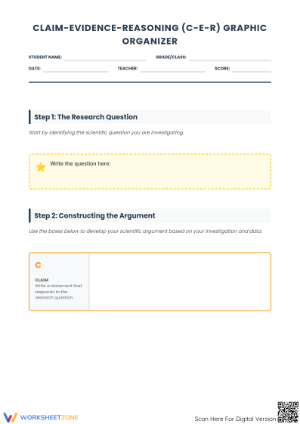
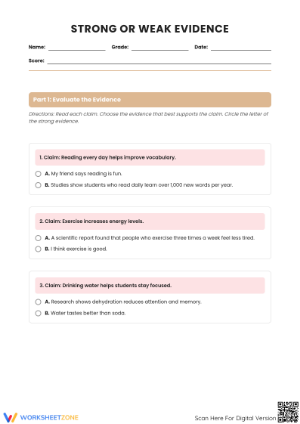
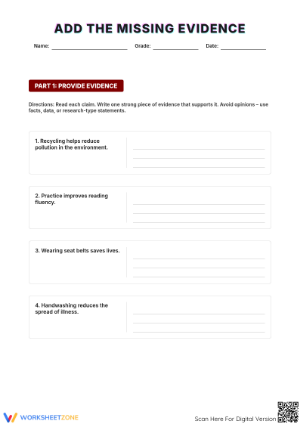
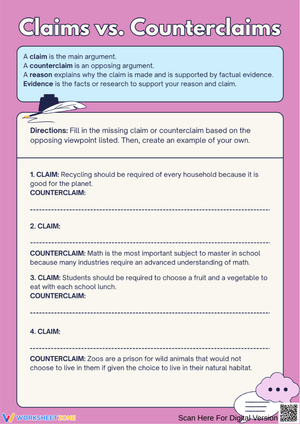
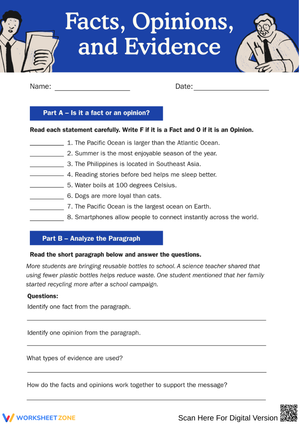
The set covers the full CER sequence and isolates each move so students build competency in one area before combining all three. Across the worksheets, students annotate model CER paragraphs to identify where the claim, evidence, and reasoning each appear; decide whether a given claim is genuinely arguable or merely a restatement of fact; select the strongest piece of textual evidence from several options and justify that choice in writing; and write complete reasoning sentences that connect the quoted or paraphrased detail back to the claim. A graphic organizer worksheet lets students gather text details and plan before drafting a full paragraph, and paired-text sheets ask students to draw evidence from two sources to support a single claim — a format that appears frequently on state assessments and district writing tasks.
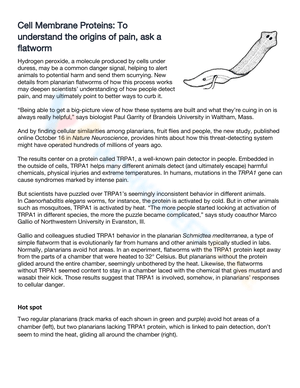
Each worksheet in this 8th grade claim evidence reasoning worksheets collection pairs with almost any reading selection, so teachers keep the same organizer and change only the passage and the prompt. That flexibility makes the set useful from the first week of a novel unit through end-of-unit constructed response tasks.
The Writing Habits That Trip Up 8th Graders in CER
The most persistent problem in student work is quote-dropping. A student selects a relevant line from the text, places it in the response, and moves on — assuming the evidence proves the claim without further explanation. This pattern appears most often in strong readers, because they process the inferential connection automatically and do not realize they have left it unwritten. Consider a student reading a story about a character who finds a stranger's wallet: the student quotes "She slid the wallet across the counter without looking inside" and considers the claim about honesty proved. The reasoning that matters — that her deliberate refusal to inspect the contents shows active resistance to temptation, not simply an absence of dishonesty — never makes it onto the page. These worksheets close that gap by requiring reasoning in complete sentences, with stems that specifically ask why this detail proves the claim rather than what happened in the text.
A quieter but equally common error shows up at the claim step: students write descriptions instead of arguments. "The character experiences hardship" is a description that cannot be proved or disputed. "The character's response to hardship reveals that loyalty drives his choices more than self-preservation" is a claim that demands evidence and analysis. The prompts in the set push students toward genuinely arguable positions by asking questions that a plot summary alone cannot answer — which also makes the claim-construction worksheet a useful diagnostic for identifying which students are still conflating summary with analysis.
Lesson-Planning Strategies for Getting the Most From These Worksheets
A practical sequence runs across three to four days rather than treating CER as a single-session task. Start with the model paragraph worksheet for whole-group annotation — students mark where the claim, evidence, and reasoning each appear, then discuss what makes the reasoning different from a restatement of the evidence. On the second day, use the evidence-selection worksheet: give students a claim and three possible text details, and ask them to choose the strongest and explain why the others fall short. That session tends to generate better discussion than anything else in a CER unit, because students have to argue about what makes evidence effective rather than just whether it is accurate. The third day focuses on writing reasoning sentences before day four combines all three moves into a full independent response.
For station rotations, one station works well as annotation practice, another as revision work — students receive a weak CER response and rewrite the reasoning step — and a third as independent production with a short passage and a blank organizer. Having a complete 8th grade claim evidence reasoning worksheets set organized by task type makes last-minute station prep much simpler; teachers pull whichever format fits the day's focus without building the organizer from scratch. One of the most effective feedback moves with these resources is to mark evidence quality and reasoning quality with separate scores — a student can select an accurate quote and still write a vague explanation, and when those two moves get independent feedback, students know exactly what to revise rather than redoing the whole response.
Standard Alignment
These worksheets address CCSS.ELA-LITERACY.RI.8.1 and RL.8.1, both of which ask students to cite the textual evidence that most strongly supports an analysis — not just any evidence, but the strongest. The distinction between adequate evidence and compelling evidence is exactly what the evidence-selection tasks in the set build. The resources also connect directly to CCSS.ELA-LITERACY.W.8.1, the argument writing standard, which requires 8th graders to support claims with clear reasons and relevant evidence. In classroom terms, these three standards converge on one central challenge: teaching students to reason from text rather than summarize it. Teachers in non-Common Core states will find close parallels in their own anchor standards for evidence-based reading and argument writing at the middle school level.
Making the Worksheets Work for Struggling, On-Level, and Advanced Writers
Students who struggle with CER typically break down at one of three places: forming a precise claim, choosing relevant evidence, or writing an explanation that moves past paraphrase. Identifying which step is failing matters more than applying uniform support. For students whose claims are too vague, provide a focused prompt alongside two or three claim options — the task becomes choosing and defending the best one rather than generating from nothing. For students who select weak or irrelevant evidence, narrow the passage and ask them to underline three possible details before writing anything. For students whose reasoning disappears after the quotation, require two reasoning sentences instead of one and offer frames like This detail shows that ___ or The author uses this moment to reveal ___.
For students ready for more challenge, remove the frames and add a second evidence requirement with an evaluative question: which piece of evidence is stronger, and why does the other one fall short? That metacognitive move — comparing and ranking evidence rather than just selecting it — is where students who have already internalized the basic sequence can push their analytical writing further. An 8th grade claim evidence reasoning worksheets set that includes multiple task-type versions means teachers handle a mixed-ability class without producing three separate lesson plans for the same skill.
Frequently Asked Questions
What should a CER worksheet for 8th grade ELA include?
At minimum: a text-based prompt that requires an arguable response, space for a written claim, room for quoted or paraphrased evidence, and a section that requires written explanation of how the evidence connects to the claim. The most useful worksheets also include a model paragraph for annotation practice, brief reasoning stems for students who need sentence-level support, and a short rubric with separate criteria for claim precision, evidence relevance, and reasoning quality.
How is CER in ELA different from CER in science?
In science, evidence typically comes from data, experiments, or measurable observations. In ELA, evidence comes from the text — a quotation, a paraphrase, or a specific passage detail. The reasoning step in ELA asks students to explain what the textual detail reveals about a character, theme, argument, or author's craft choice, not what it measures. That distinction matters when introducing CER to students who learned the framework in science and assume a well-chosen quote explains itself once cited.
Can these worksheets be used with texts from different units and genres?
Yes. The graphic organizers and prompts are built around the CER structure rather than any specific passage, so teachers pair them with whatever their class is currently reading — novel chapters, informational articles, speeches, primary sources, or short poems. The same worksheet format works across genres because the analytical move is identical regardless of text type: make a claim, find evidence, explain the connection.
What helps students who understand the text but freeze when asked to write the reasoning step?
Start with a short passage and give students the claim rather than asking them to generate one — removing that variable lets them focus entirely on the reasoning sentence. Model one complete example first, then have the class revise a weak response together before asking for independent writing. Using stems like This supports the claim because ___ or The author shows ___ when ___ gives students a starting structure without producing the reasoning for them. Requiring two reasoning sentences instead of one — even brief ones — consistently produces more developed explanations than asking for a single, longer attempt.












 Interactive Worksheet Maker
 Quiz Maker
 Word Search Maker
 Crossword Puzzle Maker
 Word Scramble Generator
 Sentence Scramble Generator
 Handwriting Worksheet Generator
 Name Tracing Generator
 Fill In The Blank Generator