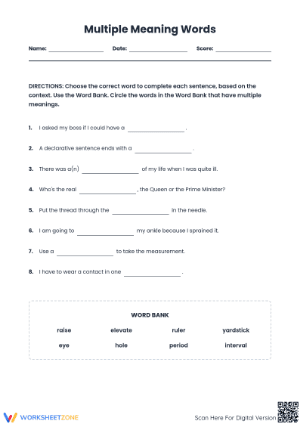
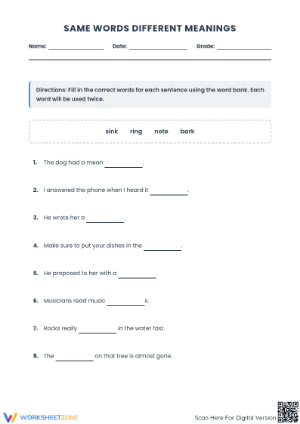
These vocabulary worksheets for 8th grade give ELA teachers immediately usable practice across the word-study skills that matter most in middle school — context clues, Greek and Latin roots, affixes, multiple-meaning words, analogies, and academic vocabulary. Each worksheet targets one skill with clear, focused tasks: students underline context clues, mark word parts, or sort words by relationship. The format fits real lesson structures, from an 8-minute warm-up at the start of a period to a quick formative check before moving into a longer reading unit.
What Each Worksheet Covers
The set spans six vocabulary skill areas that eighth graders encounter repeatedly in ELA and across content classes. Each worksheet focuses on a distinct strategy, which makes it easier to match the right resource to a specific lesson objective or to a gap visible in student writing and reading performance.
- Context clues: Students read a sentence or short passage and determine the meaning of a bolded or underlined term using surrounding language — definition clues, contrast clues, example clues, and inference signals are all represented across the set.
- Greek and Latin roots: Students identify root meanings, match related words, and explain how a single root such as chron or bene generates meaning across a family of academic terms.
- Prefixes and suffixes: Students mark affixes, define their effect on base words, and complete or rewrite words using affix rules — a strategy that carries directly into decoding during independent reading.
- Multiple-meaning words: Students read two or more sentences and annotate how the same word carries a different meaning depending on context, which is essential practice for close reading and precise writing.
- Academic vocabulary: Each worksheet reviews terms that appear in discussion prompts, writing directions, and informational texts: words like analyze, perspective, cite, and contrast.
- Analogies and word relationships: Students complete analogy pairs, identify the relationship type, and explain their reasoning — a stronger challenge for students who move quickly through definition-matching work.
Student Mistakes Worth Anticipating Before You Assign These
The most persistent error on context-clue worksheets at this grade level is something like confirmation bias in word inference. A student who already half-knows a word reads the sentence, picks the definition closest to their existing understanding, and then points to the first nearby adjective as "the clue." They are not actually reading the surrounding syntax — they are pattern-matching to a guess. These worksheets surface that because the tasks require students to name the type of clue and quote the specific words that signal meaning. Vague or invented answers to those steps tell you immediately that the strategy did not transfer; that information is worth more than a percentage score on a matching task.
With root-word worksheets, the common slip is conflating roots that look similar. Eighth graders routinely confuse the Latin port (to carry, as in transport) with port as a place for ships, without recognizing they are looking at a homograph situation rather than a true root pattern. Students also frequently apply the meaning of a suffix like -tion correctly but then treat description as an entirely different word from describe because the spelling shifted at the base. Pointing this out during a two-minute class review after the worksheet prevents weeks of confused decoding — and it only comes up because the worksheet forced students to look at the word closely enough to notice the pattern in the first place.
How to Build These Worksheets Into Your Lesson Plans
The most natural entry point is the first 8 to 10 minutes of class. A single context-clue or root-word worksheet — students work independently, then partners compare answers — fits that window comfortably and settles the room before transitioning into a reading or writing block. This works especially well on Monday mornings after morning meeting when the class needs something structured before longer literacy work begins.
For a repeating weekly structure, one approach that holds across a semester: context clues on Monday, roots on Tuesday, affixes on Wednesday, multiple-meaning words on Thursday, and a mixed-skill review on Friday. This keeps vocabulary instruction consistent without turning any single day into vocabulary-heavy territory. Teachers who batch all word study into one day per week tend to see lower retention — the spacing between exposures is simply too wide for durable learning.
During a small-group pull-out or support block, preteaching two or three words before distributing the worksheet narrows the cognitive load enough that students can focus on the skill strategy rather than being derailed by unfamiliar content. After the group finishes, a brief "show me in the text" step — finding a similar context clue, affix, or root in that day's reading passage — helps the strategy move beyond the paper. That bridge is small to set up and makes a noticeable difference in whether students apply word-study thinking during actual reading or reserve it only for worksheet exercises.
Standard Alignment
These worksheets address CCSS.ELA-LITERACY.L.8.4 directly: students determine or clarify the meaning of unknown and multiple-meaning words and phrases using context (L.8.4a), Greek and Latin affixes and roots (L.8.4b), and verification through reference materials (L.8.4d). L.8.4 has more daily classroom presence than almost any other language standard in grade 8 because it activates every time students read something with unfamiliar vocabulary — which in eighth grade is often. Worksheets that build these strategies give teachers concrete formative data about which approach a student can apply independently versus which one still feels like guessing.
Vocabulary worksheets for 8th grade that target word relationships and nuances align to L.8.5 as well. Analogy and multiple-meaning worksheets address the reasoning about connotation, denotation, and semantic relationships that L.8.5 requires — skills that transfer into literary analysis writing when students need precise language to build or support a claim.
Adjusting the Set for a Range of Eighth-Grade Learners
Most worksheets here work across readiness levels with minor adjustments rather than a full replacement. For students who need additional support, reducing the number of items and providing a word bank keeps the strategy practice intact without the frustration of a fully open-ended format. Sentence frames for written response also help students who understand a word's meaning but struggle to articulate their reasoning in complete sentences — a common gap in grade 8 that is different from not knowing the word.
For students reading significantly below grade level, shorter passages and pre-highlighted signal words — terms like however, in other words, and for example that mark contrast and definition clues — make context-clue worksheets more accessible. This is a structural support, not a conceptual simplification; the skill goal stays the same.
Advanced students benefit from having the word bank removed entirely and from being asked to identify the precise words in a sentence that constitute the clue, rather than simply circling the correct definition. Asking them to generate their own analogy pairs — and then explain the relationship type — extends the same printed worksheet into genuinely more complex language analysis territory without requiring a separate resource.
Frequently Asked Questions
Do these worksheets work for both on-level classes and intervention groups?
Yes. The same worksheet functions differently depending on how a teacher frames the task before and after. For intervention, preteach a few words and model the first item before releasing students to work independently. For on-level practice, assign the full worksheet with a written justification requirement for each answer. The vocabulary worksheets for 8th grade in this set carry enough structure for support groups and enough rigor for on-level ELA without needing separate print runs for each group.
How much class time does each worksheet typically take?
Most students finish in 10 to 20 minutes. Context-clue and multiple-meaning worksheets move faster; root-analysis tasks where students write out their reasoning take a bit longer. Either way, a standard class period leaves room for the full worksheet and a short review discussion without crowding out reading, writing, or other lesson elements.
What if I need these for a substitute or no-technology day?
All resources are PDFs — printer-ready, consistent across devices, and legible in black and white on a standard school copier. The directions on each worksheet are written for independent student use, which means a substitute can distribute them without needing to deliver a lesson. That also makes them reliable for early finisher folders and homework assignments that don't require teacher explanation to complete.
How do I connect a vocabulary worksheet to what students are currently reading?
After students finish the worksheet, pull one or two words or roots from the day's assigned reading that mirror the skill just practiced. If the worksheet covered context clues, find a sentence in the current novel or article where context signals meaning in the same way and ask students to annotate it using the same process. That "show me in the text" step is where the vocabulary worksheets for 8th grade set earns its place in the unit — not as a standalone task, but as a strategy entry point that connects directly to what students are reading.















 Interactive Worksheet Maker
 Quiz Maker
 Word Search Maker
 Crossword Puzzle Maker
 Word Scramble Generator
 Sentence Scramble Generator
 Handwriting Worksheet Generator
 Name Tracing Generator
 Fill In The Blank Generator