


























Views
Downloads

Properties of Water Practice | Essential Science Worksheet
Paste this activity's link or code into your existing LMS (Google Classroom, Canvas, Teams, Schoology, Moodle, etc.).
Students can open and work on the activity right away, with no student login required.
You'll still be able to track student progress and results from your teacher account.
This comprehensive science worksheet helps students master the unique chemical and physical properties of water. By exploring concepts like polarity, hydrogen bonding, and surface tension, learners develop a concrete understanding of why water is essential for life. Students will identify key terms and apply their knowledge to real-world biological and physical phenomena.
At a Glance
- Grade: 6-12 · Subject: Science
- Standard:
MS-PS1-1— Develop models to describe the atomic composition of simple molecules and extended structures.- Skill Focus: Chemical properties and molecular behavior of water
- Format: 2 pages · 20 problems · Answer key included · PDF
- Best For: Independent practice or formative assessment
- Time: 25–35 minutes
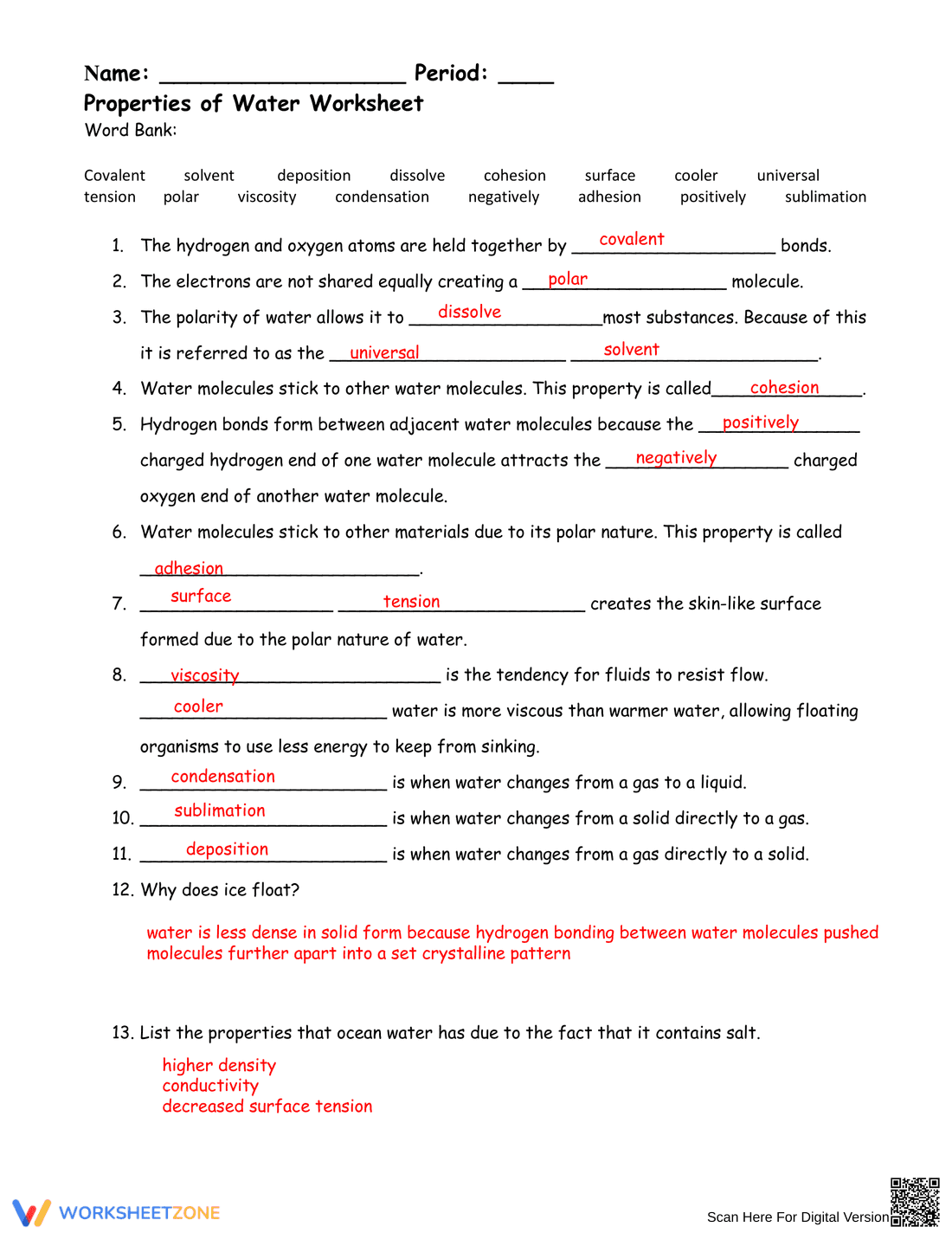
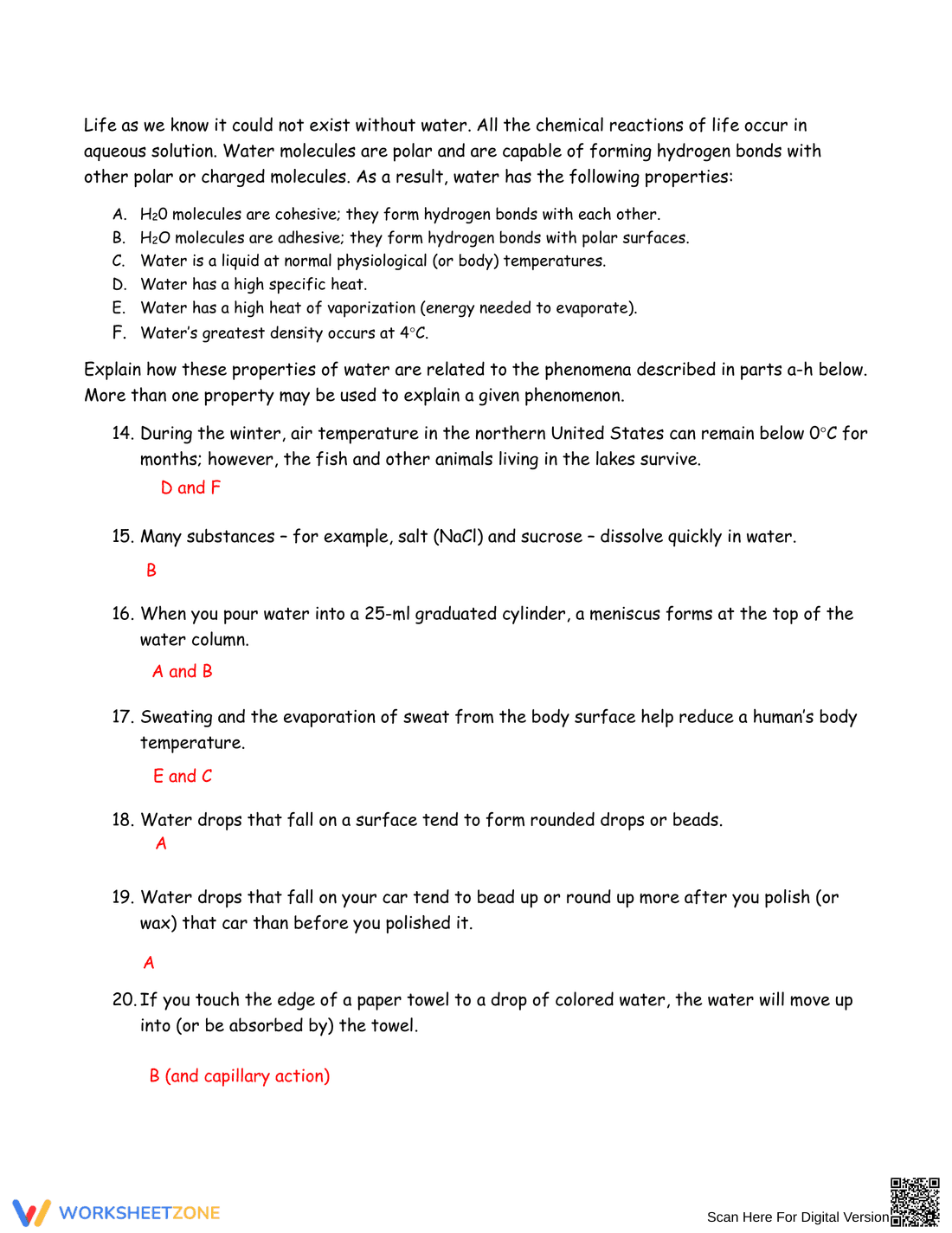
What's Inside: The resource consists of two structured pages. The first page features 11 fill-in-the-blank questions supported by a targeted word bank, covering vocabulary like covalent bonds, viscosity, and sublimation. It also includes two critical thinking questions regarding ice density and ocean water properties. The second page provides a reference list of water's unique traits and challenges students to match these properties to seven specific environmental scenarios.
Zero-Prep Workflow: This worksheet is designed for immediate classroom implementation. Teachers can print the two-page PDF in less than 30 seconds. Distribution takes approximately one minute, as the instructions and word bank are self-explanatory, requiring no additional teacher setup or lecture. Reviewing the 20 tasks is streamlined by the included answer key, allowing for a 5-minute whole-class check or quick individual grading during a planning period.
Standards Alignment: The primary focus is MS-PS1-1, which requires students to understand molecular structures. By identifying how hydrogen and oxygen atoms interact through covalent and hydrogen bonding, students build the foundational knowledge necessary for high school chemistry. Additionally, the worksheet supports HS-PS1-3 by asking students to infer the strength of electrical forces based on bulk-scale observations like surface tension and meniscus formation. Both standard codes can be copied directly into lesson plans, IEP goals, or district curriculum mapping tools.
How to Use It: Use this worksheet as a mid-unit check for understanding after introducing molecular polarity. It serves as an excellent bridge between a direct instruction lesson on bonding and a hands-on lab involving water's cohesive properties. For a formative assessment, observe students during the matching section on page two; if they struggle to link "specific heat" to "sweating," it indicates a need for further discussion on energy transfer. Completion typically takes 30 minutes.
Who It's For: This resource is ideal for middle and high school students in General Science, Biology, or Chemistry courses. The inclusion of a word bank provides necessary scaffolding for English Language Learners and students with IEPs, while the application questions on the second page offer enough rigor for advanced learners. It pairs naturally with a molecular modeling kit or a "Properties of Water" anchor chart.
This 20-task instructional resource targets the MS-PS1-1 standard by requiring students to model the behavior of water molecules through vocabulary synthesis and scenario-based application. By focusing on the relationship between molecular polarity and macroscopic traits like adhesion and solvent capability, the worksheet reinforces the "structure and function" crosscutting concept essential for scientific literacy. According to the Fisher & Frey (2014) framework for gradual release of responsibility, the transition from word-bank supported identification to independent application of properties to phenomena ensures that students move beyond rote memorization toward conceptual mastery. The inclusion of an answer key facilitates immediate feedback, a critical component for correcting misconceptions in molecular science. This resource provides a structured pathway for students to explain why water's unique chemical makeup allows life to persist in extreme environments, making it a reliable tool for secondary science curriculum alignment.


