


























0
Views
0
Downloads

0.0
0
Save
0 Likes
Share
Exploring Osmosis and Tonicity Concepts
0 Views
0 Downloads
Paste this activity's link or code into your existing LMS (Google Classroom, Canvas, Teams, Schoology, Moodle, etc.).
Students can open and work on the activity right away, with no student login required.
You'll still be able to track student progress and results from your teacher account.
Information
Description
What It Is:
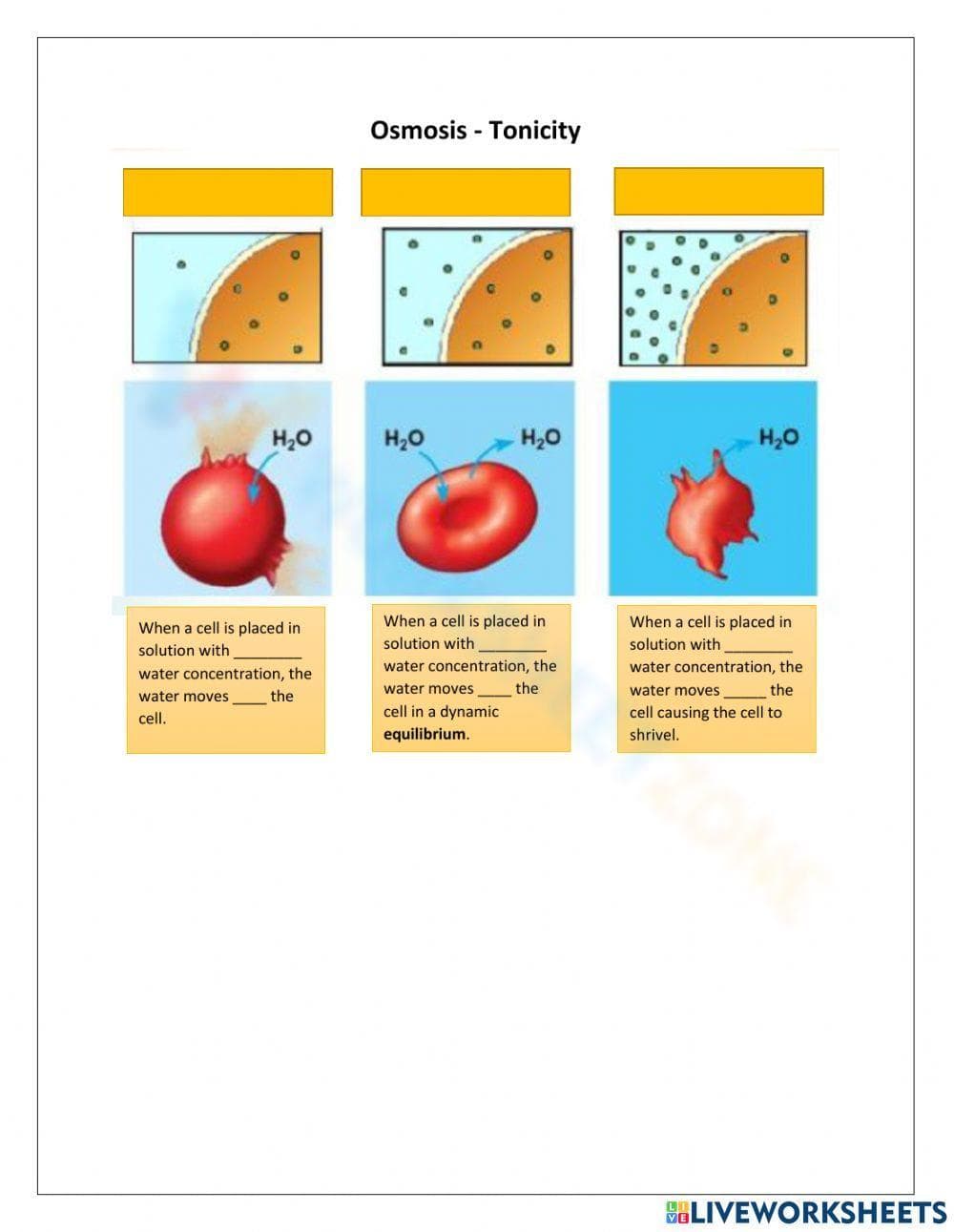
This is an educational worksheet focused on osmosis and tonicity. It presents three scenarios showing cells in different solutions. Each scenario includes a diagram of a cell in a solution with varying concentrations, an arrow indicating water movement, and a fill-in-the-blank sentence describing the cell's behavior (shrinking, staying the same, or expanding) in relation to the solution's concentration. There are three blank boxes above the scenarios, likely for labeling the tonicity of each solution (hypertonic, hypotonic, isotonic).
Grade Level Suitability:
This worksheet is suitable for high school biology students (Grades 9-12). The concepts of osmosis and tonicity are typically introduced in high school biology courses. The worksheet requires understanding of concentration gradients and their effect on cell behavior.
Why Use It:
This worksheet helps students visualize and understand the concepts of osmosis and tonicity. It reinforces learning by requiring students to relate the visual representation of cells in different solutions to the written description of the cell's behavior. The fill-in-the-blank format encourages active recall and reinforces key vocabulary.
How to Use It:
Students should first observe the diagrams in each scenario, paying attention to the concentration of the solution relative to the cell. They should then use this information to determine the tonicity of the solution and write the appropriate label in the blank box at the top. Finally, they should complete the fill-in-the-blank sentences describing the water movement and the resulting effect on the cell.
Target Users:
This worksheet is designed for high school biology students learning about osmosis and tonicity. It can be used as a classroom activity, homework assignment, or review tool. It is also suitable for students who benefit from visual learning aids.
This is an educational worksheet focused on osmosis and tonicity. It presents three scenarios showing cells in different solutions. Each scenario includes a diagram of a cell in a solution with varying concentrations, an arrow indicating water movement, and a fill-in-the-blank sentence describing the cell's behavior (shrinking, staying the same, or expanding) in relation to the solution's concentration. There are three blank boxes above the scenarios, likely for labeling the tonicity of each solution (hypertonic, hypotonic, isotonic).
Grade Level Suitability:
This worksheet is suitable for high school biology students (Grades 9-12). The concepts of osmosis and tonicity are typically introduced in high school biology courses. The worksheet requires understanding of concentration gradients and their effect on cell behavior.
Why Use It:
This worksheet helps students visualize and understand the concepts of osmosis and tonicity. It reinforces learning by requiring students to relate the visual representation of cells in different solutions to the written description of the cell's behavior. The fill-in-the-blank format encourages active recall and reinforces key vocabulary.
How to Use It:
Students should first observe the diagrams in each scenario, paying attention to the concentration of the solution relative to the cell. They should then use this information to determine the tonicity of the solution and write the appropriate label in the blank box at the top. Finally, they should complete the fill-in-the-blank sentences describing the water movement and the resulting effect on the cell.
Target Users:
This worksheet is designed for high school biology students learning about osmosis and tonicity. It can be used as a classroom activity, homework assignment, or review tool. It is also suitable for students who benefit from visual learning aids.


