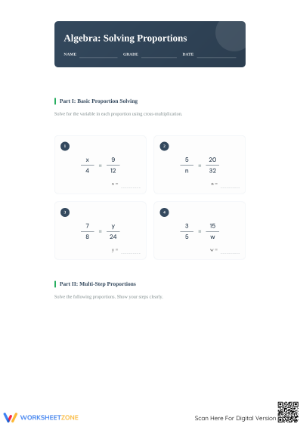
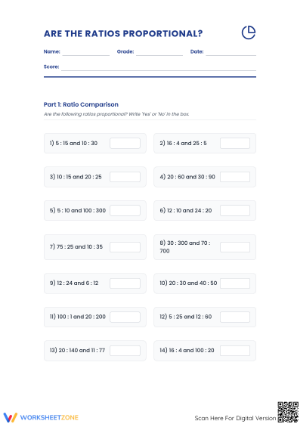
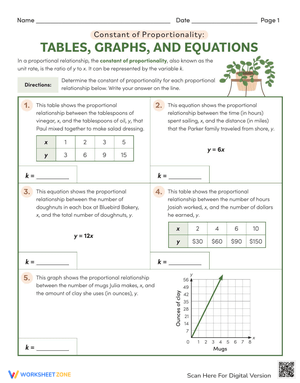
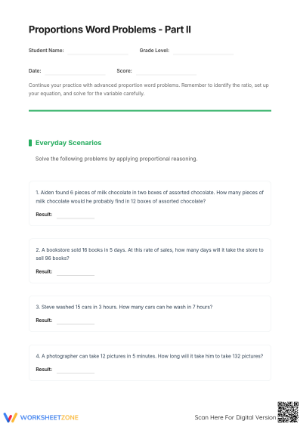
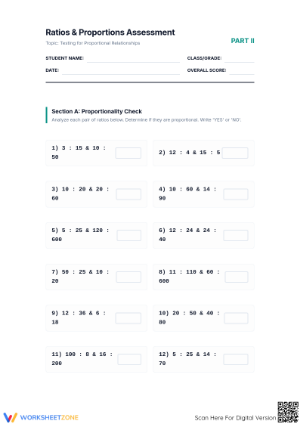
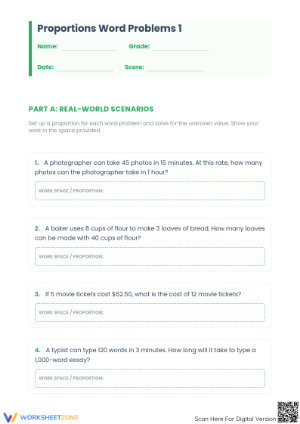
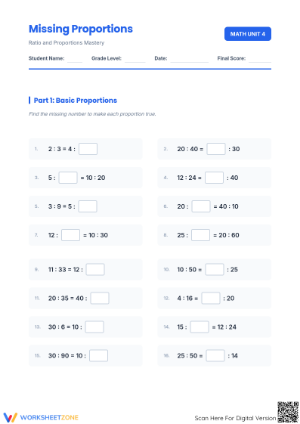
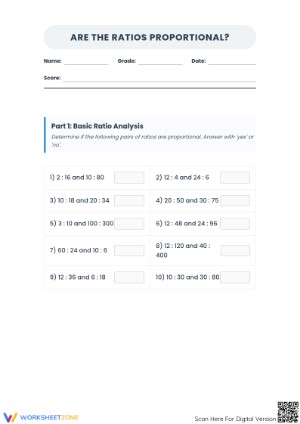
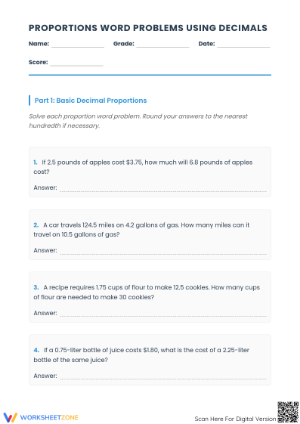
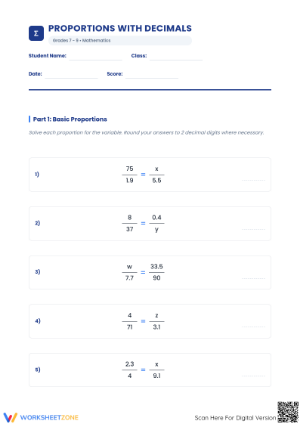
These 7th grade proportional relationship printable worksheets resources give teachers structured practice that moves students across all four representations of proportionality — tables, coordinate graphs, equations, and word problems — in a format that prints cleanly and works in any part of the math block. Each worksheet targets a specific skill inside the proportional reasoning strand, so teachers assign only what their class actually needs rather than working through a fixed sequence. The set covers the full arc of 7th-grade proportionality instruction: from the earliest identification tasks through multi-representation application problems.
What's Inside the Set
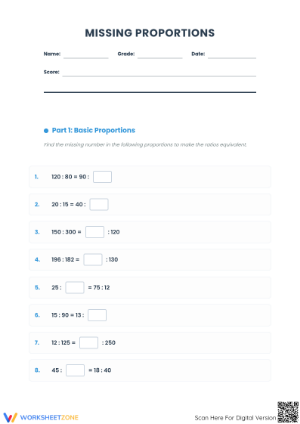
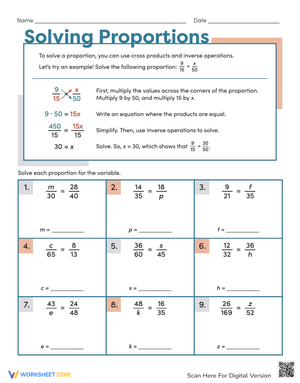
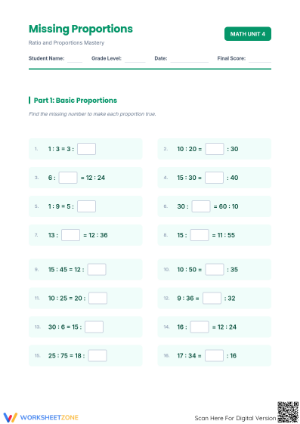
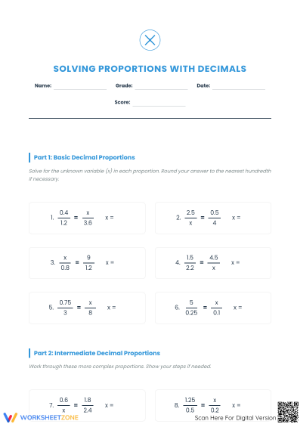
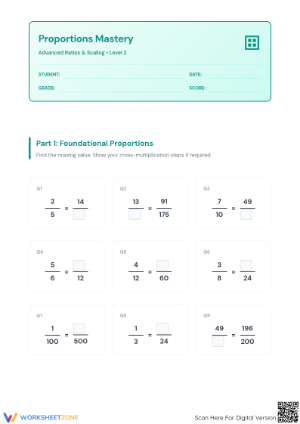
These worksheets address the exact moves students must make to demonstrate mastery of proportional relationships at the 7th-grade level. Most printable practice in this area covers a narrow slice — usually tables only — and leaves students without enough exposure to the representations they will encounter on assessments and in future coursework.
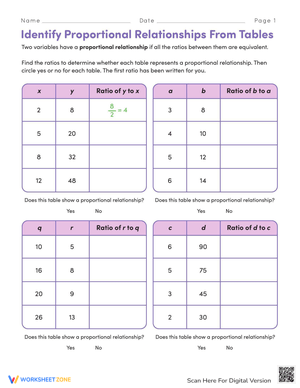
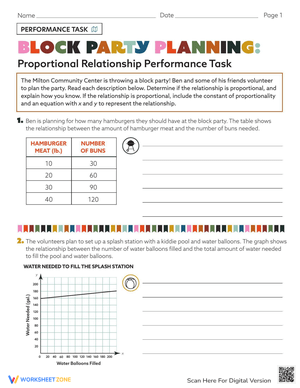
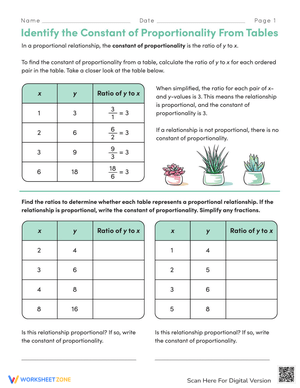
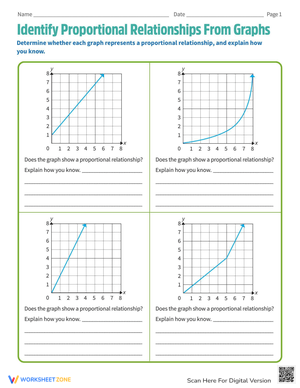
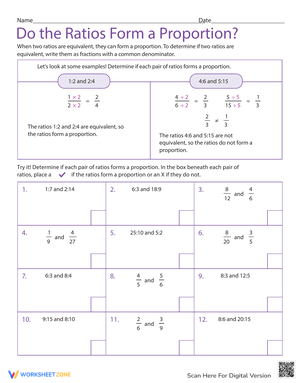
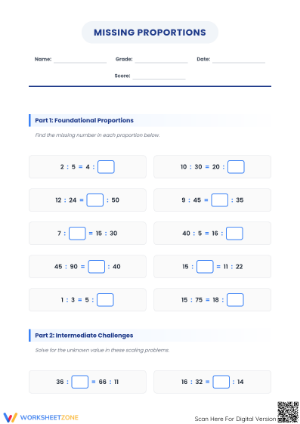
- Identifying proportional vs. nonproportional relationships: Students examine tables, check whether the ratio of y to x stays constant, and decide whether a graphed line passes through the origin. Items pair examples with nonexamples so students look for defining features rather than surface patterns.
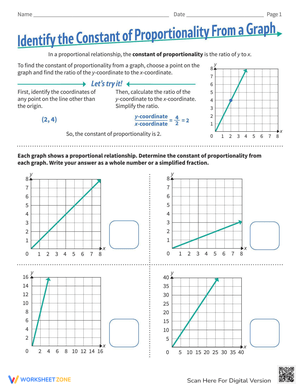
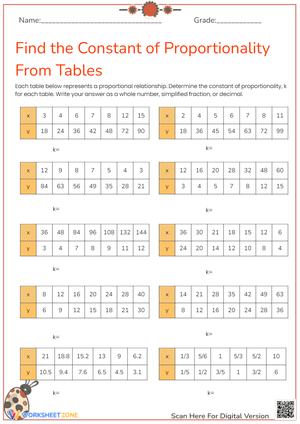
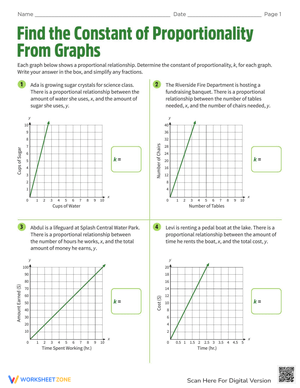
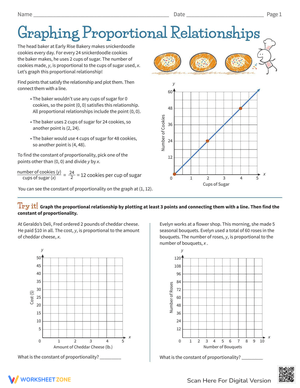
- Finding the constant of proportionality: Students calculate k from a table, extract it from the slope of a graphed line, and name it in context — for example, recognizing that k = 12 means a car covers 12 miles per gallon.
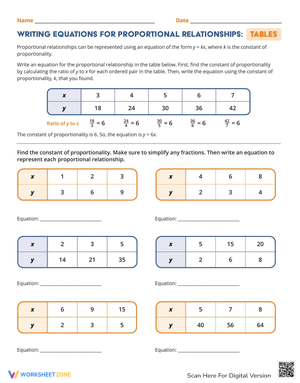
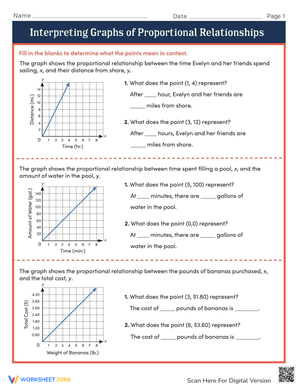
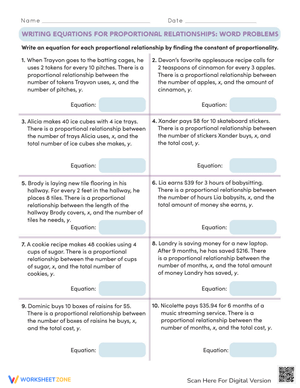
- Writing and interpreting equations in the form y = kx: Students connect a table or graph to its equation, substitute values, and explain what the constant represents in a realistic situation.
- Graphing proportional relationships: Students plot ordered pairs, confirm that the line passes through the origin, and label the unit rate directly on the graph.
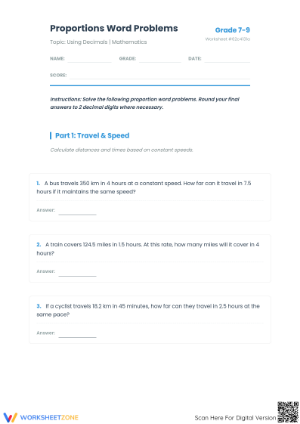
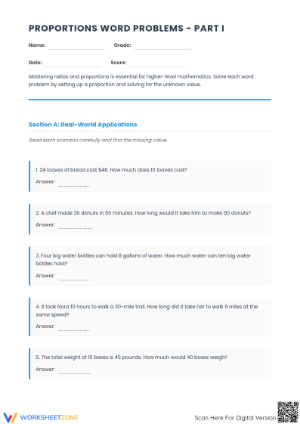
- Word problems across contexts: Problems draw from unit pricing, speed and distance, recipe scaling, and scale drawings — the same domains that appear in 7.RP.A.2-aligned curriculum materials and standardized assessments.
Each worksheet also requires at least one written explanation rather than a numerical answer alone. That requirement catches a specific gap: students who calculate k correctly but cannot say what it means for the quantities in the problem.
Mistakes Students Make That These Worksheets Help You Catch
The most persistent error in this unit is additive thinking. A student looks at a table with rows (2, 5), (4, 7), (6, 9) and concludes the relationship is proportional because y increases by 2 each time x increases by 2. The student is checking differences instead of ratios. The actual ratios — 5 divided by 2, 7 divided by 4, 9 divided by 6 — are not equal, and the relationship is linear but not proportional. This error surfaces often and goes undetected when worksheets ask only for a final answer without requiring students to show the ratio test.
Two related misconceptions show up in graphing work. Many students believe any straight line represents a proportional relationship — they graph y = 2x + 3, see a straight line, and mark it proportional without checking the y-intercept. And students who work comfortably with tables frequently freeze when the same relationship appears as a graph or equation. If a student finds k = 4 from a table but cannot identify k in y = 4x or read it from a graphed line, the understanding is surface-level. Placing all three representations on the same worksheet, tied to a single real-world context, surfaces that compartmentalized thinking before it becomes a test-day problem.
Standard Alignment
These resources address CCSS 7.RP.A.2 and all four of its sub-standards: 7.RP.A.2a (deciding whether two quantities are in a proportional relationship), 7.RP.A.2b (identifying the constant of proportionality from tables, graphs, equations, and verbal descriptions), 7.RP.A.2c (representing proportional relationships by equations), and 7.RP.A.2d (explaining what a point on a graph means in context). In most 7th-grade math courses, this cluster lands in the fall semester and sits directly before the formal introduction of linear functions. Students who leave this unit without understanding why the graph must pass through the origin — or what k actually represents — arrive in 8th-grade linear functions carrying a gap that is difficult to close mid-year. The 7th grade proportional relationship printable worksheets in this set align each task explicitly to a sub-standard, which helps teachers identify exactly where a student's understanding breaks down.
Lesson-Planning Strategies That Work With This Set
Teachers who get the most out of these worksheets spread the skill sequence across several sessions rather than treating proportional relationships as a single unit. A two-week arc might open with identification from tables, move to graphing on day three, introduce equation writing in week two, and close with mixed-representation practice and word problems. That spacing lets students consolidate each representation before being asked to connect multiple ones at once.
- Warm-ups: Start class with a two- or three-item classification task — students sort a table, a graph, and an equation as proportional or not and record their reasoning in a sentence. The first five minutes produce immediate information about what transferred from the previous lesson.
- Guided practice: Present a single real-world context — a worker earning $15 per hour — and have students complete the table, graph, and equation for that situation on the same worksheet. Moving through all three representations for one context builds connection more effectively than treating each representation as a separate topic.
- Small-group intervention: Pull students who are struggling with the origin requirement and use the graphing worksheets in a group of four or five. Have students draw two lines on the same axes — one through the origin, one with a y-intercept of 3 — then decide which is proportional and explain why in writing.
- Exit tickets: Close class with one nonexample — a nearly proportional table or a graph that misses the origin — and ask students to identify the flaw. Their written responses show immediately who understands the definition and who is guessing based on appearance.
These worksheets also work well the day after a quiz or unit test, when teachers know exactly which students need more practice with a specific representation. Because each worksheet addresses one distinct skill, targeted reteaching does not require rebuilding the full unit from scratch.
Adjusting the Worksheets for a Range of Learners
The most effective differentiation strategy for this topic is not changing the math — it is adjusting the representation demand. Every 7th-grade student should grapple with proportional relationships, but students entering below grade level need to start with whole-number constants before working across representations. The introductory worksheets in the set use clean whole-number constants — k = 3, k = 5, k = 10 — that keep the arithmetic manageable while still requiring the core ratio reasoning. For 7th grade proportional relationship printable worksheets tasks at higher levels, the later worksheets introduce rational number constants, two-step application problems, and contexts that require students to first decide whether a relationship is proportional before calculating anything.
Adjusting the writing requirement is another practical lever. For students still building confidence, a sentence frame — "This relationship is / is not proportional because ___" — maintains the reasoning demand without the added barrier of open-ended composition. For students ready for more, removing the partially completed table or graph and asking them to build both from a written description turns the same worksheet into a significantly harder task without requiring a different resource entirely.
Frequently Asked Questions
What grade level and standards do these worksheets address?
These worksheets are written for 7th grade and align to CCSS 7.RP.A.2 and its four sub-standards. They assume students have worked with ratios and unit rates in 6th grade and are ready to formalize that understanding using the y = kx structure, coordinate graphs, and written justification.
How do students find the constant of proportionality from a graph?
Students select any point on the line other than the origin — for example, (3, 12) — and divide the y-coordinate by the x-coordinate: 12 divided by 3 equals 4, so k = 4. The worksheets guide students through this step across multiple points to confirm the ratio holds before they record k. A common early mistake is choosing the origin itself, which produces 0 divided by 0 and creates confusion, so the items explicitly prompt students to select a different point.
Do these worksheets include nonproportional relationships alongside proportional ones?
Yes. Each identification worksheet pairs proportional examples with nonproportional ones — linear relationships with a nonzero y-intercept, tables where differences are equal but ratios are not, and graphs that do not pass through the origin. Seeing both within the same practice session is one of the most reliable ways to firm up students' understanding of the definition and prevent the misconception that any increasing pattern is proportional.
Can I use these for test preparation as well as initial instruction?
Many teachers use 7th grade proportional relationship printable worksheets resources specifically in the week before an assessment. The skill sequence here follows the progression of the 7.RP.A.2 sub-standards, and the mixed-representation review worksheets mirror the format most standardized assessments use — identify, calculate, graph, and explain, often within the same cluster of items.
Are answer keys included?
Yes. Each worksheet in the set comes with a fully worked answer key, not just final answers. Graph items show plotted points with the line drawn and labeled. For explanation items, the key provides a sample response so teachers have a reference point when evaluating student writing rather than judging open-ended answers from scratch.













 Interactive Worksheet Maker
 Quiz Maker
 Word Search Maker
 Crossword Puzzle Maker
 Word Scramble Generator
 Sentence Scramble Generator
 Handwriting Worksheet Generator
 Name Tracing Generator
 Fill In The Blank Generator