


























Views
Downloads



Essential Proportional Ratios Worksheet | Grades 6-9 Math
Paste this activity's link or code into your existing LMS (Google Classroom, Canvas, Teams, Schoology, Moodle, etc.).
Students can open and work on the activity right away, with no student login required.
You'll still be able to track student progress and results from your teacher account.
This comprehensive worksheet helps middle school students master the concept of proportionality through 40 targeted practice problems. By comparing pairs of ratios across four levels of difficulty, students build the fluency needed to recognize equivalent relationships in mathematical and real-world contexts. It is an ideal resource for strengthening core algebraic foundations.
At a Glance
- Grade: 7 · Subject: Math
- Standard:
7.RP.A.2— Decide whether two quantities are in a proportional relationship by testing for equivalent ratios- Skill Focus: Identifying Proportional Ratios
- Format: 3 pages · 40 problems · Answer key included · PDF
- Best For: Independent practice and formative assessment
- Time: 25–35 minutes
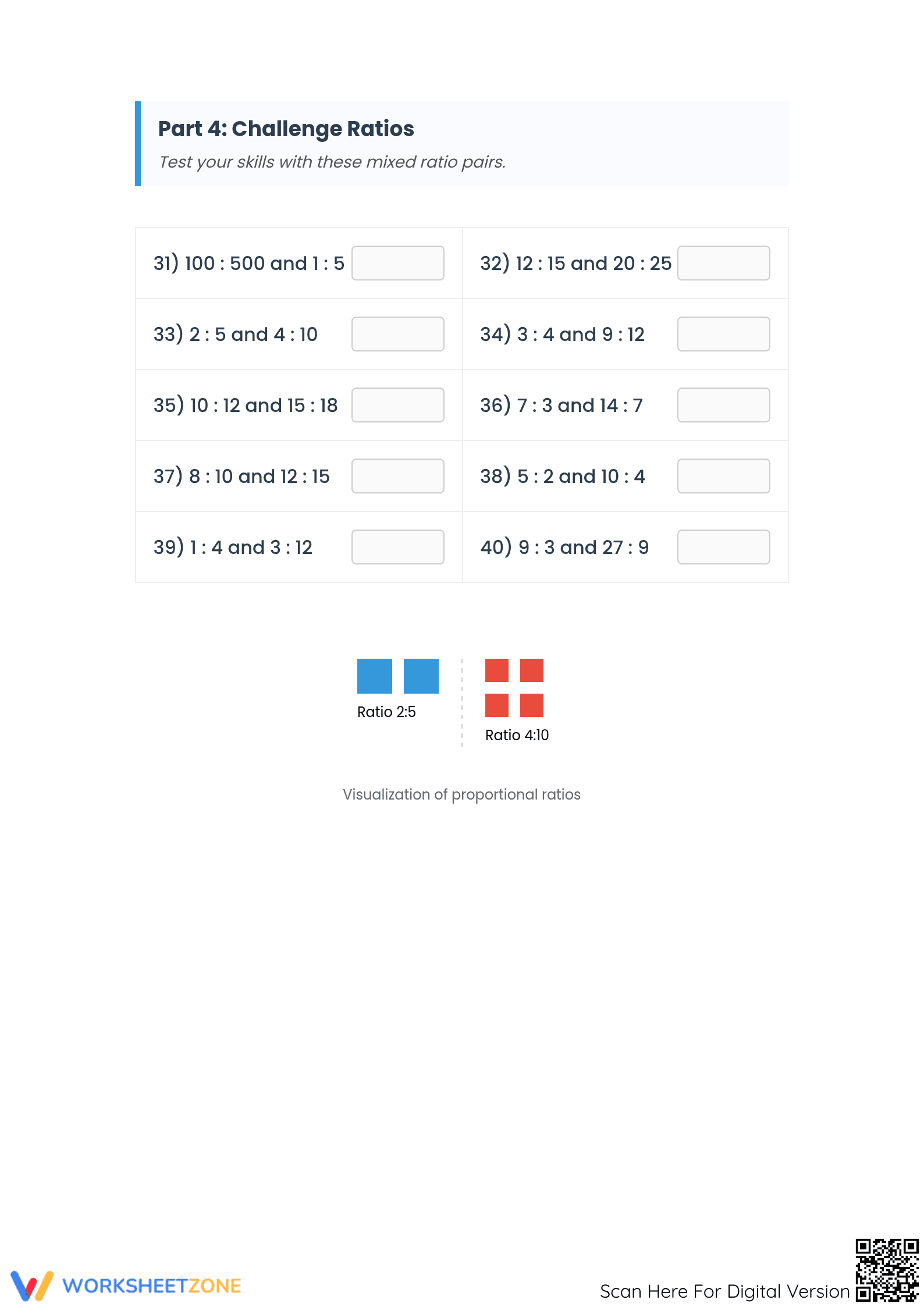
Inside this three-page PDF, educators find a structured progression of tasks designed to solidify ratio understanding. The worksheet is divided into four distinct parts, totaling 40 problems that transition from simple whole-number comparisons to more complex challenge pairs. A complete answer key is provided for every page, and the final section includes a visual representation to help students bridge the gap between abstract numbers and geometric proportionality.
Skill Progression
- Guided practice: Part 1 presents 10 basic ratio pairs where students determine proportionality with simple yes or no responses to build initial confidence and recognition speed.
- Supported practice: Parts 2 and 3 introduce intermediate and advanced pairs, requiring students to simplify ratios or use cross-multiplication strategies to verify their mathematical answers.
- Independent practice: The final challenge section tests mastery with 10 mixed ratio pairs, including larger numbers that demand high-level computational accuracy and deep conceptual understanding.
The worksheet follows a gradual-release model, moving from intuitive recognition to rigorous calculation.
Standards Alignment
This resource is directly aligned to `7.RP.A.2`, which requires students to recognize and represent proportional relationships between quantities. Specifically, students must decide whether two quantities are in a proportional relationship by testing for equivalent ratios in a table or graphing on a coordinate plane. This standard code can be copied directly into lesson plans, IEP goals, or district curriculum mapping tools.
How to Use It
Use this worksheet as a primary independent practice activity following a lesson on cross-multiplication or ratio simplification. It also serves as an excellent bell-ringer or exit ticket across multiple days by assigning one Part per session. For formative assessment, observe students during Part 3 to see if they are consistently applying the cross-product property or attempting to find a common multiplier. Most students complete the full set in 30 minutes.
Who It's For
This collection is designed for students in Grades 6 through 9 who are developing or refining their understanding of proportional reasoning. It provides necessary scaffolding for struggling learners through its tiered structure while offering extension opportunities in the challenge section. It pairs naturally with a visual anchor chart illustrating equivalent fractions or a direct instruction lesson on the constant of proportionality.
The ability to verify proportionality is a cornerstone of middle school mathematics, acting as a bridge between elementary arithmetic and high school algebra. According to the NAEP framework, proportional reasoning is one of the most significant indicators of future success in higher-level math courses. This worksheet supports that development by providing 40 structured opportunities for students to apply equivalent ratio tests, consistent with the recommendations in Fisher & Frey (2014) regarding the importance of scaffolding complex tasks. By moving from basic whole-number ratios to advanced challenge problems, the resource ensures students develop a robust understanding of the 7.RP.A.2 standard. This repetitive but varied practice helps internalize the cross-multiplication and simplification heuristics required for rapid problem-solving. It is a vital tool for any classroom focused on building long-term mathematical fluency and procedural confidence in ratio analysis.


