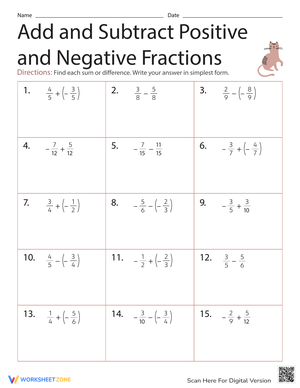
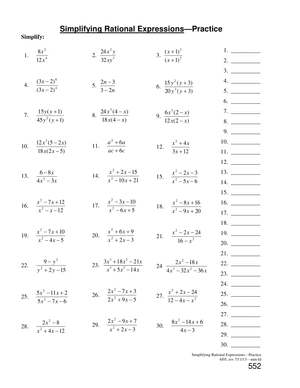
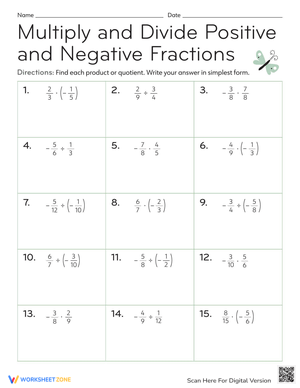
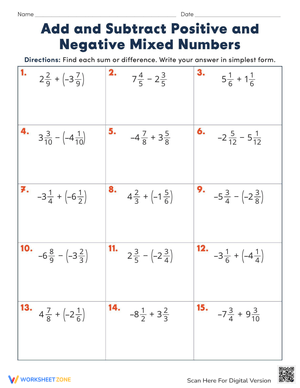
What 7th Grade Rational Numbers Worksheets Actually Cover
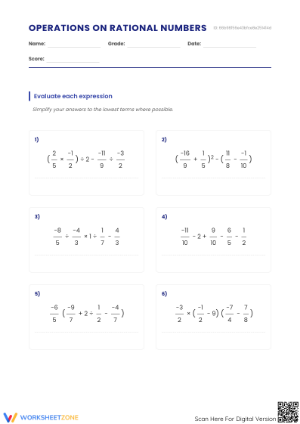
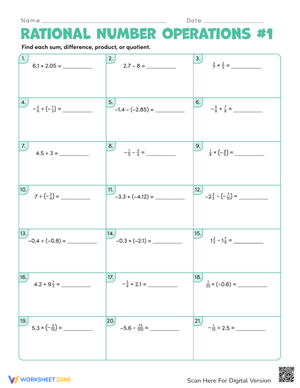
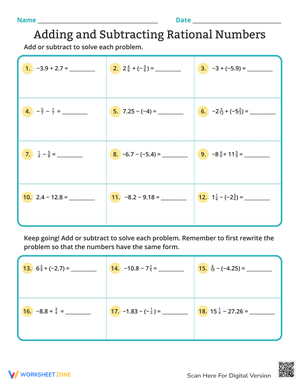
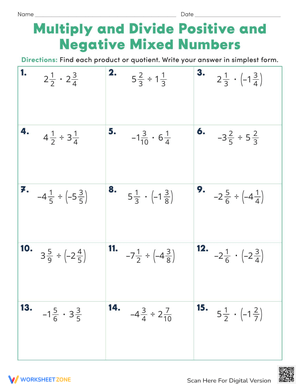
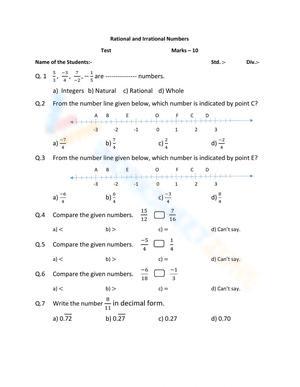
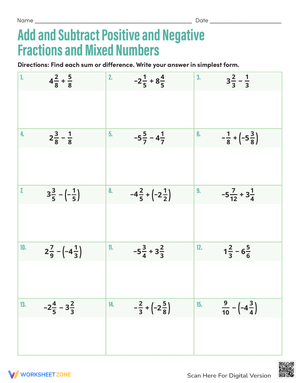
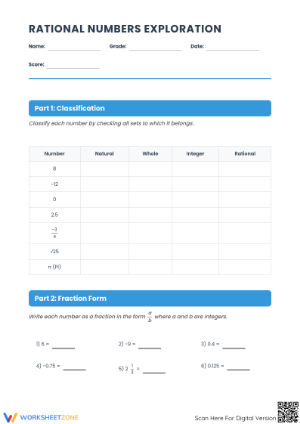
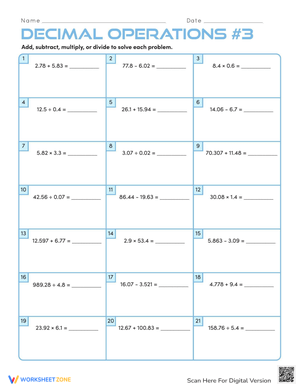
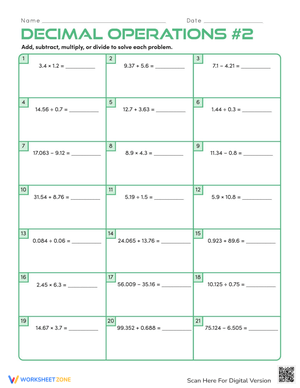
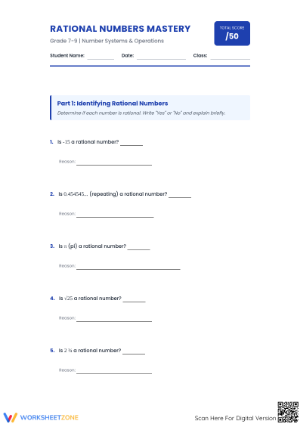
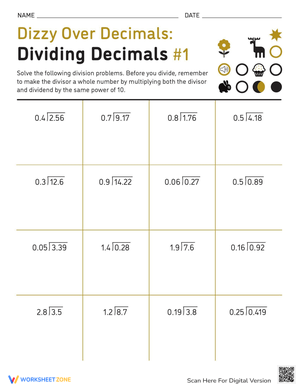
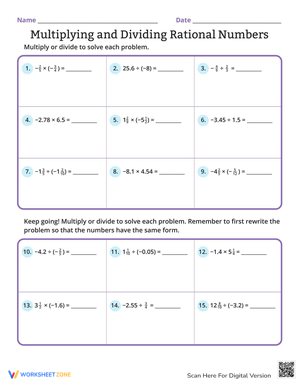
If you teach seventh grade math, rational numbers is the umbrella that finally pulls together everything students met in grades 5 and 6. A strong set of 7th grade rational numbers worksheets asks students to add, subtract, multiply, and divide positive and negative integers, fractions, and terminating or repeating decimals inside the same practice set. That mix is the point. A student who can handle -3/4 + 1/2 on one line and -6 divided by 0.5 on the next is building the fluency the rest of the grade depends on.
These pages aren't drill for its own sake. They give you a clean way to target one operation at a time, then blend operations once students are ready. Whether you're planning whole-class instruction, pulling a small intervention group, or running a quick review before a unit test, ready-made practice at the right grain size saves prep and keeps the math consistent from one day to the next.
How These Worksheets Map to CCSS 7.NS.1-7.NS.3
The cleanest way to plan the unit is to line your worksheets up against the three number-system standards for grade 7. Each targets a different skill, and worksheets let you isolate them one at a time.
- 7.NS.A.1 - adding and subtracting rational numbers, representing sums and differences on a number line, and understanding that p - q = p + (-q).
- 7.NS.A.2 - multiplying and dividing rational numbers, applying sign rules, and converting a rational number to a decimal through long division that either terminates or repeats.
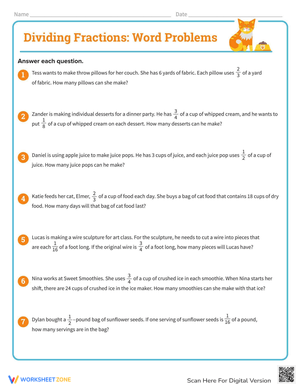
- 7.NS.A.3 - solving real-world and mathematical problems using all four operations with rational numbers.
Here's a sequencing detail that trips up a lot of unit plans: 7.NS.A.1 and 7.NS.A.2 are not simply "addition week" and "multiplication week." The first standard bundles the additive inverse idea directly into subtraction, so a worksheet that rewrites every subtraction as "add the opposite" is doing standards-aligned work, not just teaching a shortcut. Front-loading that rewrite step in the first three or four worksheets pays off later, because both division and multi-step 7.NS.3 problems lean on students trusting that -8 - (-5) and -8 + 5 are the same expression.
Number Line Models Before Abstract Practice
Before students grind through pages of signed-number arithmetic, spend time on the number line. CCSS 7.NS.A.1 explicitly asks students to represent addition and subtraction on a horizontal number line, and worksheets that include a number line strip give kids a place to show their thinking instead of guessing at signs.
The model does real conceptual work. When a student sees that adding a negative moves left and subtracting a negative moves right, the sign rules stop feeling arbitrary. Choose worksheets that open with number line representations for the first few problems, then fade the scaffold so students move toward abstract computation with the reasoning still intact.
Common Errors and How Targeted Practice Fixes Them
The single most common mistake at this level is a sign error when a subtraction is rewritten as addition of the opposite. A student computes -5 - 3 and lands on -2 because they quietly treated the problem as -5 + 3. Multiplication and division bring the second big one: forgetting that a negative times a negative is positive.
Worksheets help here precisely because they let you concentrate the practice. A page of nothing but "subtract a negative" problems surfaces the misconception fast, and a mixed page afterward checks whether the fix actually stuck.
According to the Common Core State Standards Initiative, grade 7 students must apply properties of operations to add, subtract, multiply, and divide rational numbers under standards 7.NS.A.1 through 7.NS.A.3 - three connected standards that together define the signed-number fluency expected across the entire seventh grade number system unit.
Classroom Implementation
Sequence matters more than volume. A workable order across the unit:
- Start with adding rational numbers on a number line, integers first, then fractions and decimals.
- Move to subtraction, framed entirely as adding the opposite.
- Introduce multiplication with its sign rules, then division.
- Finish with mixed four-operation and word-problem pages for 7.NS.A.3.
For small-group intervention, hand a group the same skill but drop the numbers to friendlier values - single-digit integers before fractions - so the reasoning stays visible. For whole-class review, a mixed page works as a five-minute warm-up or an exit ticket. Because each worksheet targets a known skill, you can read a stack of exit tickets in a couple of minutes and know exactly who needs another pass at "subtract a negative" tomorrow.
Connecting Practice to Real-World Problems
Standard 7.NS.A.3 asks students to use all four operations with rational numbers in real contexts, and those contexts are what make signed numbers stick. Temperature change, elevation above and below sea level, and gains and losses of money are the three that read most naturally to seventh graders.
Look for worksheets that move a student from bare computation to a short word problem using the same numbers. A student who just computed -12 + 7 should then meet "the temperature was -12 degrees and rose 7 degrees" so the arithmetic gets an anchor. That bridge from abstract to applied is exactly what 7.NS.A.3 is testing, and it's the part students most often skip when they only practice bare computation.
Frequently Asked Questions
1. What are rational numbers in 7th grade math?
Rational numbers in grade 7 are any numbers that can be written as a fraction of two integers, which includes positive and negative integers, fractions, and terminating or repeating decimals. The big shift from earlier grades is that students now work with negatives across all four operations, not just positive fractions and whole numbers.
2. Which standards do 7th grade rational numbers worksheets cover?
These worksheets align to the grade 7 number system standards. 7.NS.A.1 covers adding and subtracting rational numbers, 7.NS.A.2 covers multiplying and dividing them along with decimal conversion, and 7.NS.A.3 covers solving real-world problems with all four operations. Matching each worksheet to one standard keeps the unit organized.
3. How can I use these worksheets for intervention?
For intervention, keep the skill the same but simplify the numbers. If the class is subtracting negative fractions, give your small group single-digit integers first so the sign reasoning stays visible. Pair each problem with a number line, and add fractions back in only once students trust the direction of every move.
4. How should I sequence the worksheets?
Sequence by operation, not by difficulty. Start with addition on a number line, then subtraction framed as adding the opposite, then multiplication with its sign rules, then division. Finish with mixed pages and word problems for 7.NS.A.3. This order lets each skill build on the one before it instead of competing with it.













 Interactive Worksheet Maker
 Quiz Maker
 Word Search Maker
 Crossword Puzzle Maker
 Word Scramble Generator
 Sentence Scramble Generator
 Handwriting Worksheet Generator
 Name Tracing Generator
 Fill In The Blank Generator