


























Views
Downloads


CCSS.MATH.7.NS.A.2 Worksheet: Rational Numbers — Complete Guide
Paste this activity's link or code into your existing LMS (Google Classroom, Canvas, Teams, Schoology, Moodle, etc.).
Students can open and work on the activity right away, with no student login required.
You'll still be able to track student progress and results from your teacher account.
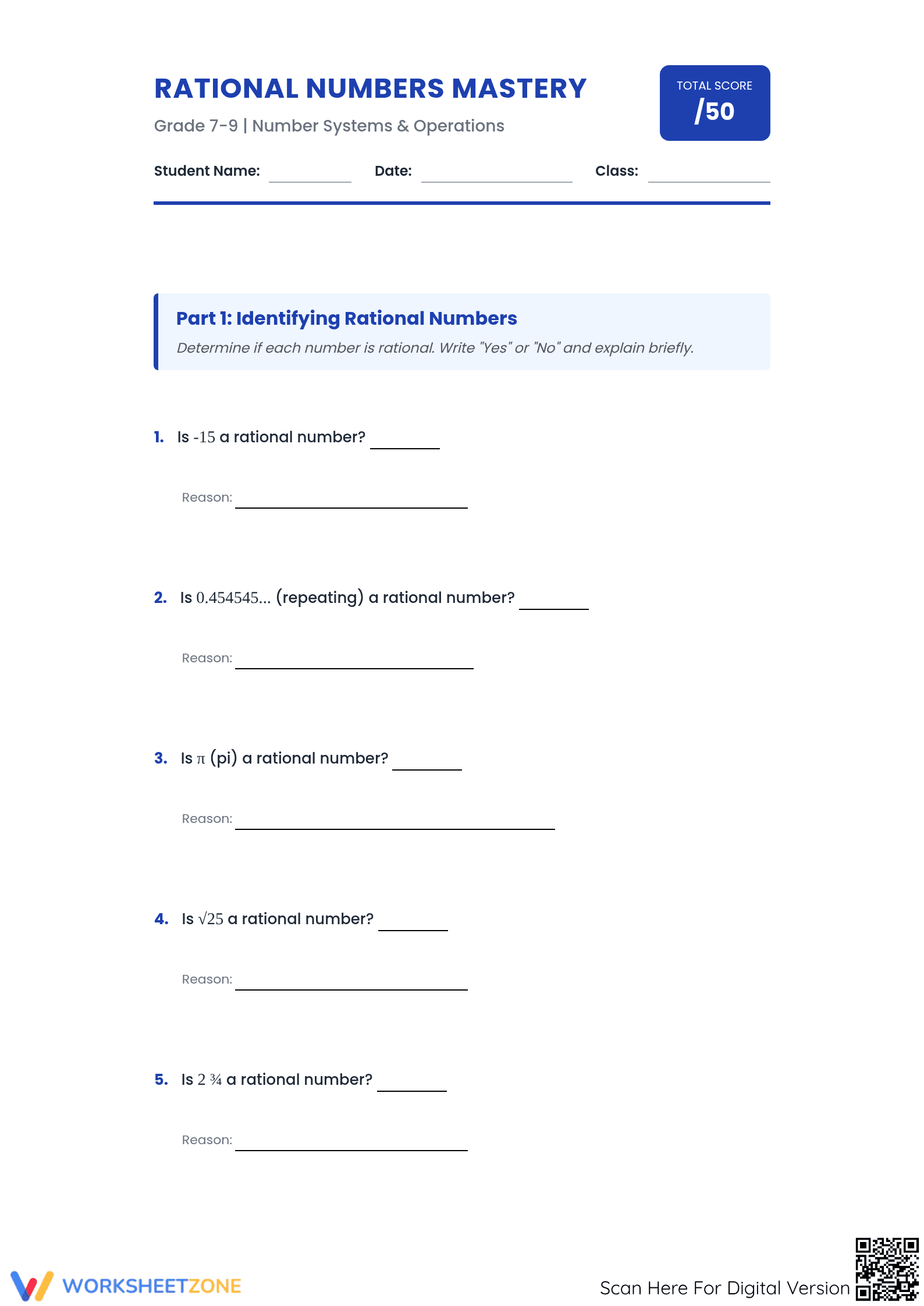
This Grade 7 rational numbers worksheet provides a comprehensive pathway for students to identify, convert, and perform complex operations with positive and negative fractions and decimals. By engaging with 23 structured problems, learners move beyond simple arithmetic to demonstrate a deep conceptual understanding of the number system. Answer key included. Aligned to CCSS.MATH.CONTENT.7.NS.A.2.
At a Glance
- Grade: 7 · Subject: Math
- Standard:
7.NS.A.2— Apply and extend previous understandings of multiplication and division to rational numbers- Skill Focus: Rational Number Mastery
- Format: 4 pages · 23 problems · Answer key included · PDF
- Best For: End-of-unit assessment or intensive test prep
- Time: 45–60 minutes
What's Inside
This essential resource is organized into five distinct sections: identification of rational vs. irrational numbers, conversion tables for fractions and decimals, number line plotting, inequality comparison, and multi-step computational expressions. The four-page PDF includes a detailed answer key and a final challenge question designed to spark critical thinking regarding the properties of reciprocals and zero.
Mastery Evidence
Each task in this standards-aligned set is specifically mapped to the sub-skills required for grade-level mastery. Part 1 builds the foundational vocabulary for the number system, while Part 4 requires students to apply order of operations to mixed rational formats. Teachers can use the total score of 50 to generate evidence for IEP progress notes or district-level standard reporting, ensuring that every problem serves as a data point for student growth.
Standards Alignment
The primary focus of this worksheet is `CCSS.MATH.CONTENT.7.NS.A.2`, which requires students to apply and extend previous understandings of multiplication and division and of fractions to multiply and divide rational numbers. Additionally, it supports `CCSS.MATH.CONTENT.7.NS.A.3` through real-world application problems involving temperature shifts and financial calculations. Both standard codes can be copied directly into lesson plans, IEP goals, or district curriculum mapping tools.
How to Use It
This worksheet is ideal for use after direct instruction on the properties of integers and decimals. For a formative assessment, observe students during Part 2 to see if they accurately transition between fractional and decimal representations before they attempt the more complex word problems in Part 5. Expect a completion time of 45 to 60 minutes depending on whether students are working independently or in guided small groups.
Who It's For
This resource is designed for Grade 7 general education students, Grade 8 students requiring intervention, or advanced Grade 6 learners. It pairs naturally with a number line anchor chart or a decimal-to-fraction conversion guide for students who need additional scaffolding during the independent practice phase.
According to NAEP research, the ability to fluently transition between different representations of rational numbers is a key predictor of success in high school algebra. This worksheet targets that specific fluency by requiring students to justify their reasoning in writing for standard 7.NS.A.2. By integrating real-world scenarios—such as elevation changes and recipe adjustments—the curriculum ensures that the mathematical theory remains grounded in practical application. Educators utilizing the Fisher & Frey (2014) gradual release model will find the progression from simple identification to multi-step problem solving particularly effective for classroom implementation. The inclusion of a 50-point scoring system allows for immediate quantitative feedback, which research from ScienceDirect TpT Analysis identifies as a critical factor in student motivation and mastery retention. This complete package provides the rigorous practice necessary for 7th-grade math proficiency.


