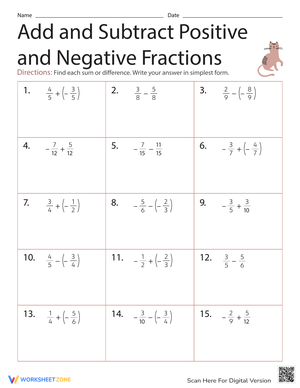
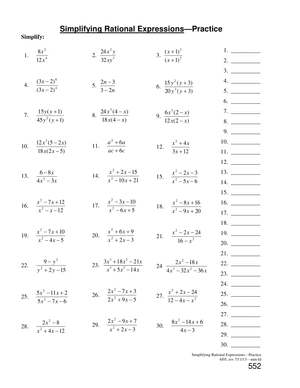
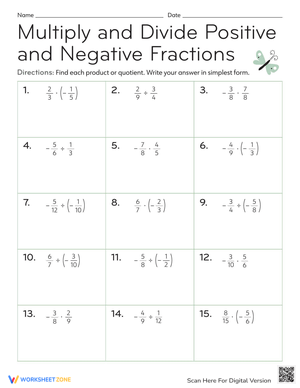
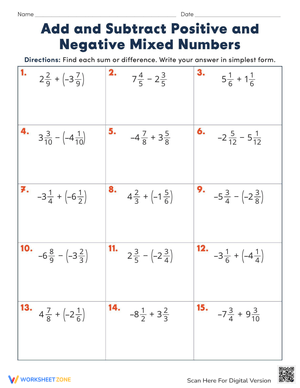
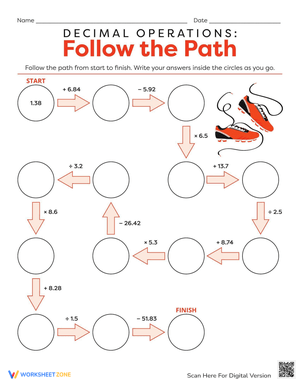
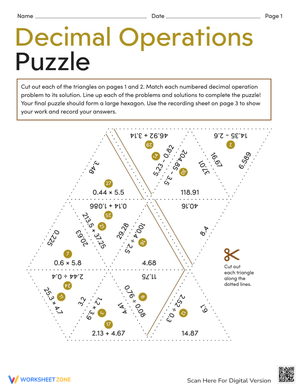
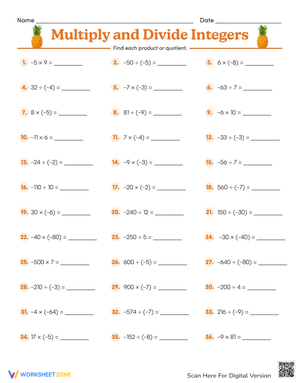
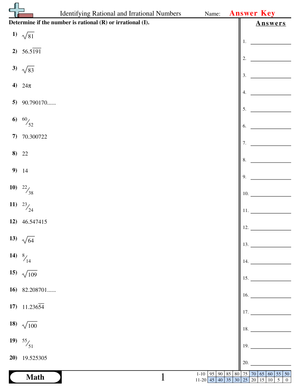
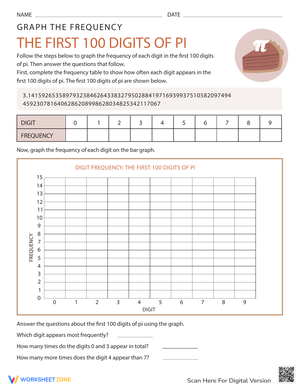
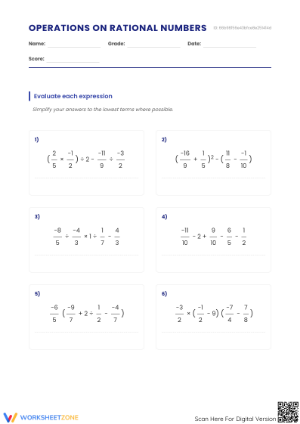
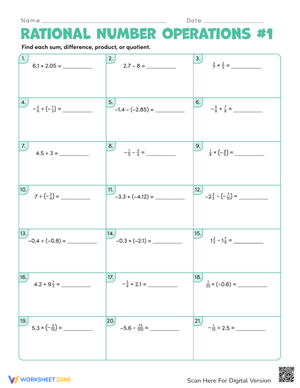
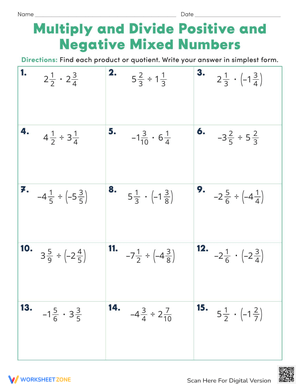
These 7th grade integers and rational numbers worksheets resources cover the full range of signed-number skills Grade 7 students need—from placing values on a number line to solving multi-step problems that mix fractions and decimals in the same expression. Each worksheet is a standalone printable organized by skill, so teachers can assign exactly what the moment requires rather than working through an undifferentiated packet. The set runs from foundational number sense through operations and into applied problem-solving, giving teachers usable entry points at any stage of the unit.
The Specific Skills Targeted
The set addresses integer and rational number concepts in a deliberate sequence. Early worksheets focus on opposites, absolute value, and number line placement—skills that look straightforward but expose real confusion once negative fractions and decimals appear alongside whole numbers. Students mark, order, and compare values before they touch operations.
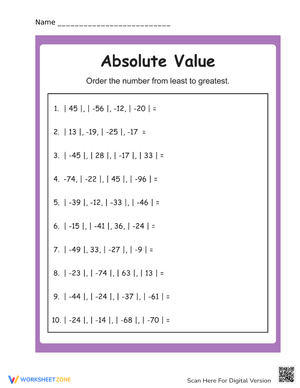
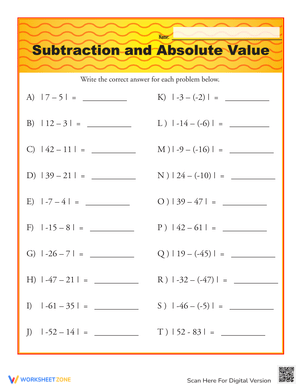
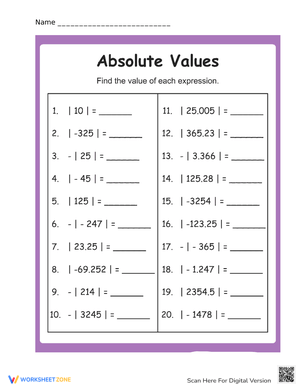
- Absolute value and opposites: identifying the absolute value of integers and rational numbers, writing opposites, and distinguishing between a negative number and its absolute value.
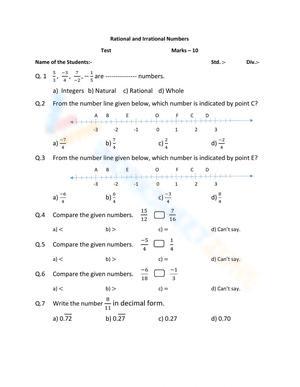
- Number line work: placing integers, fractions, and decimals accurately; identifying values between given points; and using position to compare magnitude.
- Comparing and ordering: ranking mixed sets—negative fractions, terminating decimals, and integers—from least to greatest and greatest to least.
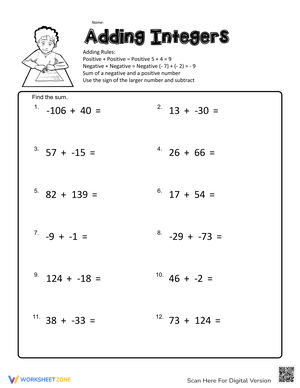
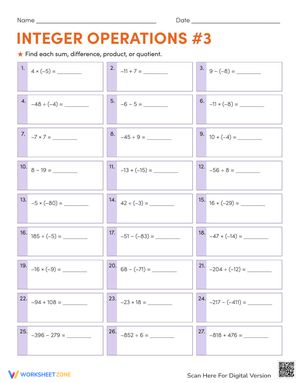
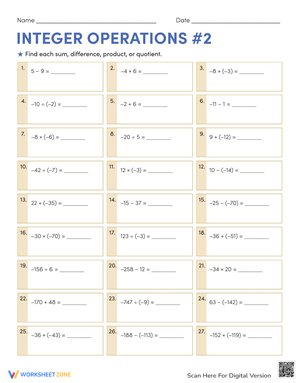
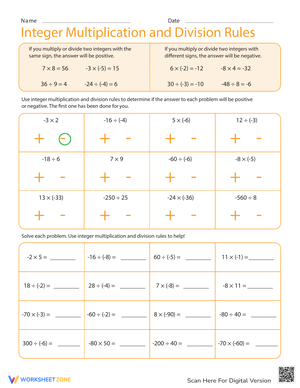
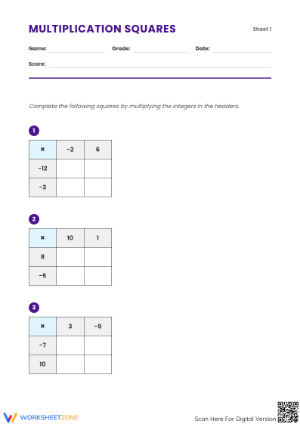
- Operations with integers: adding and subtracting integers with and without a number line model, then multiplying and dividing with close attention to sign rules.
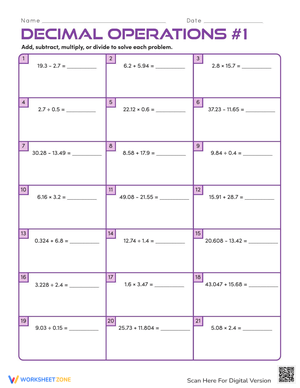
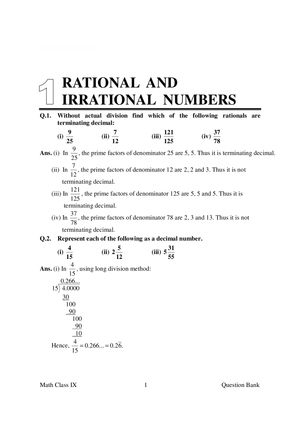
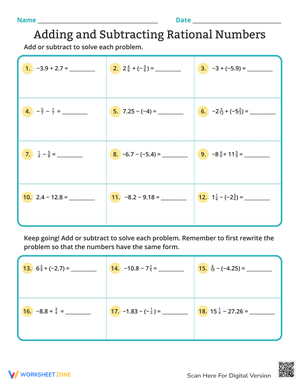
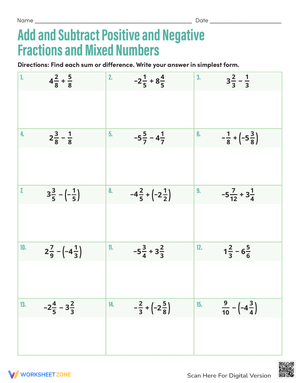
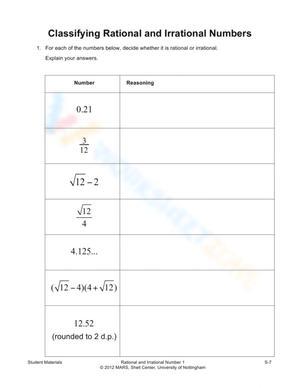
- Operations with rational numbers: extending integer rules to fractions and decimals, including problems that mix forms within the same expression.
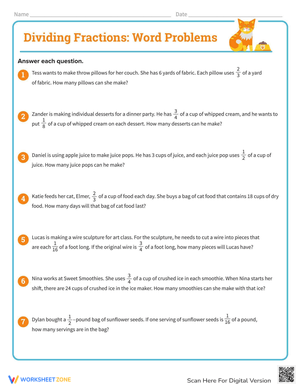
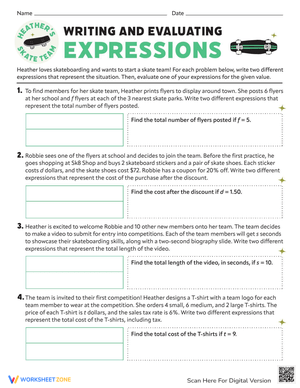
- Word problems and context: temperature change, elevation, bank account balances, and yardage gain and loss—situations where students must interpret the sign of a result, not just compute it.
Each worksheet stays within one skill cluster. That focus makes it practical to use one worksheet for bell work and a different one for independent practice the same day without the two overlapping.
Mistakes Students Make That These Worksheets Help You Catch
The error patterns in this unit are predictable enough that you can plan instruction around them. One of the most persistent appears with subtracting a negative number. Students who handle −4 + 2 correctly will still write −3 − (−5) = −8, applying the subtraction operation to the sign on the 5 rather than converting to addition of the opposite. Several worksheets include worked-example comparison items where students examine two similar expressions and explain why one result is positive and the other is negative—a format that surfaces this confusion directly.
Absolute value trips students up in a different way. Many read |−9| as −9, conflating the negative sign inside the bars with the bars' meaning. This mistake compounds quickly when absolute value appears inside a larger expression. A short worksheet on this concept alone—assigned before it shows up in mixed computation—prevents the error from taking hold.
A third pattern involves ordering a set like −1.5, −¾, 0.25, and −2. Students frequently misplace the negative fractions relative to the negative decimals because they apply fraction-to-decimal conversion rules inconsistently at the negative end of the number line. Number line worksheets that require plotting before ordering catch this before it disrupts operations practice downstream.
How to Build These Worksheets Into Your Lesson Plans
The most practical approach is to treat each worksheet as a single instructional move rather than a full day's activity. A number line worksheet works well in the first 8 to 10 minutes of class—before direct instruction on operations—because it activates magnitude thinking without requiring computation. An integer operations worksheet fits the independent practice block right after a lesson. A word problems worksheet lands well in the end-of-week block when students have enough procedural fluency to work contextually.
For substitute days, the printable PDF format means directions stay embedded in the worksheet itself. A teacher can leave two worksheets—one on comparing rational numbers, one on operations—with a short sequencing note, and the lesson runs without live support. Station rotations also benefit from this format: one station targets number line placement, another targets operations with fractions, and a third presents multi-step problems. Students rotate with a new worksheet at each stop rather than sharing a single class set.
Answer keys make the same resources useful during math workshop. Students who finish early can self-correct and annotate errors. A teacher working with a small reteach group can identify in under a minute whether a struggling student is making sign errors across all problem types or only on subtraction—which changes the next instructional decision considerably.
Standard Alignment
The worksheets align to CCSS 7.NS.A—the Number System domain for Grade 7. The specific standards covered include 7.NS.A.1 (applying properties of operations to add and subtract rational numbers), 7.NS.A.2 (applying properties of operations to multiply and divide rational numbers), and 7.NS.A.3, which addresses solving real-world problems using all four operations on rational numbers. Word problem worksheets throughout the set address that third standard directly.
These standards anchor the Number System domain at Grade 7 because students are formalizing signed-number reasoning for the first time. The conceptual work here—understanding why subtracting a negative is equivalent to adding a positive—directly supports 8th grade expressions and equations and later algebraic thinking. Teachers using Illustrative Mathematics Grade 7 Unit 5 or a similar curriculum sequence will find that a 7th grade integers and rational numbers worksheets set fits naturally alongside those lessons as additional practice or targeted review.
Adjusting the Worksheets for a Range of Learners
For students still building integer foundations, the number line worksheets provide concrete support before abstract operations. Let those students use a physical number line alongside the worksheet and focus on integer-only problems before mixing in fractions and decimals. The word problem worksheets can be narrowed by assigning only the elevation and temperature items first, which tend to be more intuitively grounded than bank balance or ratio contexts.
Students who move through integer operations quickly benefit from the multi-step and mixed-form problems in the set. Assign the rational number word problems that combine fractions and decimals in the same scenario, or ask those students to complete an error analysis: given a student's work on −2.5 × (−¾), identify the mistake and correct it. That task demands deeper understanding than computing from scratch. For students who need significant reduction in complexity, pairing a 6-problem integer comparison worksheet with a brief verbal check—asking students to explain one answer aloud—yields useful assessment information without requiring a full mixed set before they're ready.
Frequently Asked Questions
What topics are covered across the set?
The full set covers opposites, absolute value, number line placement, comparing and ordering rational numbers, operations with integers, operations with rational numbers in mixed forms, and word problems. Mixed review worksheets appear toward the end of the set for students who have practiced each skill separately and need to choose operations without the cue of a topical heading.
Do the worksheets include answer keys?
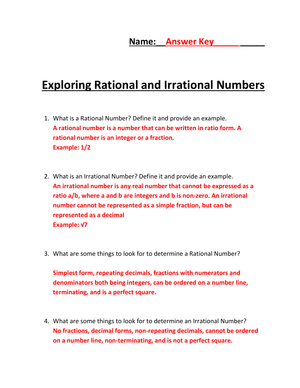
Yes. Each worksheet comes with a corresponding answer key formatted to show final answers clearly. Teachers can use the keys for fast homework checks, hand them to a paraprofessional running a small group, or let students self-correct during math workshop.
Are these suitable for intervention or primarily whole-class use?
Both. The single-skill format makes each worksheet strong for intervention because a teacher can identify exactly which concept is breaking down and assign that one worksheet rather than a mixed set. The 7th grade integers and rational numbers worksheets resources also work well for whole-class independent practice, homework, and test prep—especially the mixed review worksheets, which reflect the format students encounter on unit assessments.
Can the PDF files be assigned digitally?
PDF format supports digital assignment through most learning management systems. Teachers upload the file, students download and complete it, and the layout stays consistent across devices. Many teachers keep a printed class set for in-room use and a digital copy for absent students or remote submission. The 7th grade integers and rational numbers worksheets format works in both contexts because nothing in the layout depends on interactive tools—number lines, comparison problems, and computation work all read cleanly on screen and in print.













 Interactive Worksheet Maker
 Quiz Maker
 Word Search Maker
 Crossword Puzzle Maker
 Word Scramble Generator
 Sentence Scramble Generator
 Handwriting Worksheet Generator
 Name Tracing Generator
 Fill In The Blank Generator