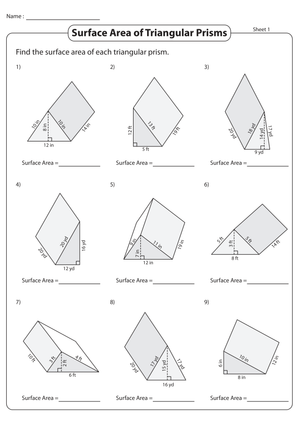
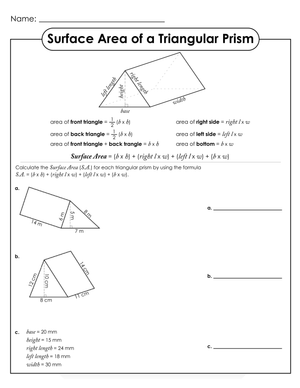
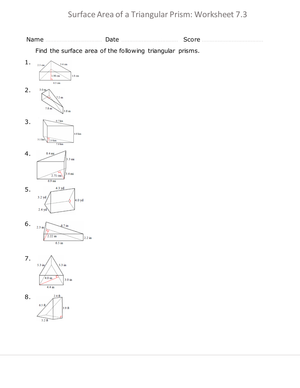
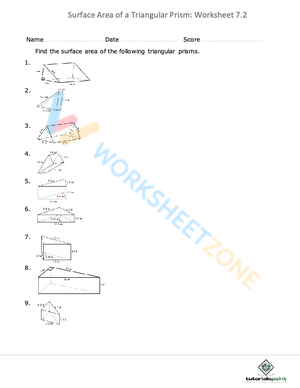
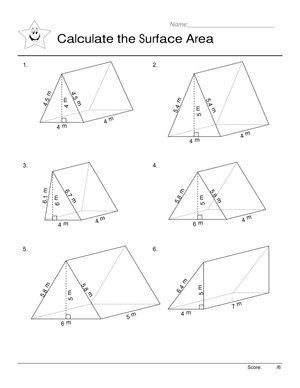
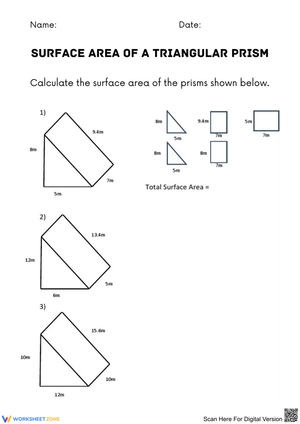
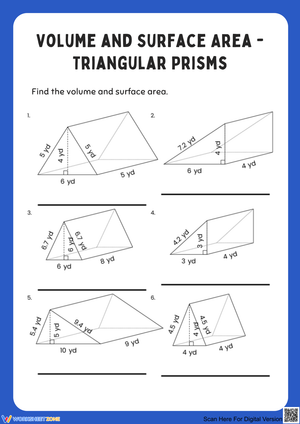
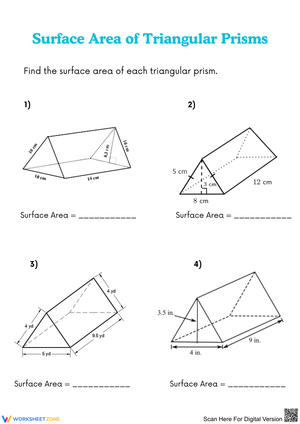
These surface area of a triangular prism pdf worksheets for 7th grade move students from net diagrams through formula work to applied problems, with each worksheet targeting a different phase of the skill rather than repeating the same calculation in a new context. This topic sits at the intersection of triangle area, rectangle area, and three-dimensional thinking — three ideas that need to work together — and well-designed practice makes misconceptions visible before a unit test does.
Concepts and Skills Covered in the Set
A triangular prism has five outside surfaces: two triangular bases and three rectangular lateral faces. Surface area is the sum of all five face areas. That sounds manageable, but reaching it accurately asks students to hold several things in place at once — the triangle area formula (A = ½bh), the rectangle area formula, and which dimensions belong to which face. Each worksheet in the set builds a different part of that skill.
- Net labeling: Students identify each of the five faces on an unfolded diagram, write the area of each face inside the face outline, and then sum the total.
- Dimension identification from 3D diagrams: Students read a labeled drawing and correctly assign each measurement — including separating the triangle's interior height from the prism's length.
- Formula practice: Students apply SA = ph + 2B by finding the perimeter of the triangular base, the prism length, and the triangular base area in sequence before combining them.
- Error analysis: Students review a worked example containing one or more mistakes — a missing face, volume thinking, or a swapped measurement — and explain what went wrong.
- Word problems: Students calculate how much material covers a prism-shaped real object: a tent, a wedge ramp, a display case. These require selecting the right formula and interpreting an area unit in context.
Dimensions in the set range from whole numbers to decimals. Whole-number versions let students focus on the prism's structure without arithmetic getting in the way. Decimal versions extend the same problems for students who need more challenge or serve as review later in the semester.
Errors Teachers Should Anticipate and Address
The most persistent error on this topic is failing to count both triangular bases. Students find one triangle, feel satisfied that they have handled the "triangle part," and move to the three rectangles. The result is four face areas instead of five. Asking students to name each calculation before adding — writing triangle 1, triangle 2, rectangle A, rectangle B, rectangle C beside each line of work — catches this error almost every time and makes answer review faster because you can see exactly where the calculation broke down.
Confusing the triangle's height with the prism's length is a close second. On a standard 3D diagram, both measurements appear near the triangular face of the figure and often look close in value. Students grab whichever number is nearby. Net worksheets reduce this confusion because the faces are physically separated on the diagram — the triangular bases sit apart from the rectangular faces, and there is no visual overlap between measurements that might blur which number belongs where.
Volume thinking shows up reliably in the first week after students have spent time on prism volume. They multiply three dimensions together rather than summing five face areas. An error-analysis item — specifically one showing a worked solution that multiplies all three dimensions — is more effective than a reminder written in the margin, because students have to articulate the error rather than simply be told to avoid it.
Building These Worksheets Into Your Lesson Sequence
The most effective opening for this unit is ten minutes on one projected net. Have students count the faces aloud, identify the two triangles and the three rectangles, and shade matching pairs. That physical accounting — five faces, named and tracked deliberately — gives students an image to return to when they get confused mid-problem three days later.
A natural three-day flow works well here. Day 1 centers on net worksheets, ending with a brief comparison of the face-by-face sum and the formula SA = ph + 2B. Day 2 shifts to 3D diagram worksheets where students extract dimensions without the net's spatial separation. Day 3 uses word problems and error-analysis items as the primary work. The surface area of a triangular prism pdf worksheets for 7th grade in this set are organized to support exactly that kind of daily progression — each worksheet does different cognitive work, so students are building on the previous lesson rather than re-running the same procedure in a new font.
For exit tickets, a three-question set works better than three identical problems: one net item, one formula item, one misconception item. The misconception question alone distinguishes students who understand what surface area measures from students who have memorized a sequence of steps — a distinction that matters for planning the next day's instruction.
Adapting the Set for Mixed-Ability Classrooms
For students who are still shaky on triangle area, the net worksheets are the right starting point because the triangular faces are visually unmistakable. Providing a small reference card with the triangle area formula keeps the lesson focused on the prism's structure rather than stalling at a prior skill. This is a deliberate tradeoff — some students need that support to move forward on the surface area task, and removing it too early produces frustration rather than productive struggle.
Students who move through the face-by-face approach quickly can take on the decimal-dimension problems and word problems that require reading a real context and extracting measurements. A useful extension: give those students a right triangular prism with a 3-4-5 right triangle base and ask them to verify their perimeter calculation using the Pythagorean theorem before proceeding. That adds genuine reasoning without needing additional materials.
For intervention, reduce the set to the net worksheets and ask students to write each face's area directly inside that face on the diagram before computing a total. Writing inside the shape builds the habit of accounting for all five surfaces before summing — and it makes reteaching conversations concrete, because both teacher and student are looking at the same labeled figure rather than a column of numbers disconnected from the geometry.
Standard Alignment
CCSS 7.G.B.6 — Solve real-world and mathematical problems involving area, volume and surface area of two- and three-dimensional objects composed of triangles, quadrilaterals, polygons, cubes, and right prisms — is the direct standard for this skill. In classroom terms, this standard falls late in the 7th-grade geometry unit, typically after students have worked with area of composite figures and before they shift into volume work. The word-problem worksheets address the "real-world" clause directly. The error-analysis items connect to the mathematical practice standard calling for students to critique the reasoning of others. Net worksheets address the geometric understanding underlying the standard, not just procedural formula use — a distinction that matters when students encounter unfamiliar prism orientations on assessments.
Frequently Asked Questions
When should teachers introduce the formula SA = ph + 2B versus face-by-face addition?
Most teachers get better results running face-by-face addition first — at least twice, using net worksheets — before introducing SA = ph + 2B. When students already know that 2B represents the two triangular bases and ph represents the combined area of the three rectangles, the formula reads as a description of work they have already done rather than an abstract substitution drill. Introducing the formula before students have found those five areas by hand tends to produce substitution errors, because students do not know what each variable is actually accounting for.
How are net worksheets useful beyond the first day of instruction?
Nets stay useful as a diagnostic tool throughout the unit. When a student's answer looks wrong and they cannot isolate the error, returning to a net and writing in each face area is the fastest way to find the problem — either a face is missing or a measurement has been placed in the wrong face. The surface area of a triangular prism pdf worksheets for 7th grade in this set include net problems at multiple points, not only at the start, so they remain available as a recovery resource after formula work is underway.
How many problems should a single worksheet include at this grade level?
For new instruction, four to six problems per worksheet is the right range. Below that, students do not get enough repetition to consolidate the procedure. Above eight or nine, fatigue-driven arithmetic errors begin to look like conceptual misunderstanding, which skews your data. For review sessions, more problems are appropriate — but only if the types vary. Six problems that cycle through net labeling, formula application, error analysis, and a word problem build more understanding than eight problems that all request the same calculation with different numbers.
Can these worksheets work for students who are below grade level in area computation?
Yes. Students who have not yet mastered triangle area can work through the net worksheets with a formula reference for triangle area and keep their attention on the prism's structure — identifying five faces, setting up each calculation correctly, and summing the total. The surface area of a triangular prism pdf worksheets for 7th grade in this set keep the instructional target on the prism rather than cycling through every area formula, which makes them workable even when the triangle area prerequisite needs reinforcement alongside the main lesson.













 Interactive Worksheet Maker
 Quiz Maker
 Word Search Maker
 Crossword Puzzle Maker
 Word Scramble Generator
 Sentence Scramble Generator
 Handwriting Worksheet Generator
 Name Tracing Generator
 Fill In The Blank Generator