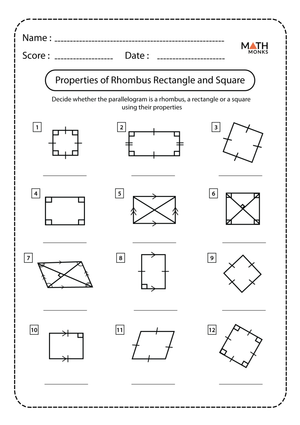
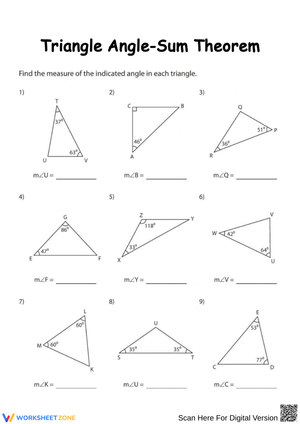
These 7th grade shapes printable worksheets resources give teachers ready-to-use geometry practice that spans both 2D classification and 3D measurement — the two domains that define most of seventh-grade geometry work. Each worksheet targets a specific concept, from sorting triangles by angle measure to calculating the surface area of composite solids, so teachers can match practice to the lesson goal without rebuilding materials from scratch.
The Geometry Skills Each Worksheet Targets
At grade 7, shape work stops being about recognition and starts being about reasoning. Students need to classify figures using precise attributes, not just identify them by appearance. That shift is harder than it looks — a student who correctly calls a shape "a quadrilateral" still has to learn why a square belongs to the rectangle family and why a rhombus does not. The worksheets address that layering directly, moving from naming to justifying.
- Polygon classification: regular vs. irregular polygons, naming by number of sides, and comparing interior angle sums
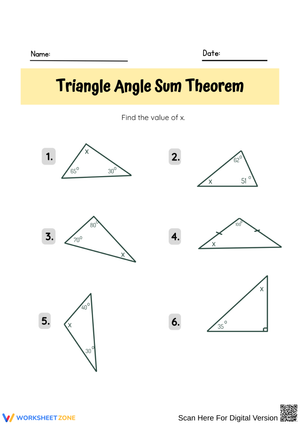
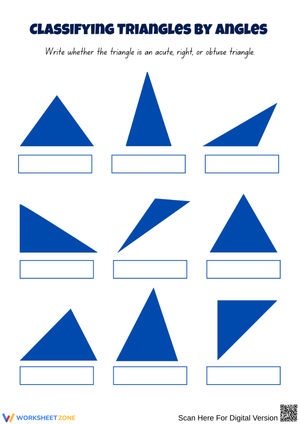
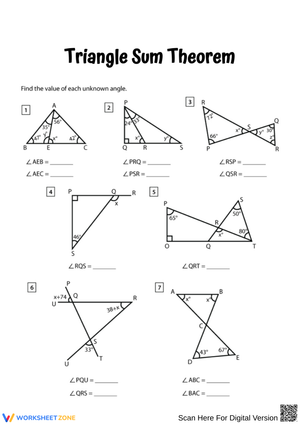
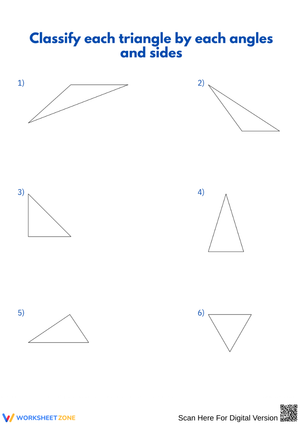
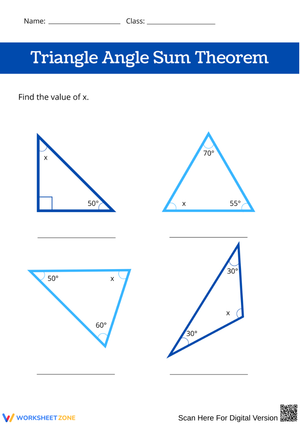
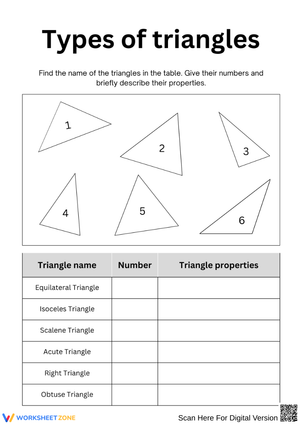
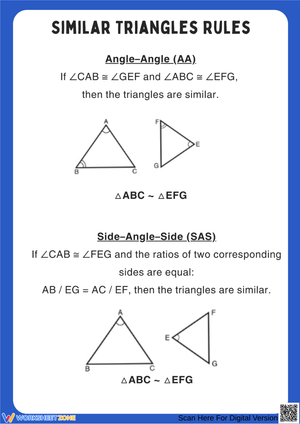
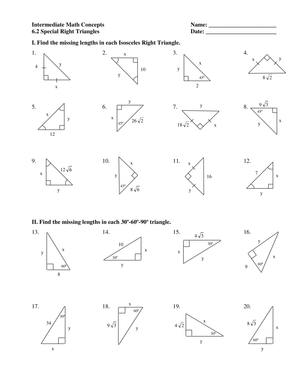
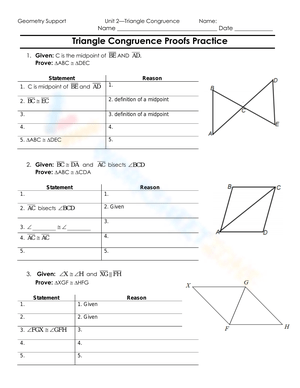
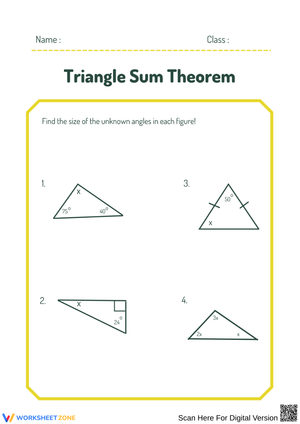
- Triangle types: sorting by side length (scalene, isosceles, equilateral) and by angle measure (acute, right, obtuse), then using those classifications to work through missing-angle problems
- Quadrilateral hierarchy: distinguishing parallelograms, rectangles, rhombuses, squares, trapezoids, and kites through side and angle relationships — not guessing from appearance
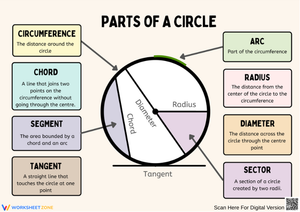
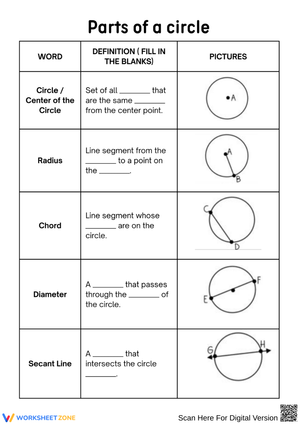
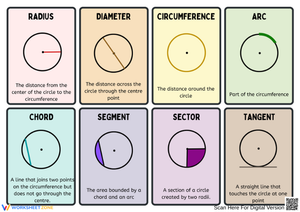
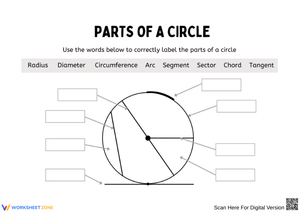
- Circle measurement: radius, diameter, circumference, and area tasks in both straightforward and word-problem formats
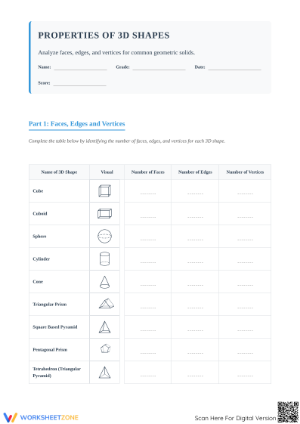
- 3D figures: identifying prisms, pyramids, cylinders, cones, and spheres; counting faces, edges, and vertices; then applying surface area and volume formulas
- Mixed geometry review: worksheets that pull vocabulary, diagrams, and calculation into a single practice session
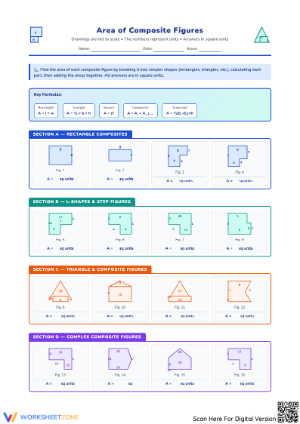
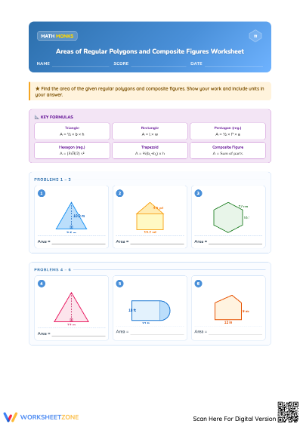
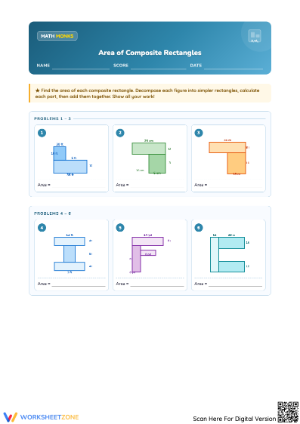
A few worksheets also include composite figure problems — finding the area of an L-shaped room or the surface area of two rectangular prisms joined together. Those tasks appear later in the set, after foundational skills have been practiced in isolation.
Student Mistakes Worth Anticipating Before the Lesson
The most persistent error in seventh-grade shape classification is treating a category name as exclusive rather than inclusive. Students who know that a square has four right angles and four equal sides will still insist it is not a rectangle — because they learned "rectangle" before "square" and built a mental model where the two shapes are opposites, not members of the same family. Expect this on any worksheet that asks students to place figures into hierarchical categories. A Venn diagram alongside the worksheet makes the containment relationship visible in a way that repeated labeling alone does not.
Surface area problems generate a different class of mistake. Students consistently confuse lateral surface area with total surface area on cylinders — adding only the curved surface and forgetting both circular bases. On prism problems, the opposite happens: students include the bases twice. Watching for which error a student makes tells you whether the gap is conceptual (they don't know what "total" means in this context) or procedural (they're losing track of formula components mid-calculation).
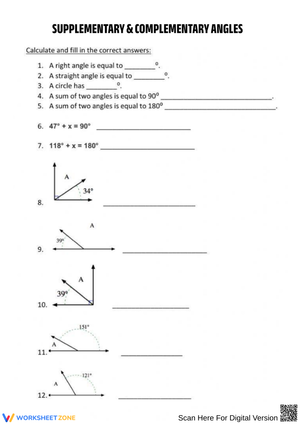
A third pattern appears on orientation-based tasks: students who draw correct diagrams but mislabel angle types when the figure is rotated. A student will mark an obtuse angle as "right" because it looks roughly square when the triangle sits with the right angle at the top. Worksheets that present shapes in non-standard orientations reveal this confusion immediately and give teachers a specific reteaching target before the assessment.
Fitting These Worksheets Into Your Week's Lesson Plans
The most practical entry point is the bell-ringer. A five-question classification worksheet takes roughly eight minutes and reactivates the previous day's vocabulary before new instruction begins. Because the tasks are visual, students can start independently while attendance is taken — no launch explanation required.
On direct instruction days, pair a guided worksheet with the lesson: walk through two or three problems together, then release students to finish the remaining items independently. That structure gives you a real-time read on who followed the explanation and who is still guessing. Circulating during the independent block — before homework has been assigned — lets you reassign or reteach within the same period rather than discovering the confusion the next morning.
These 7th grade shapes printable worksheets sets work well in rotation stations. A sorting worksheet at one station, a measurement task at another, and a vocabulary-matching activity at a third can address three facets of the same geometry unit simultaneously. The worksheet format holds the task structure steady so attention can stay on whichever group needs teacher presence most.
For sub days, geometry worksheets outperform most other leave-behinds because clear diagrams carry the instruction. A substitute doesn't need to understand quadrilateral properties to proctor a classification worksheet. Include the answer key and a direction to self-check after completion, and the session stays productive without teacher oversight.
Standard Alignment
These worksheets address the geometry cluster in the Common Core State Standards for Grade 7, specifically:
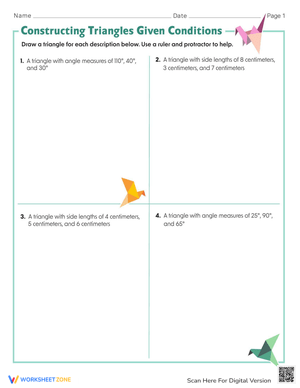
- CCSS 7.G.A.1–3 — scale drawings, constructing geometric figures given conditions, and describing cross-sections of 3D figures
- CCSS 7.G.B.4 — using formulas for circumference and area of circles, including the relationship between diameter, radius, and pi in problem-solving contexts
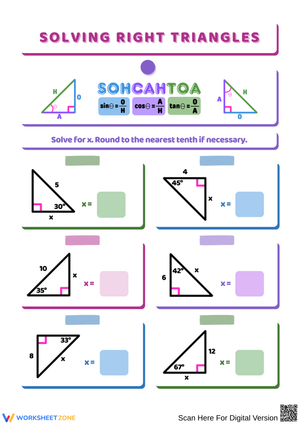
- CCSS 7.G.B.6 — solving real-world and mathematical problems involving area, surface area, and volume of 2D and 3D figures
In classroom terms, 7.G.B.4 typically arrives mid-unit, after students have worked with polygons and are ready to handle irrational results from pi-based calculations. 7.G.B.6 lands near the end of the unit or in a spiral review block, because surface area and volume require students to hold multiple formulas and figure types in mind simultaneously. The sequencing in this set reflects that arc — classification and polygon worksheets come first; 3D measurement worksheets come later.
Adjusting the Set for a Range of Learners
Students who need additional support benefit from worksheets with fewer problems, larger diagrams, and tasks that ask them to label before they classify. A student who can't yet reliably identify an isosceles triangle from a diagram shouldn't be asked to compare its angle properties to a scalene triangle in the same problem. Separating those demands makes the learning gap easier to close and keeps frustration from blocking effort.
On-level students handle the standard mixed worksheets well — a combination of vocabulary, property questions, and basic measurement. These resources move at the right pace for students who understood the lesson but need reinforcement before a quiz or unit test.
For students working above grade level, composite figure tasks and problems requiring written justification provide real depth. Asking a student to explain in writing why a rhombus is not always a square demands more precision than labeling a diagram. That explanation also functions as informal assessment — circular or incomplete reasoning shows up on paper long before it surfaces on a test.
In intervention settings, limit each session to one worksheet per concept: triangle types before quadrilateral properties, area before surface area. Mixing skills too early is one of the most reliable ways to produce frustration without producing understanding.
Frequently Asked Questions
Do these worksheets include answer keys?
Yes. Each worksheet comes with a corresponding answer key. Answer keys matter most during sub coverage and small-group self-check routines — both situations where a teacher can't verify every response in real time. They also make quick grading during a planning period significantly faster.
What is the most effective way to use these for test prep?
The mixed review worksheets work best for cumulative test prep because they combine classification, measurement, and vocabulary in the same set of problems — which is exactly how geometry items appear on most state assessments. Using these 7th grade shapes printable worksheets resources in the week before a benchmark gives students contact with varied figure types under low-stakes conditions, so the test format itself doesn't become a separate obstacle on assessment day.
Which worksheet types work best for homework?
Assign focused, single-skill worksheets for homework rather than mixed-review ones. When students practice without teacher support, encountering several different question types on the same worksheet increases the chance of errors going uncorrected overnight. A focused worksheet — circles only, or triangle classification only — keeps homework accurate and usable as formative data the next morning.
Are these appropriate for a dedicated intervention block?
These 7th grade shapes printable worksheets resources fit intervention well when paired with intentional grouping. First identify whether the student's gap is visual vocabulary (cannot read diagrams accurately), conceptual (doesn't follow the classification logic), or procedural (misapplies formulas). Then choose the worksheet type that targets that specific gap. One focused worksheet per session produces more usable progress than a longer mixed review that touches everything and confirms nothing.













 Interactive Worksheet Maker
 Quiz Maker
 Word Search Maker
 Crossword Puzzle Maker
 Word Scramble Generator
 Sentence Scramble Generator
 Handwriting Worksheet Generator
 Name Tracing Generator
 Fill In The Blank Generator