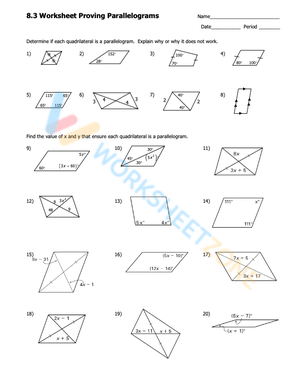
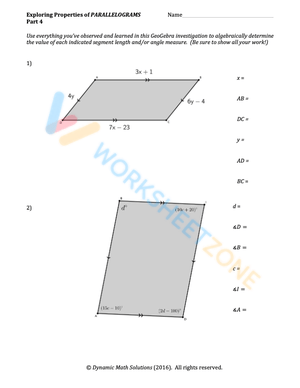
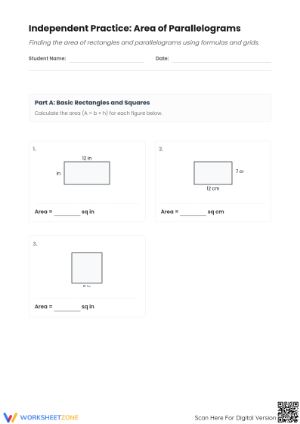
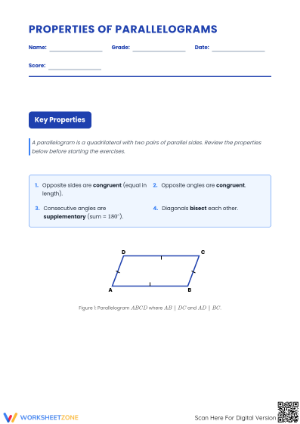
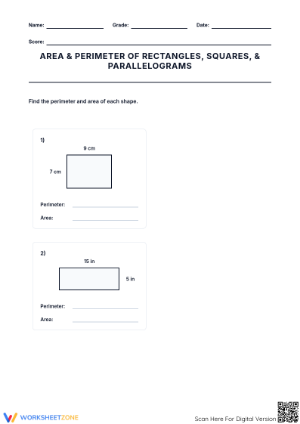
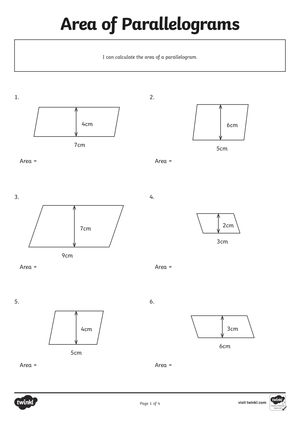
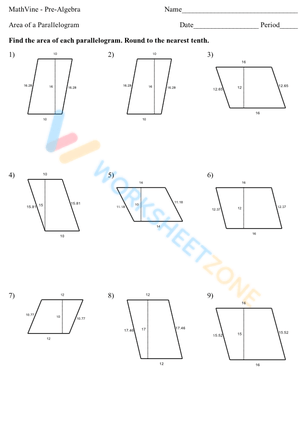
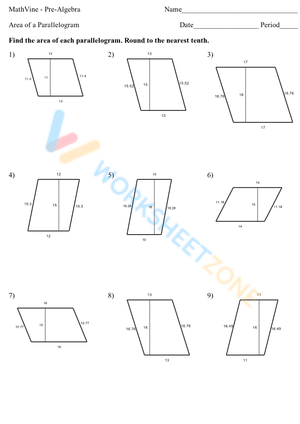
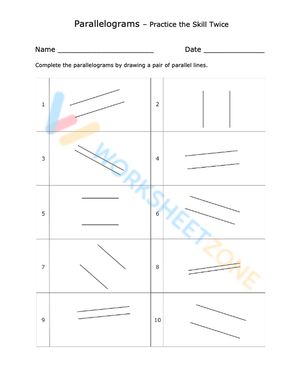
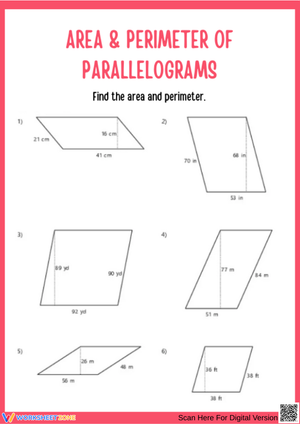
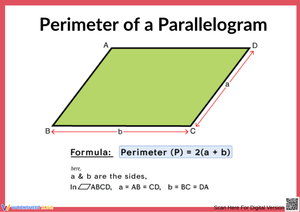
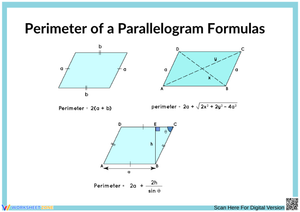
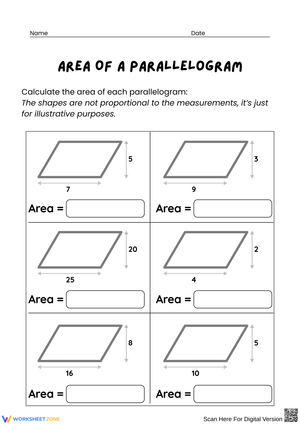
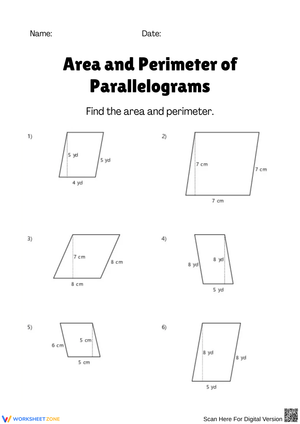
These 7th grade parallelogram printable worksheets give teachers focused geometry practice that matches how the topic actually develops in seventh grade — starting with property recognition and building toward missing-measure problems, perimeter, area, and short algebraic applications. Each worksheet targets a specific skill cluster rather than piling everything into a single dense task. The set is print-ready and works across instructional contexts: bell work, guided practice, exit tasks, homework, and small-group reteaching.
The Specific Skills Each Worksheet Builds
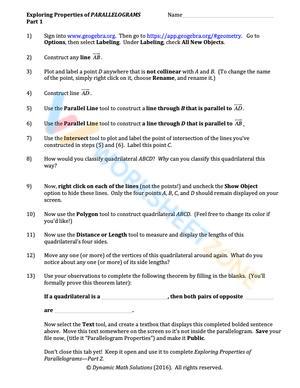
Seventh graders studying parallelograms work with four core relationships: opposite sides are congruent, opposite angles are equal, consecutive angles are supplementary, and diagonals bisect each other. They also apply the area formula — base times height — and must understand why the perpendicular height is not interchangeable with the slanted side. These 7th grade parallelogram printable worksheets address each of those skill areas in distinct, focused practice sets rather than bundling everything into one undifferentiated review.
- Identifying parallelograms: Students mark parallel side pairs, sort quadrilateral figures, and distinguish parallelograms from trapezoids and other four-sided shapes based on attributes rather than appearance.
- Opposite side relationships: Students find a missing side length when its opposite side is given — or, in more advanced problems, set up an equation when variable expressions are involved.
- Angle relationships: Students solve for missing angles by applying both the opposite-angles-equal rule and the consecutive-angles-supplementary rule, sometimes in the same problem.
- Diagonal bisection: Students use the property that each diagonal is cut into two equal segments at the intersection point to find unknown lengths.
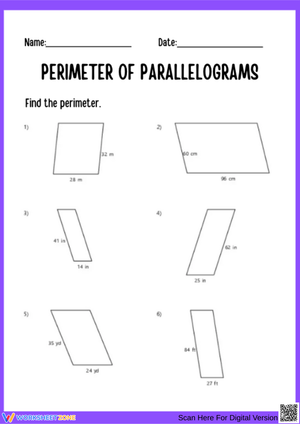
- Perimeter: Students add side lengths — typically two distinct measures, each appearing twice — and in stronger problems work backward from a given perimeter to find a missing side.
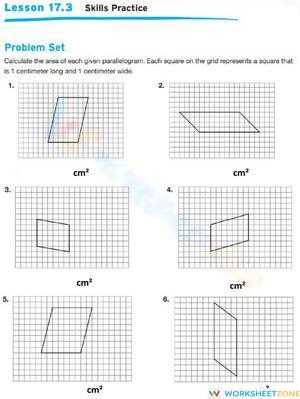
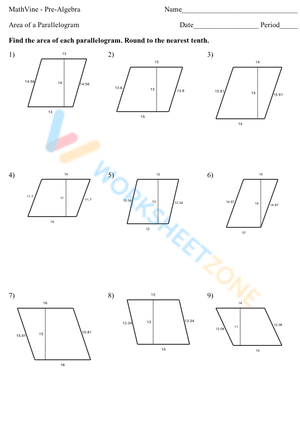
- Area: Students apply base × height using diagrams that show both the slanted side and the dashed perpendicular height, requiring students to choose the correct measurement before calculating.
Error Patterns That Surface in Parallelogram Work
The most persistent mistake is geometric rather than algebraic. A student who correctly labels the base as 9 cm will often multiply by the slanted side — say, 6 cm — and write 9 × 6 = 54, because the slanted side looks like "the other number" sitting visibly on the diagram. The perpendicular height, shown as a dashed interior line, reads as decorative rather than essential. One move that interrupts this before independent practice begins: place a worked example at the top of the area worksheet with exactly that error already made, and ask students to find and correct it. Students who fix the error catch the distinction in a way that teacher explanation alone doesn't always produce.
The second trouble spot is consecutive angles. Students who learn that opposite angles are equal frequently apply that same rule to angles that share a side. They mark two adjacent angles as congruent rather than checking whether they should sum to 180 degrees. Part of the problem is vocabulary — "consecutive" doesn't land naturally for seventh graders, and without a direct link to "next to each other in the figure," they often skip the supplementary check even when they know the property in isolation.
With diagonals, the confusion comes from what bisection actually does to the segment. If a problem states a full diagonal measures 14, students label each half as 14 instead of 7. It reads like a careless error, but it usually reflects an incomplete mental model of what the intersection point is doing — splitting the diagonal rather than simply touching it.
Fitting These Worksheets Into a Real Geometry Week
A practical sequence: open a parallelogram unit with an identification worksheet on Monday during bell work. Students mark parallel sides and make yes/no judgments about each figure. That 8-to-10-minute task quickly shows who still conflates a parallelogram with a general trapezoid and gives you a formative read before guided instruction begins. Mid-week, the angle-relationship and side-length worksheets work well for gradual release — model two problems for the class, then let students complete the rest while you circulate and note which students reach for the wrong property.
By the end of the unit, the area worksheets serve cleanly as exit tasks. They take about five minutes to score and tell you precisely which students haven't separated perpendicular height from the slanted side before the unit quiz. For sub days or targeted intervention blocks, 7th grade parallelogram printable worksheets hold up well without teacher presence because the diagrams carry most of the instructional context — students can begin working from the figures alone.
If your class runs stations, these resources adapt cleanly to a rotation model. One station focuses on property matching using labeled diagrams, a second covers area and perimeter calculations, and a third presents challenge problems with algebraic expressions. Because every worksheet is print-based, students mark directly on the figures — labeling congruent sides, circling the height they're using — which keeps the reasoning visible and gives you something concrete to discuss during the debrief.
Standard Alignment
The primary standard addressed is CCSS 7.G.B.6, which asks students to solve mathematical and real-world problems involving the area of two-dimensional figures, including quadrilaterals. Parallelogram area is the instructional entry point for this standard in seventh grade because it requires students to distinguish a linear attribute — the slanted side — from the measurement that drives area calculation: the perpendicular height. That distinction also prepares students for surface area work with three-dimensional figures later in the same unit. The property work on these worksheets — opposite side congruence, supplementary consecutive angles — also connects to 7.G.A.2, where students draw figures based on stated conditions. Knowing which measurements are determined by a parallelogram's properties is prerequisite knowledge for that constructive work, making these worksheets relevant earlier in the geometry sequence than just the area lesson.
Adjusting the Set for a Range of Student Readiness Levels
Differentiation here doesn't require building separate lesson plans. A few purposeful adjustments in how students interact with the same worksheet address a wide readiness range without the overhead of redesigning the task from scratch.
- Students who need more support: Provide diagrams with properties pre-labeled — tick marks on congruent sides, arc marks on equal angles — so students can concentrate on calculating rather than identifying. Asking them to state which property they used before they write their equation adds accountability without piling on additional cognitive demands.
- On-level students: Use mixed-skill worksheets where each problem requires students to determine which property applies before solving. Removing the pre-labeled diagram marks is often the only structural change needed.
- Extension: Replace given measurements with algebraic expressions. Instead of "find the missing angle," the problem reads: "one angle measures 4x − 10 and its consecutive angle measures 2x + 30 — find both angle measures." That task requires equation setup, solution, and geometric verification, folding early algebra content into the geometry work.
Response format is another adjustment lever. Some students benefit from circling the applicable property before they begin calculating — a small prompt that slows down impulsive guessing. Others are ready to write equations with no structural support at all. These 7th grade parallelogram printable worksheets support both approaches because the problem structure is explicit enough to use with or without teacher-added prompts, depending on what a given group needs that day.
Frequently Asked Questions
Which parallelogram properties should students know before starting these worksheets?
Students should have received instruction on all four core properties: opposite sides are congruent, opposite angles are equal, consecutive angles are supplementary, and diagonals bisect each other. The area formula — base × height — is also central. If a class hasn't yet covered all four properties, the identification and angle worksheets work well as first-exposure practice, while the area worksheets function as follow-up once the formula has been taught directly.
How long does a typical worksheet take in a seventh-grade class?
A focused single-skill worksheet — missing angles only, or area problems only — generally takes 12 to 18 minutes for on-level seventh graders working independently. Mixed-skill worksheets run closer to 20 to 25 minutes. That range makes each worksheet usable as a full independent-practice block or, when assigned partially, as a warm-up or exit task depending on where you are in the lesson.
Can these worksheets support test preparation?
Yes, especially the mixed-skill versions. Parallelogram properties appear on most seventh-grade geometry assessments, and returning to these worksheets one or two days before a quiz activates the relevant rules without overwhelming students with unfamiliar material. Spaced retrieval — revisiting the same skill set across several days rather than massing all practice into one block — produces stronger retention, and this set supports that approach because each worksheet is brief enough to revisit in 10 to 15 minutes during a warm-up block.
What's the best way to use these worksheets for homework or intervention?
For homework, a 6-to-10-problem worksheet covering content from that day's lesson is a reasonable assignment for most seventh graders. Homework works best as retrieval practice rather than first exposure, so choose a worksheet that reinforces a property students have already seen rather than introducing a new relationship. For intervention, use a worksheet that repeats a single property type — angles only, or diagonals only — so the focus stays narrow. Misconceptions are far easier to isolate and correct when the practice isn't jumping between five different properties at once.













 Interactive Worksheet Maker
 Quiz Maker
 Word Search Maker
 Crossword Puzzle Maker
 Word Scramble Generator
 Sentence Scramble Generator
 Handwriting Worksheet Generator
 Name Tracing Generator
 Fill In The Blank Generator